Global
Bethlehem University Announcement and fundraiser in honor of nomination to
Nobel Peace Prize of Prof. Qumsiyeh
https://www.bethlehem.edu/2025/01/15/prof-qumsiyeh-nominated-for-2025-nobel-peace-prize/
“This (Gaza) is the moral issue of our time; this is the Holocaust of our
time, this is the Trail of Tears of our time, this is the Middle Passage of
our time.” Max Blumenthal
“Silence in the face of Evil is itself evil” Dietrich Bonhoeffer, German
anti-Nazi dissident
“Those who can make you believe absurdities, can make you commit
atrocities.” Voltaire
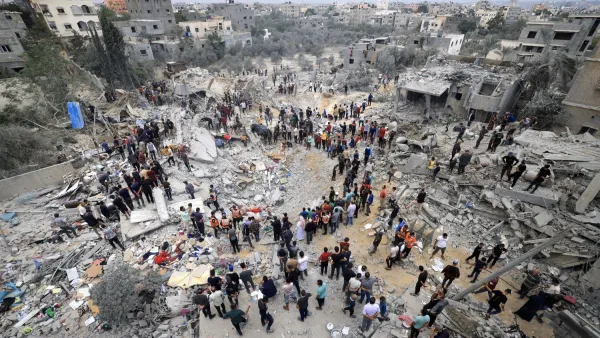
As a hudna (ceasefire) will start Sunday, the occupation regime intensified
its killings of Palestinians including 150 civilians in the last 30 hours
(including six journalists). Despite corporate media being Zionized, even
We Celebrate The Magnificent Life Of Dr. Martin Luther King & Welcome the Release Of Leonard Peltier
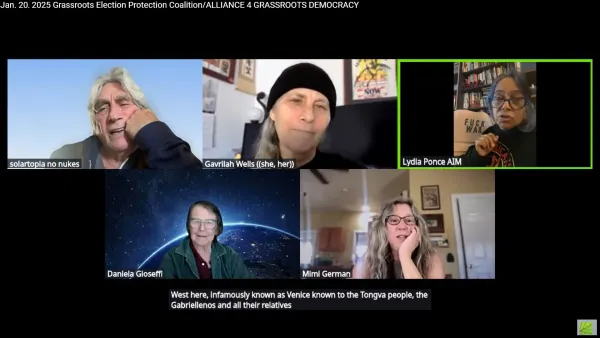
We begin this celebratory GREEP zoom #208 with TATANKA BRICCA giving us some background of Joe Biden’s announcement that LEONARD PELTIER will be released from prison on February 18.
SHAWNA HOGAN-MOORE tells us about her meeting where she & asked Prez Biden to release Leonard.
Our poet laureate MIMI GERMAN gives us a poem about the duality of this amazing moment.
Crusader VINNIE DESTEFANO, who also worked to free Julian Assange, weighs in.
Co-convenor MIKE HERSH reminds us of the great & powerful life of racial justice campaigner Marcus Garvey, pardoned today.
From the American Indian Movement and NDN we hear from LYDIA PONCE.
Activist/author/poet DANIELA GIOSEFFI takes us back to Selma and reminds us of the triumphs of Martin Luther King, whose day it is.
Amnesty International’s GAVRILAH WELLS reminds us of the years of work that went into this campaign for justice.
New York activist MICKI LEADER talks of exploring the range of podcasts amidst a lifetime of social change.
The feminism pioneer Martin Luther is evoked by MARC IMLAY.
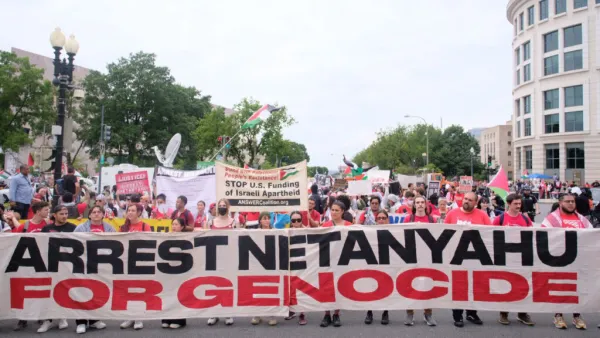
The headline in the Times of Israel says it all: "For the First Time, Israel Just Lost a War."
Regardless of the reasoning behind this statement, which the article divides into fourteen points, it suggests a shattering and unprecedented event in the 76-year history of the State of Israel. The consequences of this realization will have far-reaching effects on Israelis, impacting both this generation and the next. These repercussions will penetrate all sectors of Israeli society, from the political elite to the collective identity of ordinary Israelis.
Interestingly, and tellingly, the article attributes Israel’s defeat solely to the outcome of the Gaza war, confined to the geographical area of the Gaza Strip. Not a single point addresses the ongoing crisis within Israel itself. Nor does it explore the psychological impact of what is being labeled as Israel’s first-ever defeat.

On the one hand, there’s no sugarcoating how progressives feel as President Trump retakes office: rough.
Trump and his allies in Congress are already rolling out plans to cut taxes for billionaires, slash services for the rest of us, pollute the planet, and deport people who’ve lived here their whole lives.
But if you look closely, you’ll see signs people aren’t just going to accept all this. Here are five that caught my eye from this past election year.
1. Populist anger is boiling over.
Americans have had it with economic elites. Union activity has been on an upswing for a few years running now, with union petition filings in 2024 significantly up over 2023.
And now Trump consciousness purports to claim – or reclaim – control over America: the land of white Christian nationalists and no one else, damnit!
But of course that level of selfishness – mine, mine, mine! – is only possible to maintain with a huge helping of fear alongside it: fear of the enemy. Fear of “them.”
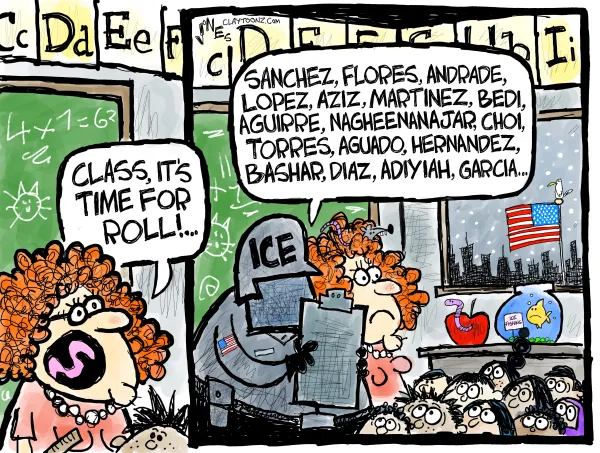
Thus Alexandra Villarreal, writing in the Guardian about Trump 2.0’s first day in office (on Martin Luther King Day), noted: “He immediately involved the military, ordering the armed forces to ‘seal’ the US’s borders ‘by repelling forms of invasion including unlawful mass migration.’
Be afraid. Be very afraid.