
Global

Israel described its clearly deliberate killing of seven humanitarian aid workers on April 1 as a “grave mistake”, a “tragic event” that “happens in war”.
Israel is, obviously, lying. This entire so-called war - actually genocide - in Gaza, has been based on a series of lies, some of which Israel continues to peddle.
invited three insightful analysts of present-day U.S. foreign policy to share their thoughts in a roundtable discussion. Here are excerpts from Phyllis Bennis, Jackson Lears and Jeffrey Sachs.
-- Norman Solomon
Question: How would you assess the most important aspects of current U.S. foreign policy?
Phyllis Bennis: I think the most important aspects are the most problematic ones. The focus on militarism that leads to a military budget this year of $921 billion, almost a trillion dollars, an unfathomable number translates to $0.53 out of every discretionary federal dollar going directly to the military. And if you add in the militarism side of things, the federal prison system, the militarization of the borders, ICE, deportations, all those things, you come up with $0.62 out of every discretionary federal dollar.
So the militarism is, I think, the single most important problem. The issue of unilateralism remains a huge problem when the rise of the so-called “global war on terror” essentially wiped out the possibility of a post-Cold-War peace dividend, which had currency for about a week, as I recall, and that unilateralism continues.
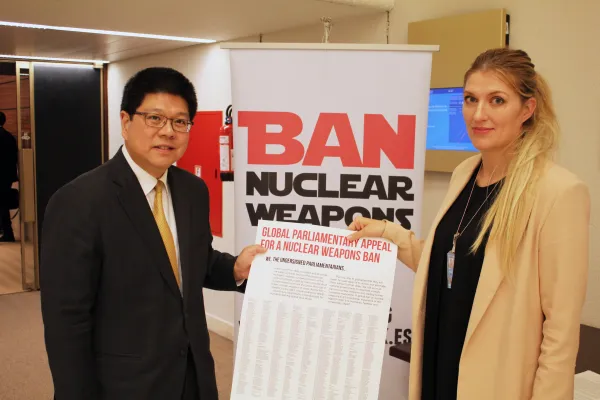
An enormous flash, a mushroom cloud, multi-thousands of human beings dead. We win!
Nuclear weapons won’t go away, the cynics — the souls in despair — tell us. You can’t put the genie back in the bottle. You can’t, as Gen. James E. Cartwright, former head of U.S. Strategic Command, once put it, “un-invent nuclear weapons.” So apparently we’re stuck with them until the “big oops” happens and humanity becomes extinct. Until then: Modernize, modernize, modernize. Threaten, threaten, threaten
David Barash and Ward Wilson make the case that this is completely false. We're not "stuck" with nuclear weapons any more than we’re stuck with obsolete and ineffective technology of any sort, bluntly pointing out: “Crappy ideas don’t have to be forgotten in order to be abandoned.

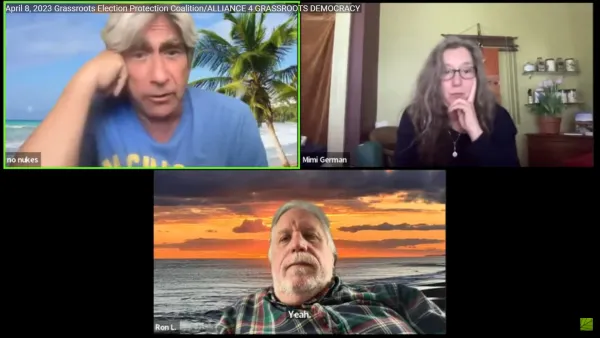
Plus she tells of our great adventure on the legendary peace boat GOLDEN RULE and the time we were rammed (true!!!) by a police boat while protesting Portland’s militaristic “fleet week.”
The great DENNIS BERNSTEIN joins us with tales of his activism as we celebrate the massive impact of his nationally syndicated FLASHPOINTS SHOW on KPFA/Pacifica.
PAUL NEWMAN chips in with a great comment on nuclear casualties.
RON LEONARD reminds us of the realities of the insane continued operations at Diablo Canyon...and of the new Friends of the Earth lawsuit against the handout to keep Diablo headed toward an uninsured Armageddon.
The connection between nuclear power and nuclear weapons is underscored by ALFRED MEYER.
WENDI LEDERMAN the introduces the amazing PAUL BURKE of VOTEWELL.NET, who fills us in on many of the crucial the realities of election theft.
DONALD SMITH and PAUL STOKES raise additional key issues on election protection,
At the top of the second hour, we’re joined by the legendary NORMAN SOLOMON.


A Noise Within’s gripping production of August Wilson’s King Hedley II is a brutal, harrowing odyssey into what W.E.B. Du Bois called “the soul of Black folks.” The drama is part of Wilson’s epic exploration of African American life consisting of ten plays set in the Hill District of Pittsburgh (except for Ma Rainey’s Black Bottom), where the award-winning playwright grew up. Wilson’s remarkable decology is known as the “American Century Cycle” and/or as the “Pittsburgh Cycle.” Each one of the plays is set in the 20th century during a different decade; for instance, Fences takes place in 1957 in that Pennsylvanian city.