
Global

Duke Energy faces rate hike pushback
Earlier this year, Duke announced a capital spending plan of $103 billion, which company officials called the largest investment on file at any regulated U.S. utility. Now Duke is under pressure from ratepayers and regulators to justify that spending as it seeks to dramatically increase residential rates.
Duke Energy argued the infrastructure plan is driven primarily by soaring electricity demand from artificial intelligence (AI) data centers and advanced manufacturing. Arguments in favor of the plan emphasize meeting this unprecedented regional load growth, modernizing the power grid for better reliability, and shifting infrastructure risks away from existing residential customers
As a consequence of this investment, Duke requested an 18 percent residential rate increase.
However at a recent hearing, a confidential internal memo was placed into the public record that contained a chart showing that Duke estimates "about 98 percent of those identified financial benefits from the infrastructure improvements will accrue to commercial and industrial rather than residential customers.

BANGKOK, Thailand -- A midnight fire burning with the intensity of a huge flame-thrower killed at least 27 people and injured 63 when a suspected electrical short-circuit ignited flamable soundproof foam and decorations on the ceiling and walls of a packed nightclub.
Thailand's Prime Minister Anutin Charnvirakul and Bangkok Governor Chadchart Sittipunt rushed to the scene in the early hours of Monday (July 13) morning to inspect the charred wreckage from the midnight blaze.
The extreme intensity of the fire forced huge flames to gush in a sustained, billowing, horizontal stream through the nightclub's front door into the street, like a huge flame-thrower or industrial blast furnace, while people screamed and ran.
Some witnesses said the front door's projectile flames looked like fire spewing from a gigantic dragon's mouth.
"The fire spread very quickly, reaching up to the ceiling," Governor Chadchart told reporters.
"Smoke was likely the main cause of death."
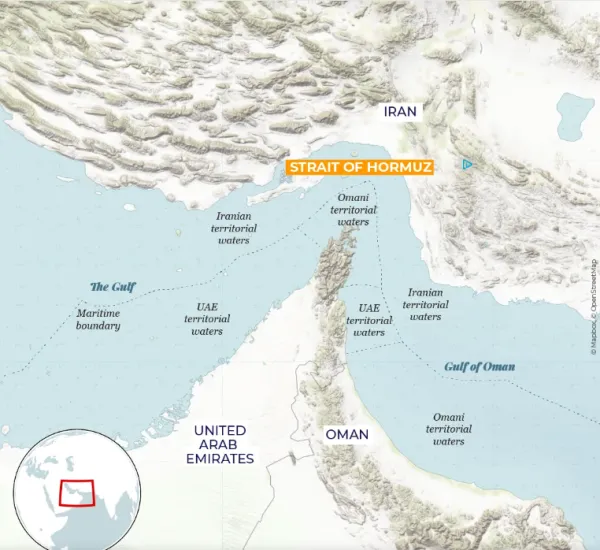
President Donald Trump announced that the United States would blockade Iran in the Strait of Hormuz, charge a 20% fee on cargo transiting the waterway, and become the "Guardian of the Hormuz Strait." According to his Truth Social post, the United States would be reimbursed for providing security to commercial shipping.
The Strait of Hormuz is an international waterway located between Iran and Oman. It is not American territory, and the United States has no sovereign authority over it.
The strait is not owned by any single country. Iran borders it to the north, while Oman borders it to the south, with a small section of the southwestern shoreline belonging to the United Arab Emirates. Iran and Oman each exercise sovereignty over their respective territorial seas, but the strait itself is an international strait governed by international maritime law.


The news of a U.S. Senator dying in office is not something many Americans are accustomed to hearing, yet the sudden passing of U.S. Senator Lindsey Graham of South Carolina last week is not unprecedented. Three hundred and two U.S. senators have died in office since the late 18th century. Nearly two hundred senators have died in office in the 20th century.
Because the U.S. Senate, aka the upper chamber, is considered Congress’s most prestigious and powerful chamber, the passing of one of its members garners national, and sometimes international media attention. Ten U.S. Senators have died in office during the 2000s including Graham. The former United States Air Force Colonel was elected to the U.S. Senate in 2003. Among the key committees on which Republican Lindsey Graham served include the Senate Judiciary Committee, Senate Committee on Appropriations and Senate Committee on the Budget. Prior to being elected to the U.S. Senate he served in the U.S. House of Representatives from 1995 to 2003.

I watched Questlove interview Los Angeles bass player Thundercat for Questlove’s podcast. Thundercat’s latest album Distracted spent 2026 at the top of North American College Community Radio Hip Hop chart. Thundercat doesn’t rap.
Thundercat is a bassist whose album Distracted found release from Flying Lotus’ Brainfeeder Records. Flying Lotus is an L.A. instrumental Hip Hop producer whose aunt is Alice Coltrane.
Lotus has worked with Radiohead, Kendrick, MF Doom and others. Flying Lotus is the legacy of J. Dilla.
Thundercat’s Distracted album features Willow Smith on Thunderwave, A$ap Rocky during Funny Friends, Lil Yatchy from I Did This To Myself, and others.
I don’t know if anyone raps during Distracted. Ok. Mac Miller’s does rap during Distracted.
I would describe Thundercat’s sound like this:

Next steps to address the growing threat of nuclear war
Dr. Ira Helfand spoke Saturday, July 11 at the Unitarian Universalist Church in Columbus, hosted by the Columbus Free Press at our Second Saturday Salon on “Back from the Brink: Addressing the growing threat of nuclear war.”


There is a good thing about having Donald J Trump as president and that is how during a normal week he will say or do a number of incredibly stupid things that make one want to smile or even laugh outright. Unfortunately, however, the fun stops shortly after that point when one recalls that the outright insanity is not only destroying the White House and much of the District of Columbia. It also means engaging in wars against otherwise non-threatening adversaries that waste trillions in taxpayer dollars while doing terrible damage to the United States and also creating economic and political catastrophes that might well wreck much of the world as is happening with Iran right now.

U.S. Sen. Lindsey Graham (R-S.C.) has died suddenly at the age of 71. He served four terms in the U.S. Senate from South Carolina from January 3, 2023 until his death on July 11, 2026.
I will remember him as a U.S. lawmaker who, in my view, betrayed not only the United States but also many of the principles he claimed to stand for. I will not mourn someone whose public record I view as being marked by support for war, anti-Muslim rhetoric, and policies that I believe caused immense suffering.
Here are my reasons:
- He repeatedly called on the White House to bomb Iran.
- Last January, he said, "Hit Iran now. Hit it hard."
- He told Fox & Friends that it would be "terrible" if a DNA test showed he had Iranian ancestry.
- He supported the displacement of Palestinians from Gaza, which critics have characterized as ethnic cleansing.
- He was the subject of allegations regarding his personal life that circulated in media reports, although he denied or did not publicly address many of those claims.
Sen. Graham threatened our European allies

The only positive thing about the Iran war heating up again is that Lindsey Graham won’t be around to enjoy it.