
Global
Here is an incomplete list of some of the culprits:
A) Foreign Mining Corporations (PolyMet, Glencore, Twin Metals, Antofagasta, etc);
Minnesota’s Elected Politicians/Accomplices (both Corporate-influenced “Liberal” Democrats, and “Conservative” Republicans); Minnesota’s “Regulatory” Agencies that are Supposed to be “Natural Resource Protectors” (Including the DNR, the PCA, and the US Forest Service); and Most Area Newspapers; Most Area Television Stations; All the Area’s Chambers of Commerce; Minnesota Power (Electric Utility); the Trump Administration; Regional Labor Unions: and Dozens of Suppliers/Businesses that will Temporarily Profit from Supplying the Mining Industry While Simultaneously Risking the Permanent Poisoning of the St Louis River Watershed, Including Lake Superior

Anyone reading the scientific literature (or the progressive news outlets that truthfully report this literature) knows that homo sapiens sapiens is on the fast track to extinction, most likely some time between 2025 and 2040.
For a taste of the evidence in this regard focusing on the climate, see ‘Climate Collapse and Near Term Human Extinction’, ‘What They Won’t Tell You About Climate Catastrophe’, ‘Release of Arctic Methane “May Be Apocalyptic,” Study Warns’ and ‘7,000 underground [methane] gas bubbles poised to “explode” in Arctic’.
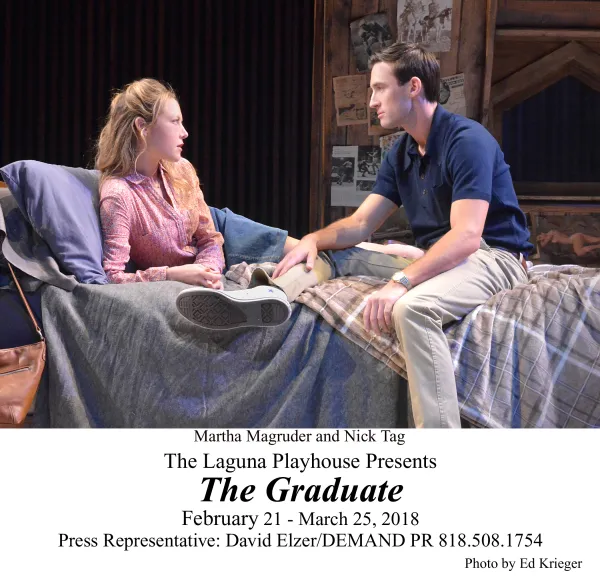
The week before British playwright Terry Johnson’s stage version of Charles Webb’s 1963 novella The Graduate and Buck Henry and Calder Willingham’s 1967 screenplay premiered at Laguna Playhouse, I happened to re-watch the classic movie on the IFC or Sundance Channel. I was struck by a number of things and wondered how could one translate its cinematic language to the medium of theatre, with real life movie star Melanie Griffith stepping into the role Anne Bancroft immortalized, that lecherous lush Mrs. Robinson?
After all, its helmer, Mike Nichols - who actually had previously been a theatre director whose movie debut was the 1966 adaptation of Edward Albee's Who’s Afraid of Virginia Woolf? - won the Best Director Oscar for The Graduate, which was only his second movie. And it was lensed by legendary director of photography Robert Surtees, who won three Best Cinematography Oscars, including for 1959’s Ben-Hur, and was Oscar-nommed another dozen times, including for The Graduate.

Since Pepper Potts in the very first Iron Man movie in 2008, the Marvel Cinematic Universe has given us solid, well-written women – in supporting roles. And when it comes to feature films, that’s where it’s kept them. Even the testosterone-saturated DC Comics movies managed to give Wonder Woman a movie of her own – and one that stood out from the mediocrity of the rest of them – before Marvel Studios did the same for any of their women.
But there are signs that they’re slowly getting the idea: The fans of the MCU deserve movies about women, too, and not just as friends and teammates and love interests to white guys played by men named Chris.
We’ve gotten a couple good woman-led TV shows out of the MCU so far – the Captain America spin-off Agent Carter and the Netflix exclusive Jessica Jones – and the Wasp gets to share title billing for Ant-Man and the Wasp, but until recently there was only one upcoming movie on their slate with a solo female character. That would be Captain Marvel, which is already filming with Brie Larson as the title character, scheduled for next year.

Trying to make sense about the recent silencing by non-human YouTube robots of many valuable, patriotic, truth-telling YouTube journalists
The report below is taken directly from Corbett Report # 332 by Gary G. Kohls, MD
“Those who question the government narrative and mainstream consensus are extremists who need to be dealt with. We can’t have free-thinking individuals roaming around our streets, spreading their damn truth!”
“In 2008, Cass Sunstein, a law professor who would go on to become Obama’s information “czar,” co-authored a paper entitled “Conspiracy Theories,” in which he wrote that the “best response” to online “conspiracy theories” is what he calls “cognitive infiltration” of groups spreading these ideas.”


It should come as no surprise to anyone that the Donald Trump administration has recently affirmed that it has a perfect legal right to remain in Syria as long as it wishes because it is fighting terrorism. The argument goes something like this: Congress has approved a bill that permits the US military to seek out and destroy al-Qaeda and associated groups wherever they may be. It is part of what is referred to as the Authorization to Use Military Force or AUMF. According to the White House, an associated group, the Islamic State in Syria (ISIS), remains currently active in Syria and the United States military presence is therefore legal until the group is completely eliminated, requiring no additional legislation or authority to remain in the country.

How close, how intimate, have you ever gotten with Greenland?
A new documentary called Stella Polaris, directed by Yatri Niehaus — part of Chicago’s tenth annual Peace on Earth Film Festival — takes you on a meditative journey to this lonely, extraordinary island, to its melting ice, its rampaging waters and crumbling glaciers, where climate change is a part of daily life, and where the native people have wisdom and heart to offer the rest of us.
It begins with a slow meditation on the beauty of the ice. Then, six minutes in, a wall of ice suddenly crashes into the ocean.

BANGKOK, Thailand -- A Belorussian woman and her nine companions from
Russia and Belarus, who are in jail for sex-related activity in
Thailand, sent a letter to the U.S. Embassy pleading for asylum in
exchange for alleged criminal evidence concerning Russians who may be
linked to President Trump.
The 10 jailed people include Anastasia Vashukevich, a Belorussian
"mistress" of Russian billionaire Oleg Deripaska, their handwritten
signed letter said.
Russian Deputy Prime Minister Sergei Prikhodkho and Russian
opposition leader Alexei Navalny were also named in their letter which
said "U.S. relations with Russia" and "very important information for
USA" were involved.
"We have photo-video-audio of crymes [sic] of Russian government.
And I give them USA if you help us," it said according to Khaosod
English, a Thailand-based online news service which published a
photograph of the letter.
Addressed "To USA Consul" it was written by Alexander Kirillov, a
Russian also known as Alex Lesley, who was jailed along with the
others.
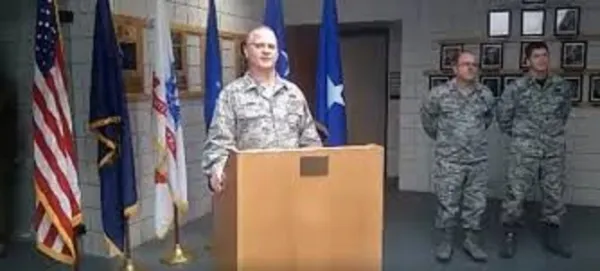
General misleads voters on weapon of mass destruction F-35
 here was a time when pretty much every American understood that the US Constitution provides for civilian control of the military. And there was a time when Americans understood that uniformed military were not to engage in civilian politics. Generals were free to be presidents or other high-ranking officials, but not till they were out of the military. Retired officers remain subject to a less stringent military code regarding political activity. The current president relies on several former generals, despite the five-year ban on such service, because it was waived.
Civilian control of the military is bedrock American constitutionalism. The president is the commander in chief. There is no parity, it is not a negotiated relationship – we have civilian control of the military. And most military officers have understood that the correct response to that assertion was “Yes, Sir!”