
Global

Strange how intellectual discussion concerning the so-called “Arab Spring” has almost entirely shifted in recent years - from one concerning freedom, justice, democracy and rights in general, into a political wrangle between various antagonist camps.
The people, who revolted across various Arab countries are now marginalized in this discussion, and are only used as fodders – killers and victims – in a war seemingly without end.
But how did it all go so wrong?
There was once a time when things were so simple, so easy to understand and explain: People, who were long oppressed, revolted against their oppressors (Arab regimes) and benefactors (western powers).
Unable to effect change using peaceful channels - for Arab civil societies either did not exist or were tightly controlled - Arab masses took to the streets, each nation with a unique struggle of its own yet united around a set of basic demands.

 merican psychologists have voted overwhelmingly against helping their government torture people. In an even more radical step, the psychologists voted to obey international law, even in instances where US law tolerates war crimes or crimes against humanity.
That would be really good news if there weren’t a huge exception: the psychologists also voted that it would be all right for them to take part in “constitutional” interrogations by federal, state, and local law enforcement in the US. Given the ragged history of US law enforcement, this is a loophole that could at any moment become another noose.

There are now articles about the predictable fluff BS horserace personality lifestyle crap coverage by the corporate media of the Bernie Sanders for president campaign (and articlesabout the predictable non-coverage of the Jill Stein for president campaign).
I wish it would all go away, as I think having no election would be preferable to holding such a broken one, and I'd limit even an open, free, credible, functioning, publicly-funded, fairly reported election to something under 6 months in duration.
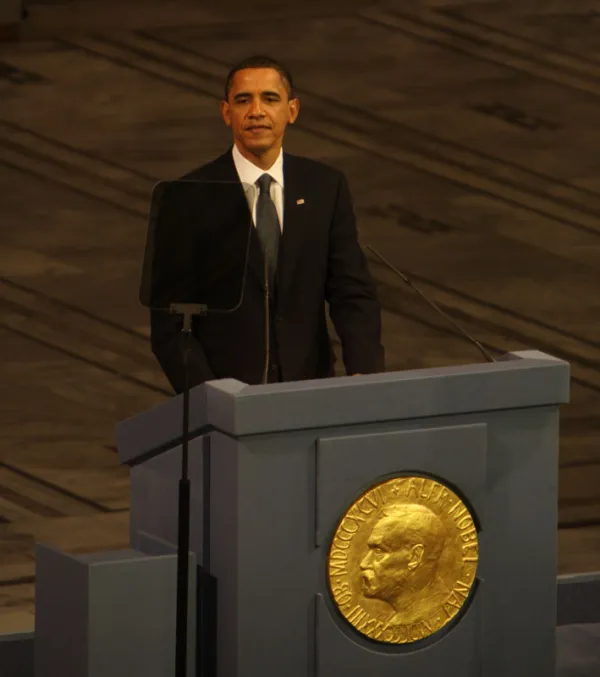
Nobel Peace Laureates Endorse Violence
Robert J. Burrowes
In a recent letter to US President Barack Obama twelve Nobel Peace laureates declared their support for the long history of US elite violence against Native Americans and enslaved Africans, as well as the US imperial violence around the world that has butchered tens of millions of people over the past 200 years. See 'US: An End to Torture: Twelve Nobel Peace Prize laureates write to President Barack Obama asking the US to close the dark chapter on torture once and for all. Obama responds'. http://thecommunity.com/no-to-torture/
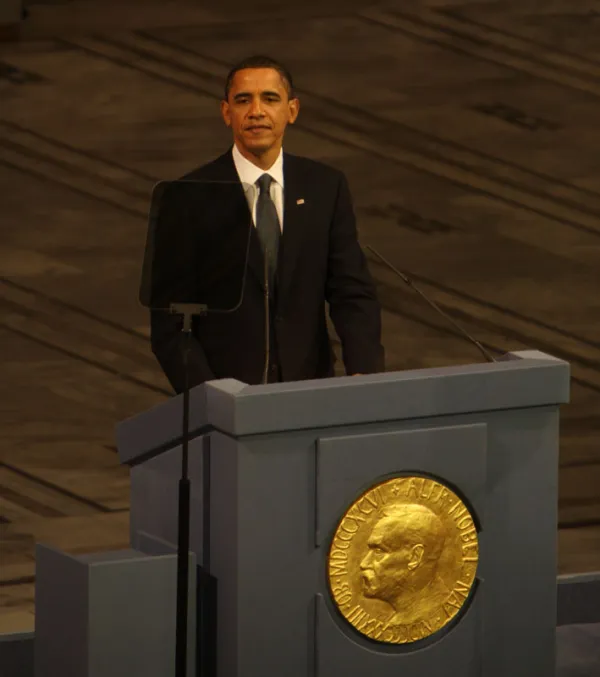
In a recent letter to US President Barack Obama twelve Nobel Peace laureates declared their support for the long history of US elite violence against Native Americans and enslaved Africans, as well as the US imperial violence around the world that has butchered tens of millions of people over the past 200 years. See 'US: An End to Torture: Twelve Nobel Peace Prize laureates write to President Barack Obama asking the US to close the dark chapter on torture once and for all. Obama responds'. http://thecommunity.com/no-to-torture/
The letter to Obama was signed by ex-President José Ramos-Horta (Timor-Leste, prize recipient in 1996), Archbishop Desmond Tutu (South Africa, 1984), Leymah Gbowee (Liberia, 2011), Mohammad ElBaradei (Egypt, 2005), Jody Williams (USA, 1997), Muhammad Yunus (Bangladesh, 2006), F.W. De Klerk (South Africa, 1993), John Hume (Northern Ireland, 1998), Oscar Arias Sanchez (Costa Rica, 1987), Bishop Carlos X. Belo (Timor-Leste, 1996), Adolfo Perez Esquivel (Argentina, 1980) and Betty Williams (Northern Ireland, 1976).

I've found there isn't really any way to touch on this topic without misunderstanding, but here's a try. Iran has never had a nuclear weapons program or threatened to launch a war against the U.S. or Israel. Many opponents of the Iran deal in the U.S. Congress and nearly every, if not every single, proponent of the agreement in the U.S. Congress has proposed war as the alternative. Some examples are here.

Defensive midfielder Dominique Alexander says the Ohio Machine is made up of many parts. How well those parts fit together has lifted the Delaware-based professional lacrosse team into the Major League Lacrosse playoffs for the second time in the club’s history.
“The coaches have done a good job of letting everyone know what their role is. We’re just playing at a high level and we’re just going out, executing and putting some wins together,” said Alexander, whose team was 8-5 overall after defeating New York Lizards 14-9 on July 18 and before hosting the Boston Cannons on July 25. “We’re a really tight knit group. Every guy is a competitor.
“We don’t like to lose. The coaches have put us in the right position to be successful and allowing us to play to our strengths.”
At first, Alexander appeared to be a square flywheel in the team’s machinery. Alexander played on the attack and in the midfield in high school and was ranked seventh in program history in assists (48) and 10th in points (95) while playing as a midfielder for Ohio State from 2010-2013.

With the coming of August, we near the end of Summer Movie Season 2015. We’ve fought Ultron with the Avengers, followed Mad Max and Imperator Furiosa down Fury Road, tamed raptors and fought Terminators, felt sad for different reasons about Inside Out and Minions, and finally watched lovable loser Ant-Man and just plain loser Adam Sandler save the world. All that’s left ahead of us is another mediocre-looking Fantastic Four movie made to keep the rights out of Marvel Studios’ hands. So from this vantage point, what did we learn from the successes, flops and social justice darlings that came out of Hollywood this summer?
Nostalgia was a big theme, but the approach this time was different. Instead of tepid remakes of beloved movies — for example, the bland Total Recall and Robocop remakes of recent years — we got three movies that sought to revive moribund franchises with long-awaited sequels. Of course, Jurassic Park, Mad Max, and The Terminator all had sequels, but only The Terminator has had any recently and none since Terminator 2 have been well-regarded.

If you use a computer with either Windows 7 or Windows 8, you’ve probably seen a notification recently about Windows 10. (What happened to 9? Don’t ask. Just roll with it.) You may have even been prompted to update already, or, if you’re impatient, you may have updated your computer manually using the installation tool released by Microsoft.
And Windows 10 is surprisingly good, especially if you’ve been using Windows 7 or trying to use Windows 8 without a touchscreen. It takes up less hard drive space, boots faster, and unlike previous Windows updates it doesn’t expect you to upgrade your hardware. It moves the Windows 8 Start screen tiles to the side of the Start menu, opens everything in windowed mode instead of the previous full-screen “Metro” apps, and gives everything a modern graphical overhaul. It generally behaves more like a computer OS and less like a tablet one. Unless you tell it otherwise; there’s an optional Tablet Mode.

The U.S. Army and Air Force public relations offices have responded to a Freedom of Information Act request by releasing huge lists of movies and television shows that they have assessed and, at least in many cases, sought to influence. Here's the Army's PDF. Here's the Air Force's PDF.
The shows and films, foreign and U.S. made, aimed at foreign and U.S. audiences, including documentaries and dramas and talk shows and "reality" TV, cross every genre from those obviously related to war to those with little discernable connection to it.