
Global
To the Editor:
In recent weeks, some misinformation about The Ohio State University African American and African Studies Community Extension Center (CEC) was published and broadcasted in the media and I want to take this opportunity to set the record straight.
First, let me reaffirm my commitment as the chair of the Department of African American and African Studies (AAAS) and the commitment of The Ohio State University to the building of a new Community Extension Center, which will be located at Mt. Vernon and Monroe. It is true that two years ago an alternate plan included a proposal for a new location at Mt. Vernon and Champion, but that plan was immediately rejected.
For the past two years, I have been talking to anyone and everyone who would listen about the “OSU Triangle” on the near eastside as my vision for growth and development in the Bronzeville/King-Lincoln District.


In Nintendo’s ongoing effort to make adult fans of the Pokémon video game series feel old, the gaming giant has released a revamped version of the third generation of its ridiculously popular handheld RPG series. Following the 2004 remake of the original Red/Blue as FireRed/LeafGreenfor the Game Boy Advance and the 2009 remake of Gold/Silver as HeartGold/SoulSilverfor the DS, Pokémon Omega Ruby/Alpha Sapphire continues the trend of updating older games in the series to fill time between newer releases. But is Hoennworth revisiting?
The original Pokémon Ruby/Sapphire is now—brace yourselves—12 years old. Pokémon games have always been some of the absolute best of Nintendo’s handheld offerings, even the best among the RPG genre regardless of publisher or platform, with gameplay that can be as simple or as complex as you want it and hundreds of hours of “endgame” breeding, leveling, and Legendary-hunting. But after the incredible Gold/Silver, which introduced a boatload of new features and even included the entire original game’s map after you completed the new one, Ruby/Sapphire felt lackluster. It was merely really good.

COLUMBUS, Ohio -- As opposition grows against the sweeping coal plant bailout cases before the Public Utilities Commission of Ohio (PUCO), Sierra Club is blanketing the state again with new ads slamming state utilities for trying to prop up their outdated plants by increasing electricity costs on customers’ bills. Statewide radio ads, direct mail pieces, online ads and animated web gifs accompany a new suite of aggressive curbside kiosk ads in downtown Columbus. This new round of advertising will continue to hit the state throughout the holiday season.
Since August, the “No Coal Bailouts” campaign has garnered and submitted thousands of petitions to the PUCO. In October, a group of 12 Ohio businesses, including Lowe’s Home Improvement, Staples Inc. and Macy’s Inc., sent a letter urging regulators to reject the bailouts proposal. The businesses cited a new poll by Public Policy Partners showing a strong percentage of Ohio electricity customers favor clean, renewable energy sources to power the state -- and do not support paying more to keep aging coal plants in operation.
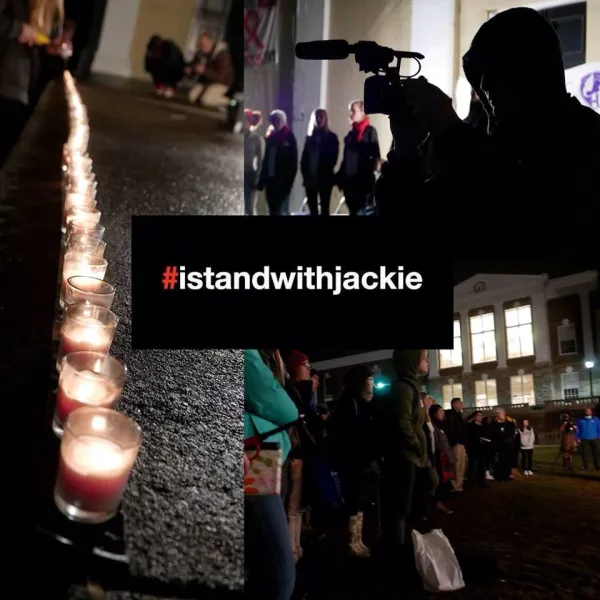
When, three weeks ago, Rolling Stone published a horrific story about University of Virginia's rampant and systemic rape culture enabled by its own administration's complicity, we may have expected that their editors had braced themselves for the backlash that would inevitably ensue. After all, as anybody familiar with rape advocacy – or, even more likely, is or is close to a survivor of sexual assault – knows, whenever a rape is denounced, forces beyond the victim's imagination surge to bombard her and her advocates with all sorts of accusations, doubts and demonization attempts. The survivor's life is scrutinized; their past, their lifestyle, their sexual history, all are reviewed and questioned, in search of character failings that might undermine her story. That story, her account of the violence she underwent, most of all, is probed and prodded endlessly; any discrepancy, however random, is immediately raised against her as 'proof' that the whole thing never happened.

First they came for the Socialists, and I did not speak out—
Because I was not a Socialist.
Then they came for the Trade Unionists, and I did not speak out—
Because I was not a Trade Unionist.
Then they came for the Jews, and I did not speak out—
Because I was not a Jew.
Then they came for me—and there was no one left to speak for me
Pastor Martin Niemoller, speaking about Nazi Germany
First, they’ve come for the people of color.
America’s police forces increasingly serve as a a private corporate army, beyond the reach of the law.
But our nation is distracted by race. And millions of white Americans are under the illusion that what was done to Michael Brown and Eric Garner can’t happen to them.
These un-prosecuted killings of African-American men go way beyond racial prejudice.
They are the calling card of an Orwellian state:

Here in Virginia, U.S.A., I'm aware that the native people were murdered, driven out, and moved westward. But my personal connection to that crime is weak, and frankly I'm too busy trying to rein in my government's current abuses to focus on the distant past. Pocahontas is a cartoon, the Redskins a football team, and remaining Native Americans almost invisible. Protests of the European occupation of Virginia are virtually unheard of.

All the original "starving hysterical naked" beatniks, cool cats, flower children, hippies and freaks are now advancing into their senior years or dead.
But their innocence and experience -- and complex experiments with words and ideals, and celebration of life -- is still available here across hilly and chilly San Francisco.
Guide books and maps will help, but you don't really need those to discover the remains of "the scene" if you keep your eyes open while wandering the city.
In the sanitized, unaware 1950s when it all began, America lacked what later became known as a mass "youth culture," which quickly branched into a deeper "counterculture."
In January 1967, the social changes engulfed San Francisco's Golden Gate Park at "The Human Be-In, A Gathering of the Tribes."
There, an invisible baton passed from revered beatnik poet Allen Ginsberg to the hippies' ex-Harvard psychedelic psychologist Dr. Timothy Leary.
Today, on nearby Haight Street, you can buy a copy of the luminescent poster of that beatific event which soon spawned a "Summer of Love."
“Some of the key technocrats and scientists of the Cold War say the nation has become overly confident about its nuclear deterrence. The nuclear enterprise, they say, ‘is rusting its way to disarmament.’”
Let’s meditate on this irony — that disarmament, finally, means no more than growing old and weak and pathetic.
What brilliant Cold War Revival propaganda, masquerading, in theLos Angeles Times last week, as objective reporting. Let’s meditate on the dark chuckles of the Cold War technocrats, as they attempt to summon an extra trillion dollars or so from the national coffers to restore America’s nuclear weapons program to the glory of the 1960s and push on vigorously with the design and development of the next generation of nukes: our national strength, the foundation of our security. All that’s missing from the article — “New nuclear weapons needed, many experts say, pointing to aged arsenal” — is Slim Pickens screaming “Ya-hoo!” as he rides the bomb into human oblivion at the end of Dr. Strangelove.

In the wake of the failure of a grand jury proceeding to indict Officer Darren Wilson in Ferguson Missouri, President Obama has finally taken a material rather than rhetorical step on the issue. The widespread unrest sparked by public anger at the killing of unarmed black teenager Michael Brown, who witnesses testified had his hands up surrendering to Wilson, could not be ignored by the Whitehouse any longer. Purportedly to institute policy changes to prevent more Ferguson situations, and return the nation to a modicum of normalcy in the wake of widespread domestic unrest, the President has appointed a commission to recommend national policing reforms.
That commission, rather than being stacked with civil libertarians, seems to be built around a handful of national policing figures with little regard for human rights. Some figures involved in this new process have a long history of suppressing domestic dissent. Their long history of violent repression, and the solutions they and the White House have already made, may lead to a vast expansion of police presence and domestic surveillance.