
Global

A visit to the Driving Park Library polling site in Franklin County found that the presiding judge said that there the primarily black precincts had 24 provisional votes, between 5-10% of total votes at approximately 1pm.
At the polling site at the King Arts Complex in Columbus’ inner city, the precinct judge reported that four voting machines would not boot up at the beginning of the day and the BOE had to send in technicians. The machines were running by the time the polls opened. She reported between 30-40% provisional votes by approximately 1:30pm.
A forwarded report to the Free Press noted that in Bexley, Ohio, a voter was told that there was no Green Party ballot.

These are the initial voting problems reported to the Free Press.
Reports came in during early voting, prior to primary Election Day:
* The Franklin County Board of Elections (BOE) (Columbus) "accidentally" mailed completed absentee ballots to some voters. The Franklin County BOE reported that it would be contacting those voters.
* An Election Protection worker attempted to see all three Party sample ballots - Democrats, Greens and Republicans. A Franklin County BOE absentee ballot official incorrectly informed her that the Green Party did not have a ballot. The problem was corrected by a BOE supervisor.
* An incumbent Franklin County Green Party Central Committee member and candidate on the Green Party primary ballot went in the Franklin County BOE early voting site and asked for a Green Party ballot. She was initially told there was no Green Party ballot. She had to demand they find and give her a Green Party ballot.
* The Free Press got a call from a Franklin County voter reporting that the home page of the Franklin County BOE did not list early voting hours for the Saturday, Sunday and Monday prior to the Tuesday, March 15 Election Day.

“What I’m not trying to do is just pass legislation. I’m trying to change the face of American politics.”
Pull these words out of the context of “the news” and let them pulse like the heartbeat of the future.
The words are those of Bernie Sanders, of course — engaged last week in a confrontational interview with Chris Matthews. Free college tuition? Matthews loosed his skepticism on the presidential candidate, who pushed back:
“You and I look at the world differently. You look at it inside the Beltway. I’m not an inside the Beltway person.”
“But the people that vote on taxes are inside the Beltway,” Matthews retorted.

If the recent spate of anti-drone movies and plays was making you feel warm thoughts about U.S. culture, you'll want to avoid seeing "Eye in the Sky," starring Helen Mirren, Alan Rickman, and Aaron Paul. This is what "Zero Dark Thirty" was for torture lies. This is what "The Interview" was for hatred of North Korea. The Director of "Eye in the Sky," Gavin Hood, openly brags about having had military advisors on this film, just as those films had their government advisors. And it shows.
"I'll bet the military loves this film," I told Hood after a screening in Washington, D.C., on Monday. He claimed that some loved it, some liked it, both in the military and in some human rights groups that I won't name because I doubt very much Hood's implication that at least one of them didn't condemn this piece of propaganda.

Like it or not, Bernie and The Donald are connected for the rest of this race and, in the bigger picture, for history. Talking heads link them by accusing Bernie's supporters of being cut from The Donald's supporters' same cloth. Shortsighted companymen in the media are undoubtedly satisfied at having noticed and developed a theory all on their own: people are angry.
While some writers write that this means Establishment Candidates will end up doing "such and such," others contend it proves that Anti-Establishment Candidates will wind up doing "this and that." Basically, expert pundits are experiencing difficulties and nobody knows whats to come.

What happens when there are endless wars accompanied by militarized policing, spreading racism, erosion of civil rights, and concentration of wealth, but the only news is election news, and none of the candidates wants to talk about shrinking the world's largest military?
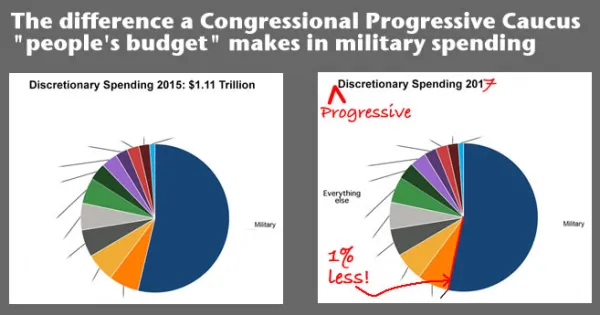

Each year the Congressional Progressive Caucus releases a weaker and weaker budget proposal. This year they asked for input first. I sent them this and communicated with them about it, so I know they read it. An excerpt:
Robert Bowdrie “Bowe” Bergdahl was held as a POW by the Taliban for 5 years and now for over a year by the U.S. Army at Fort Sam Houston in San Antonio. He has received constant treatment from an Army psychiatrist but he has not been returned to his family and home in Hailey, Idaho. Thus in my opinion his recovery and reintegration process has probably done more harm than good by continuing his isolation from the world. But his treatment after repatriation is more about politics than his service or U.S. Army procedures. Consequently, after what he has gone through and endured, he should be freed with an honorable discharge and all of his pay and benefits. Anything less would be an injustice.