
Global

Imagine an alcoholic who managed every night to get ahold of and consume huge quantities of whiskey and who every morning swore that drinking whiskey had been his very last resort, he’d had no choice at all.
Easy to imagine, no doubt. An addict will always justify himself, how ever nonsensically it has to be done.
But imagine a world in which everyone believed him and solemnly said to each other “He really had no other choice. He truly had tried everything else.”
Not so plausible, is it? Almost unimaginable, in fact. And yet:
Everyone says the United States is at war in Syria as a last resort, even though:

“Since the people are sovereign under our Constitution . . .”
Ralph Nader writes in a recent essay that we should demand acknowledgement of this fact from our presidential candidates and ask what they will do to restore this sovereignty to the American people, in their various manifestations as voters, taxpayers, workers and consumers.
“Regardless of their affiliation with either of the two dominant parties,” he writes, “politicians are so used to people being spectators rather than participants in the run-up to Election Day that they have not thought much about participatory or initiatory democracy.”
“Spectator,” “participant” . . . these are trigger words for me. I deeply fear the reckless ascendance of that first word in our cultural and political structures, as world events are increasingly reduced to reality TV mélanges of celebrity and violence. Meanwhile, the second word shrivels. This is America the superpower, its management the province of a shadowy consensus of corporate militarists.

"...at the very moment the number one nation has perfected the science of killing, it has become an impractical instrument of political domination." - Richard Barnet, Roots of War, 1972
France and Russia’s military responses to mass murders in Paris and Egypt echo the United States’ response to mass murders in New York, Washington and Pennsylvania in 2001. As Oxford University researcher Lydia Wilson told Democracy Now on November 17th, Islamic State (IS) is "seemingly delighted" by this warlike response to its latest atrocities.
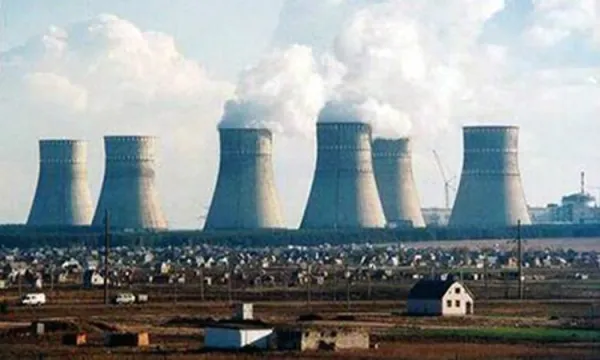
As you read this, a terror attack has put atomic reactors in Ukraine at the brink of another Chernobyl-scale apocalypse.
Transmission lines have been blown up. Power to at least two major nuclear power stations has been “dangerously” cut. Without emergency backup, those nukes could lose coolant to their radioactive cores and spent fuel pools. They could then melt or explode, as at Fukushima.
Yet amidst endless “all-fear-all-the-time” reporting on ISIS, the corporate media has remained shockingly silent on this potential catastrophe.
Ukraine’s Rivne Nuclear Power Plant in the country’s northwest. Photo credit: Wikimedia commons
Nor has it faced the most critical step needed to protect our planet in a time of terror: shutting all atomic reactors.

During the November 15 Democratic Presidential Debate, Vermont Senator Bernie Sanders sounded an alarm that "climate change is directly related to the growth of terrorism." Citing a CIA study, Sanders warned that countries around the world are "going to be struggling over limited amounts of water, limited amounts of land to grow their crops and you're going to see all kinds of international conflict."

Robert Reich's website is full of proposals for how to oppose plutocracy, raise the minimum wage, reverse the trend toward greater inequality of wealth, etc. His focus on domestic economic policy is done in the traditional bizarre manner of U.S. liberals in which virtually no mention is ever made of the 54% of the federal discretionary budget that gets dumped into militarism.
When such a commentator notices the problem of war, it's worth paying attention to exactly how far they're willing to go. Of course, they'll object to the financial cost of a potential war, while continuing to ignore the ten-times-greater cost of routine military spending. But where else does their rare war opposition fall short?

I’m sitting in the aftermath of Paris, feeling emotions tear me apart. One of the emotions is joy. My daughter, who lives there, is safe.
Has “joy” ever felt so troubling?
The aftermath of Paris seems likely to be intensified (“pitiless”) bombing raids in Syria, closed borders, heightened fear-based security and the deletion of “the gray zones of coexistence” across the planet.
Oh, it’s so nice to have an enemy who is truly evil! And the logic of war is so seductive. It simplifies all these complex emotions. Just watch the news.
The news is that terror wins. Indeed, terror is the cornerstone of civilization.
I couldn’t get that notion out of my head. That’s because I couldn’t stop thinking about an act of extraordinary terror that took place just over a dozen years ago, and its relevance to the world’s current state of shock and chaos. Doing so made it impossible to contemplate the raw savagery of the ISIS killings in Paris and Beirut and everywhere else — the “my God!” of it all, as innocent lives are cut short with such indifference — in a simplistic context of us vs. them.

The more extreme the crimes of state, the more the state seeks to shroud them in secrecy. The greater the secrecy and the accompanying lies, the more vital becomes the role of whistleblowers – and the more vindictive becomes the state in its pursuit of them.
Whistleblowers are people who start out as loyal servants of the state. Their illusions about the state’s supposed moral agenda – and the wholeheartedness of their own patriotic commitment – make them all the more shocked when they discover evidence of the state’s wrongdoing.
Given the extreme concentration of weaponry (as well as surveillance capabilities) in the hands of the state, and given the disposition of the state to apply such resources even against nonviolent mass movements, the type of defection practiced by whistleblowers – an option available to military and intelligence operatives at all levels – is crucial to any eventual triumph of popular forces over the ruling class.

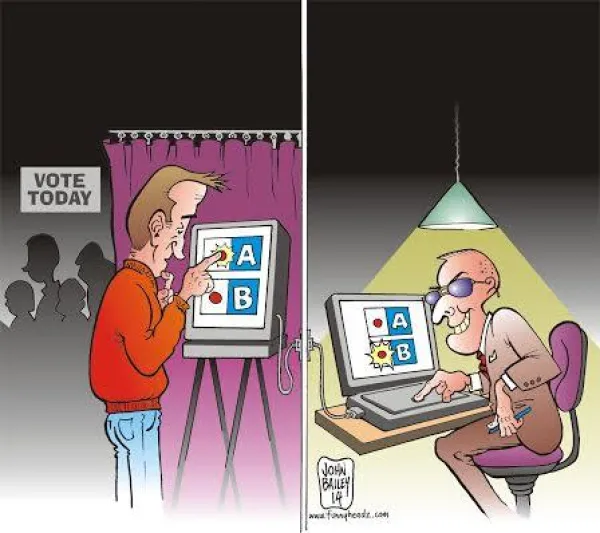
Official Vote Tally on Ohio’s Pot Issue Deemed "Statistically Impossible"
The “stolen election” controversy over this month’s officially defeated Ohio pot legalization referendum has gone to a new level.
“The results are not only impossible but unfathomable,” stated Ron Baiman, Assistant Professor of Graduate Business Administration at Benedictine University, where he teaches economics and statistics.
The Columbus Free Press asked Baiman to calculate the odds of the official vote count of Ohio’s Issue 3, to legalize marijuana, being correct – compared to the tracking polls charting voter preference leading up to this year’s November election. The Free Press supplied Baiman with poll results taken prior to the election by noted pollster Jon Zogby.
The polls leading into the November 3 vote showed the referendum passing. But the official results claim it lost by 2:1.