
Global

The U.S. Army and Air Force public relations offices have responded to a Freedom of Information Act request by releasing huge lists of movies and television shows that they have assessed and, at least in many cases, sought to influence. Here's the Army's PDF. Here's the Air Force's PDF.
The shows and films, foreign and U.S. made, aimed at foreign and U.S. audiences, including documentaries and dramas and talk shows and "reality" TV, cross every genre from those obviously related to war to those with little discernable connection to it.
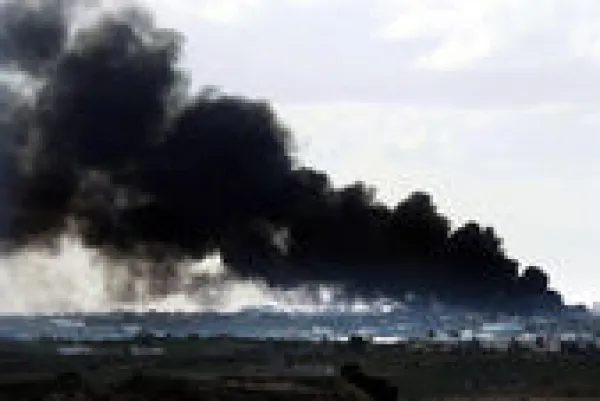
One-and-a-half year old Ali Saad Dawabsha became the latest victim of Israeli violence on July 31. He was burnt to death. Other members of his family were also severely burnt in a Jewish settlers’ attack on their home in the village of Duma, near Nablus, in the West Bank.
A spokesman for Rabbis for Human Rights told Aljazeera Arabic that this is the tenth attack on Nablus by settlers in July. A statement issued by the Palestine Liberation Organization (PLO) provided an even more alarming statistic, putting the number of Jewish settlers’ attacks, some of them lethal, at an estimated 11,000 since the end of 2014.

We love nuclear horror stories in America. We love them whether they’re somber like the film On The Beach, soapy-dramatic like the cult show Jericho, or retro-future like the Fallout series of video games. We laugh at the lunatic optimism of duck and cover, and marvel at the strangeness of the (perhaps exaggerated) all-encompassing fear of The Bomb.
Nukes get all the attention, but the fact is that intense inspections of Iranian facilities will also prevent Iran from developing a ray gun that causes your clothes to vanish and your brain to convert to Islam.
No, there is not the slightest scrap of evidence that Iran is trying to create such a thing, but then there's also not the slightest scrap of evidence that Iran is trying to create a nuclear bomb.
And yet, here are a bunch of celebrities in a video that certainly cost many more dollars than the number of people who've watched it, urging support for the Iran deal after hyping the bogus Iranian nuclear threat, pretending that the United States gets "forced into" wars, making a bunch of sick jokes about how nuclear death can be better than other war deaths, suggesting that spies are cool, cursing, and mocking the very idea that war is a serious matter.

Jimmy Carter called a war waged in Vietnam by the United States -- a war that killed 60,000 Americans and 4,000,000 Vietnamese, without burning down a single U.S. town or forest -- "mutual" damage. Ronald Reagan called it a "noble" and "just cause." Barack Obama promotes the myth of the widespread mistreatment of returning U.S. veterans, denounces the Vietnamese as "brutal," and has launched a 13-year, $65 million propaganda program to glorify what the Vietnamese call the American War:
"As we observe the 50th anniversary of the Vietnam War, we reflect with solemn reverence upon the valor of a generation that served with honor. We pay tribute to the more than 3 million servicemen and women who left their families to serve bravely, a world away . . . They pushed through jungles and rice paddies, heat and monsoon, fighting heroically to protect the ideals we hold dear as Americans."

The flag in front of Home Depot was at half-mast and I felt myself wondering why in an awkward, despairing way.
The nation and the news cycle were still thrashing in the wake of the Chattanooga killings and I figured, oh, it’s for the soldiers — but all that realization did was intensity the troubled feelings the spectacle had aroused. This is America, where you can shop and mourn . . . but it wasn’t just that.
I suddenly thought about Sandra Bland’s apparent suicide in a Texas jail cell and, from there, I thought about a year’s worth of video footage of racism-scarred arrests and violence and, beyond that, the brutal stupidity of the wars we wage and two dozen or more vet suicides every day — this was all in the space about 20 seconds, while I was parking my car — and by the time I reached the entrance of the big box, I found myself asking: Why should the flag ever NOT be at half-mast?
And that was just the beginning. The flag, the flag . . .
Maybe it’s part of the problem.
Acting Costa Rican President José “Don Pepe”Figueres Ferrer takes a sledgehammer to the Cuartel Bellavista military barracks, 1948
The 22 countries which have abolished their militaries or were founded without one are uniformly tiny, isolated, and often island nations. In many cases, these states maintain national police or paramilitary forces for internal protection (some might say from their own citizens in the event of a popular uprising to effect regime change), maritime defence patrols, or are defended by their former colonial masters. Some might say they are at little risk of invasion because there’s nothing more to take and few to fight back!
Although countries with armies may be more complex and have extensive economic and foreign policy agendas, there is no reason why they, too, could not take the first step in abolishing their large and costly militaries. One country’s standing army can only be an implied threat against other nations. When a country has an army, there is every incentive to put it to aggressive use.
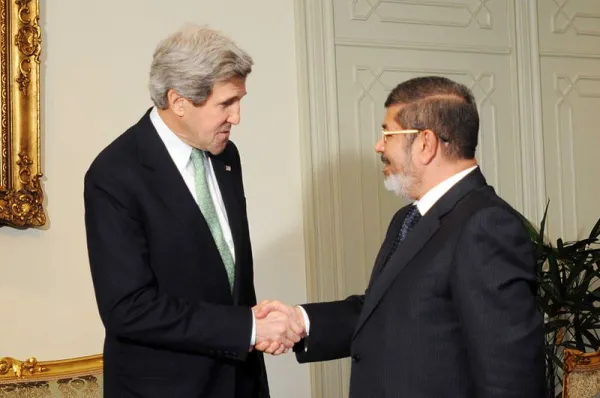
Message to The United Nations, European Union, United States, and all Democratic and Free countries
There are growing concerns that the government of Egypt intends to execute Egypt’s first ever democratically elected President, Mohamed Morsi in the coming weeks. Mr. Morsi along with hundreds of political opponents received the death sentence following what major international human rights organizations described as a hopelessly flawed and politically motivated trials that ignored acceptable minimum international standards.
President Morsi was ousted during the illegal military coup led by the then Defense Minister Abdel Fattah el-Sisi, and has been imprisoned ever since. President Morsi’s death sentence and the impending execution of countless others (students, women, religious scholars, politicians, and academics)involved in working for democracy in Egypt presents a sobering example of the escalating violence and continual human rights abuses perpetrated against the Egyptian people since the Fourth Anniversary of the January 25 Egyptian Revolution earlier this year.

There is much that is revolting about the current world and Andre Vltchek, Christopher Black and Peter Koenig are well placed to document it, which they have done in their new book 'The World Order and Revolution! Essays from the Resistance'. http://badak-merah.weebly.com/the-world-order-and-revolution.html