
Local
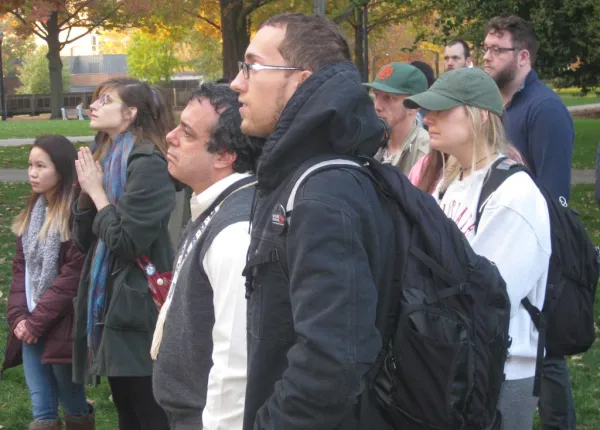
In Columbus, the looming Donald Trump presidency has added urgency and intensity to protests of the Dakota Access Pipeline. On November 16 the student group Socialist Students organized a demonstration on the Ohio State University campus.
“They’re building the pipeline through sacred Sioux burial grounds,” said Socialist Students member Mia Zerkle. “This is the equivalent of destroying somebody’s church, or disrupting the Arlington National Cemetery. This is infringing on their rights and everything they believe in.”
“This isn’t only an issue about the environment,” said Rachel Rouwenhorst, who studies ecology and evolution at OSU. “This is about Native American sovereignty. Corporations shouldn’t be putting pipelines through their burial grounds, prayer sites, and water supply.”
Rouwenhorst called for a boycott of the banks that are investing in the pipeline, including CitiBank, Wells Fargo, Bank of America, US Bank, PNC Bank, JP Morgan Chase, UBS, and Goldman Sachs. “You can close your account with them and use a credit union, or a bank that is not funding this pipeline,” she said.

Hillary Clinton's margin of victory in the 2016 vote count continues to climb, at this point well over a million.
But her impending defeat in the Electoral College comes with familiar signs that the election was stripped and flipped.
These indicators include the realities of pre- and post-election polling; the massive stripping of primarily black, Hispanic and Asian-American voters from computer generated registration rolls mostly maintained by private partisan companies; unverifiable "black box" electronic voting machines and central tabulators, also mostly manufactured and maintained by private corporations, and much more.
Were this election held in any other country, the US State Department and independent monitors from around the world would denounce it as a fraud, and contemplate international intervention.
The Electoral College

US Secretary of Agriculture Tom Vilsack recently announced 2016 USDA Rural Development grant awardees including just two recipients in Ohio. Kate Hodges and Rachel Tayse of Columbus urban farm Foraged & Sown are among this year's Value Added Producer selection, for their project Preserving Wild Flavors and Nordic Traditions.
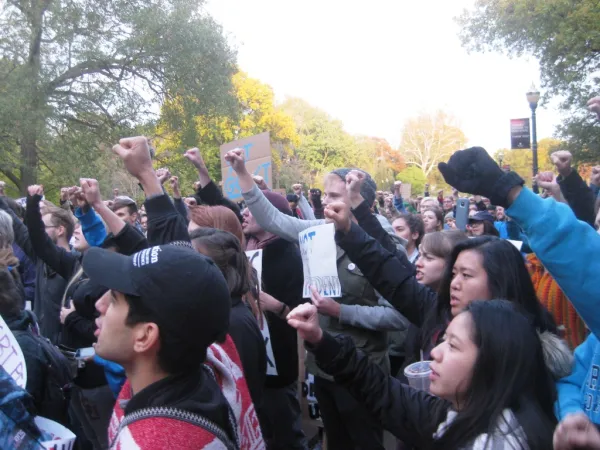
Last Wednesday morning, Donald Trump defeated Hillary Clinton in the presidential election. On Wednesday night there began protests against the idea of a President Trump all over the country. These demonstrations have spread here to campus.
There are protests because people feel like they have something to say. Or at least, that they have to say something. What is being said is not groundbreaking, but it serves as an affirmation that the words have not lost meaning since Nov. 9. People shouting at Trump Tower and proclaiming “#NotMyPresident” know both that this will not cause him to change his behavior, and that he actually is their president. But they also know that the most feasible future for Progressives is a remaking of the Democratic party. And considering the cluelessness of party “elites” (to adopt the nom de guerre of the campaigns) on Tuesday night, it must be a remaking by the people.
Did you miss the Free Press Second Saturday Salon and still want to know more about using your devices and social media for activism?
Even if you attended, you still need this link to the information by our good friends Trane and Kimmy DePriest.
How to Use Social Media for Activism
Some helpful infographics that go further in boosting your social media activism!
Happy Facebooking and all that jazz!
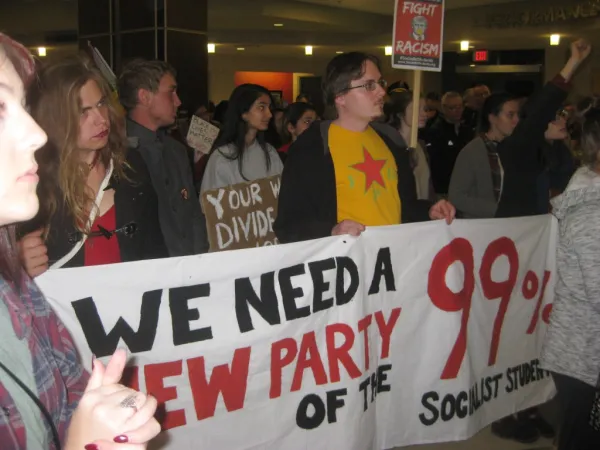
The corporate media has been on a feeding frenzy over the assault of an anti-Trump protester on the Ohio State University campus yesterday. Sensationalism drives page hits and ad revenue, so local and national media have focused almost entirely on the violent incident. Missing from the coverage is why the protesters were there in the first place — what they were trying to accomplish politically.
The OSU Lantern broke the story with a Twitter video which described the incident as a “tackle.” It’s understandable that a student newspaper that covers the OSU Buckeyes would use a football metaphor. But CNN and many other outlets picked up the innocuous-sounding word in their headlines.
It was not a tackle. Timothy Adams (called Timothy Joseph in some reports) was not wearing protective gear. He didn’t land on grass or Astroturf. He landed face-down on hard concrete. It was a violent attack that Adams was fortunate to walk away from with only bruises.
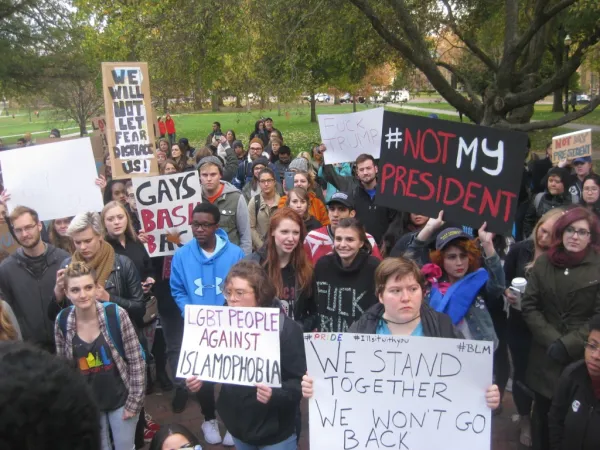
Protests and vigils in Columbus last week focused largely on fear of President-elect Donald Trump, outrage at his supporters, and grief over Democratic candidate Hillary Clinton losing the election. But while over 200 demonstrators had a lot to say against Trump at the OSU Oval on Friday, they also pointed a clear path forward: mass organizing and rejection of establishment politics.
“This is our wake-up call. We’ve been asleep, and we woke up to a nightmare,” said Bilal El-Yousseph, a Palestinian Muslim. “My mother wears a head covering, and she shouldn’t be scared to go to her job.”
El-Yousseph supported Bernie Sanders as the Democratic nominee, who polled better against Trump than Hillary Clinton did. He was angry when the DNC used underhanded tactics to give Clinton the nomination anyway. “The Democratic Party is not here for us,” he said.

Tuesday, November 15, 3-5pm, U.S. Army Corps of Engineers, 5905 Lewis Center Rd., Lewis Center, Ohio
Join us Tuesday [November 15] in front of the Lewis Center office of the Army Corps of Engineers. We will demand that the U.S. government and the Army Corps of Engineers reject the Dakota Access Pipeline.
We will have a few signs, but, if you can, make a sign to bring and brandish.
We will stand with our signs until close to dark.

If I told you Moonlight is about an African-American boy growing up in a world of drugs and poverty, you’d probably begin to form an image of the film in your mind. And that image probably would be wrong.
Director/screenwriter Barry Jenkins has put together a movie so sensitive, so lyrical and so different from anything we’ve seen that there’s no way to avoid being taken by surprise.
Moonlight tells the sad tale of Chiron, a boy growing up in a scruffy neighborhood of Miami. Divided into three chapters, the film follows him into high school and finally into adulthood. At all three stages of his life, he struggles with loneliness brought on by his own—and other people’s—inability to accept him for who he is.
As a boy, Chiron (Alex R. Hibbert) is nicknamed Little due to his small size and is constantly bullied for being somehow different from the other boys. A sympathetic classmate named Kevin (Jaden Piner) advises him to stick up for himself, but Chiron’s mother, Paula (Naomie Harris), is too consumed by her drug habit to pay attention to his needs.
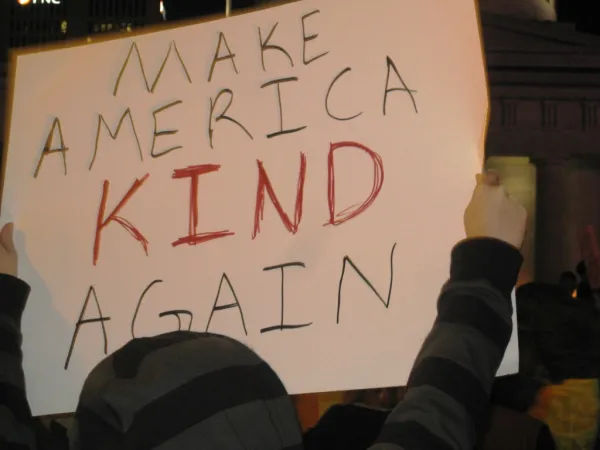
Hundreds joined a protest against President-elect Donald Trump at the Statehouse on November 10. The turnout was encouraging. The messaging probably gave protesters a needed catharsis. But more needs to be done to direct the momentum into building a fighting movement of the 99%.
Protesters chanted about how awful Trump is. They bemoaned that Hillary Clinton didn’t win the presidency. And hey, let’s sign a petition to ask the Electoral College to give Hillary the election.
All of this is easy, and it won’t accomplish anything. What’s needed is a clear path forward. And the way forward needs to be informed by an accurate assessment of why so many working-class Americans have turned away from the Democratic Party. Robert Reich’s article in The Guardian is a good place to start.