
Local

A rising tsunami of U.S. nuke shut-downs may soon include California’s infamous Diablo Canyon double reactors. But it depends on citizen action, including a statewide petition.
Five U.S. reactor closures have been announced within the past month. A green regulatory decision on California’s environmental standards could push the number to seven.

The summer solstice of course is June 21st and we need to honor those who perhaps best celebrated Mother Earth’s longest day: Native Americans. While not definitively known, the summer solstice’s most sacred Ohio celebration in antiquity probably took place at Serpent Mound in Peebles County. And again, because no one definitively knows how old Serpent Mound is, the celebration itself could be thousands of years old. This year’s celebration begins this weekend and of course hosted by Friends of the Serpent Mound.
The following feature on Ohio Native American history and Indian mounds by an Ohio Bear Clan Seneca is a message to today’s Ohioans. Simply put, we need to recognize our ignorant past and amend our future.

Young viewers can learn valuable lessons from Finding Dory: lessons about perseverance and learning to celebrate their individuality. Let’s just hope these future drivers don’t pick up any ideas about traffic safety.
A climactic scene has Dory, the blue tang fish, and Hank, her octopus pal, driving a truck the wrong way down a freeway while other vehicles swerve frantically to avoid them. Funny? Maybe for the kids in the audience, but adults’ enjoyment might be tempered by memories of the countless tragedies wrong-way drivers have caused in real life.
Beyond teaching the dubious message that reckless driving is harmless fun, the scene may strike some as odd for another reason. Namely, it places two marine animals in an environment where they’re completely out of their element. And it’s far from the only scene where this is the case.
Beginning around the halfway point or sooner, the plot takes the plucky but forgetful Dory (Ellen DeGeneres) to the human-run Monterey Marine Life Institute. As a result, she spends most of her time hopping from one water receptacle to the next rather than swimming around in the deep blue sea.
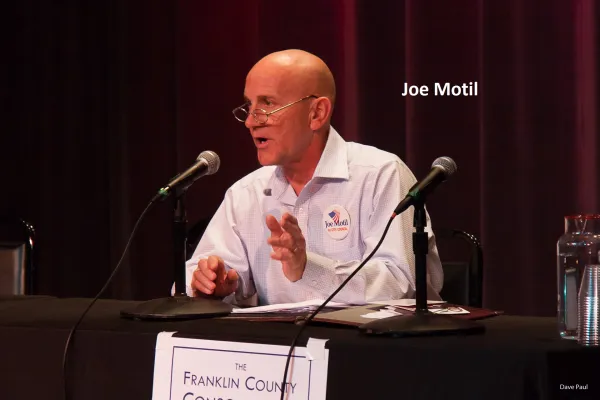
On June 6th at the weekly City Council meeting they granted yet another multimillion dollar tax abatement to another major corporation with gross profits over a billion dollars. This time it was to UPS. Council member Elizabeth Brown, who chairs the Economic Development Committee, did her best to try and justify this tax abatement. In my comments to City Council, I suggested that UPS is not in danger of bankruptcy and her reply to that was she wants to make sure that companies like UPS do not fall into bankruptcy.
Really?
She then tried to tout her extensive experience in Economic Development since she used to be the Downtown Development Manager for the Department of Development.
Her duties?
You guessed it, to focus on helping companies to expand into sites in Downtown and the surrounding area (Short North) through income tax incentives and other tax giveaways. The perfect go to person for a handout. She also claimed that our surrounding suburbs give away much more in terms of tax incentives and we could have lost UPS.
Bulls#%t!

Study a picture of Jesse Hughes, my fellow old-timers. The lead singer and funny man of Eagles of Death Metal reminds you of who?
To this loving son of the '70s, I see in him:
--first and foremost, one or two members of Foghat, the quaalude boogie band spin-off of England's venerable blues-jazz band, Savoy Brown. A little bit 'Lonesome Dave' Peverett and a whole lot of Tone Earl, drummer. Unreconstructed long-hairs who couldn't hide their musicianly machismo if they tried, while at the same time being, you know, being skinny, unaggressive musicians.
--Diamond Jim Dandy of Black Oak Arkansas, the first of the flamboyant talent-less southern American home-grown boogie bone-heads. More on that in a bit.
--'Diamond' David Lee Roth, the king of such entities, and the greatest of the ass-less chaps set. Without peer. And yet a true original.
In concert at the Newport May 28, the EODM with the third great 'Diamond,' namely Hughes, put on a show of insouciant '70s-esque cock-rock the likes of which makes you realize the cliche 'everything old is new again' is an evergreen phrase of eternal usefulness.
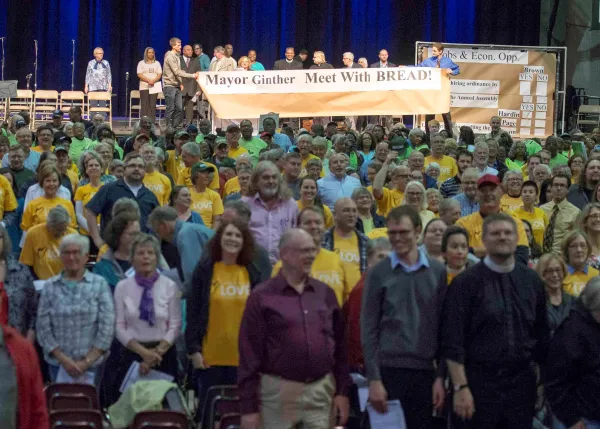
Just hours before the Nehemiah Action meeting on May 9, organizers of the interfaith social justice coalition BREAD didn’t know whether Mayor Andrew J. Ginther would make an appearance at the Celeste Center for the annual event. They had invited Ginther to weigh in on an economic initiative that would benefit residents of Linden, the Hilltop, and other marginalized neighborhoods. They had two different programs printed up for the evening: one in case the mayor would show up, and another in case he wouldn’t.
He didn’t.
Nevertheless, central Ohio faith leaders made their case at the meeting. “Early practices of deed restrictions, discriminatory lending, and highway construction have created a tale of two cities,” said Clyde Sales, senior minster at the Genessee Avenue Church of Christ. “There are the privileged neighborhoods and the throwaway neighborhoods, with clear boundaries separating neighborhoods like Linden.”

June 24-26 ComFest will fill Goodale Park once again with local music, art, food, crafts, workshops, and revelry. The festival has lots of diverse offerings, so guests are sure to find something for everyone.
This being an important election year, people can expect speakers and panels to express and explain progressive viewpoints on topics as far-ranging as economic justice, environmental crises, and voting rights. There will be workshops about gender identity and sexism, new trends and development in Columbus, local control of environment and resources, big money in local politics and how residents are represented in city council – the ward system or at large. Guest speakers will make remarks in support of labor and Planned Parenthood and other issues. And ComFest is one way to make sure you are registered correctly to vote, and learn how to defend your right to have your vote counted.

In last month’s article, I made the statement that the Electric Guitar is one of only two true American instruments, the other being the Sousaphone. Of all of the dumb things that I have said in print over the years, this one may have generated the most outrage. I was inundated with messages proposing (at times aggressively) other instrument candidates for Americanesedness. So to preserve my hard-won reputation for keeping an open mind, I have determined to explore the suggested candidates and rate them on a scale of 1-5 Bald Eagles.
To define American instruments, we must first define what “American” means. Primarily to save space, I have decided to use the Drunk Republican Uncle on the Fourth of July definition: the original 13 states after George III got the heave-ho and the other states upon their admission to the Unionas states. That is, if Wyatt Earp invented a new type of trombone while U.S. Marshall for New Mexico Territory in 1878 he's out of luck.
Without further ado, the candidates (in no particular order):

A joint report released in May by the American Civil Liberties Union of Ohio (ACLU) and Disability Rights Ohio informed us that “Solitary confinement is torture” and that “ninety-five percent of people who go to prison are one day released back to their communities.”
The American Friends Service Committee reports that today there are more than 40 states that have super-maximum security facilities “primarily designed to hold people in long-term isolation.”
The Bureau of Justice Statistics reports that ten years ago there were “more than 80,000 men, women and children in solitary confinement in prisons across the United States” and that “as with the overall prison population, people of color are disproportionately represented in isolation units.”
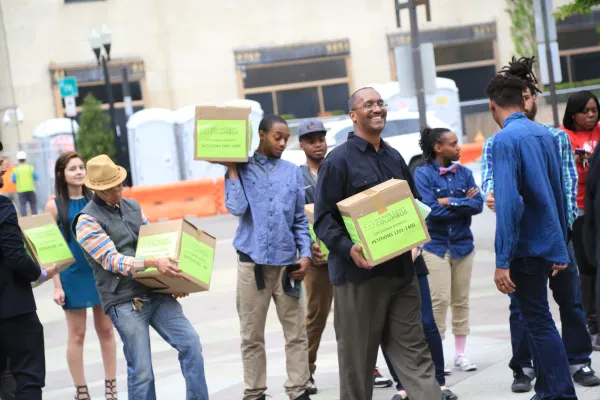
After a five-year long struggle, the grassroots effort to give a voice to more Columbus residents will finally come to a public vote at a special election on August 2 this year. The charter amendment would expand Columbus City Council from seven to 13 members and include representatives from city ward districts. This would break the all-at-large, one-party Council system and make Columbus’ city governance comparable to other U.S. cities its size.
Grassroots groups had tried twice since 2011 to get the amendment on the ballot, but were stymied by what appeared to be politically-motivated maneuverings by the current powers at City Hall.
Represent Columbus is a coalition of Democratic, Republican, Green and Independent grassroots leaders. Building upon previous work by the Columbus Coalition for Responsive Government, Represent Columbus submitted 39,308 petition signatures to the Columbus City Clerk on May 3. The Franklin County Board of Elections determined that 19,035 of those were valid – 1,200 more valid signatures than the 17,780 required. City Attorney Rick Pfeiffer found the petitions to be “legally sufficient.”