
Local
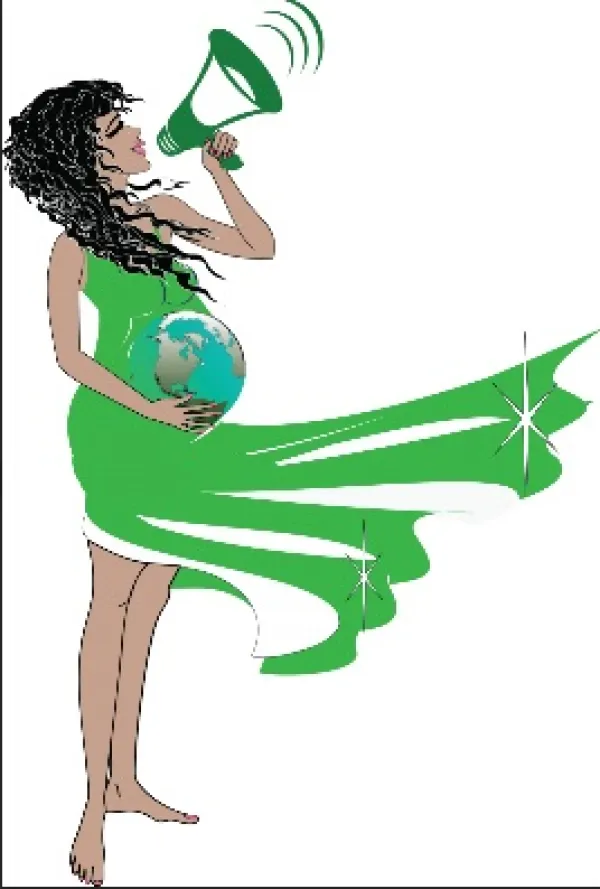
Calling itself Columbus’ Green Renaissance Network, Saturday April 23, marked the “Earth Day BirthDay” of Columbus’ newest Low Power FM Radio station, WGRN-LP 94.1. Victoria Parks, volunteer programmer for WGRN, answered some questions for the Free Press giving us the skinny on WGRN:
FP: Where can our community tune-in to WGRN-LP and what is Low Power FM radio?
Calling itself Columbus’ Green Renaissance Network, Saturday April 23, marked the “Earth Day BirthDay” of Columbus’ newest Low Power FM Radio station, WGRN-LP 94.1. Victoria Parks, volunteer programmer for WGRN, answered some questions for the Free Press giving us the skinny on WGRN:
FP: Where can our community tune-in to WGRN-LP and what is Low Power FM radio?
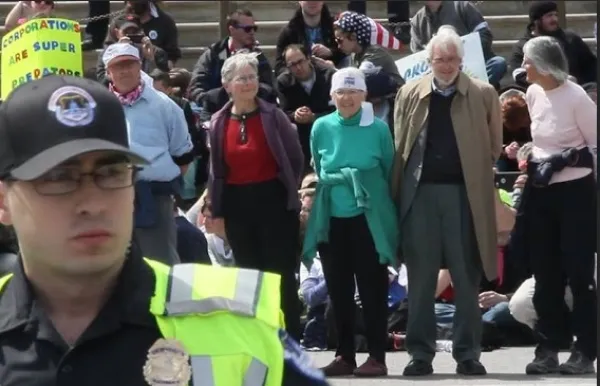
Central Ohio activists Marilyn Welker, Bob Hart, Ellen Baumgartner and Chuck Lynd were among the 400 people arrested on the steps of the US Capitol during the “Democracy Spring” – one of the largest civil disobedience actions since the Vietnam War protests, demanding a democracy that works for everyone. They were supported by another Central Ohioan, Kathleen Gmeiner. Between April 11th-18th, 1,300 people were arrested.
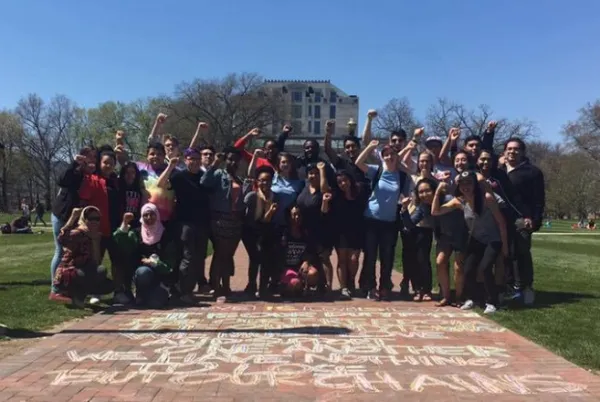
A coalition of student organizations at Ohio State University (OSU) occupied Bricker Hall, the administrative building, on April 6 to #ReclaimOSU and demand that school officials release information about the university's investments and respond to campaigns by Real Food Challenge (RFC), United Students Against Sweatshops (USAS) or OSUDivest.
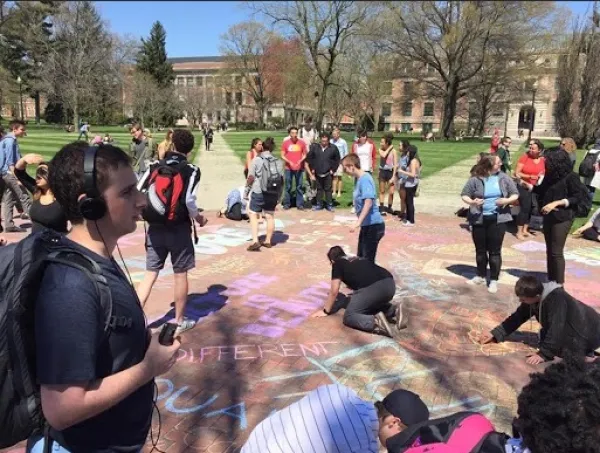
Manuel Cuellar-Rocha remembers his first Cinco de Mayo on the Ohio State University campus. The fourth-year design major from Dayton does not recall it fondly. “Ohio State doesn't necessarily aid you much with getting used to campus life...you get thrown into the fishbowl with all the other students. I just kept thinking, 'Man, I can't wait until I see someone that looks like me.' I felt extremely intimidated...I truly understood what it meant to attend a predominately white institution.”
Before long, he saw an eye-opening example of racial stereotyping that personified the unfriendly climate toward Latinos on campus. “My first semester when I got here there was a senior crawl,” he says. “A student organization designed the t-shirts for the senior crawl, which happened to be on Cinco de Mayo. On the shirt, they had a figure wearing a sombrero, crawling. When people had an issue with that shirt, no one could understand the view of the minority who saw that shirt and were disgusted. I don't celebrate Cinco de Mayo, and I sure as hell don't celebrate it crawling wearing a sombrero.”
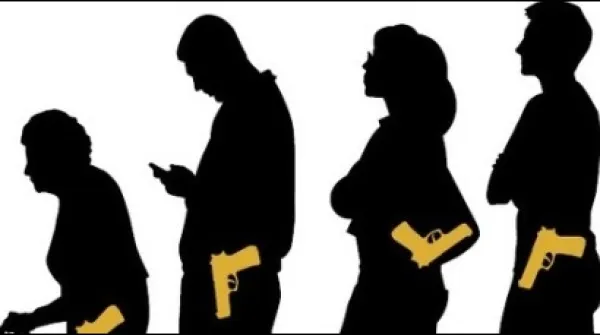
When it began to go viral a Change.org petition was calling for open carry of guns at this summer’s Republican National Convention in Cleveland, the joke that followed was this: “The only way to stop a bad Trump delegate with a gun is a good Cruz delegate with a gun.”
The petition proved to be satirical, but over 50,000 gun lovers were convinced it was real.
The fever for guns, and for what some are calling “constitutional carry”, is as hot as ever. For those who don’t want to carry a gun on their hip at all times, it’s becoming more difficult to grasp what’s real and unreal, and what’s downright surreal.
Take for instance what’s real.
An ad in the Columbus Alive says the ladies can go to Vance gun stores for over 40 styles of concealed carry handbags. In Clintonville, at a store called Gun Envy, you can rent a machine gun and invite all your pals to party.
Yet what’s deadly serious is that earlier this year two Glock 22 semi-automatic handguns went missing from Gun Envy after shipped via US Postal Service, this according to Columbus police. The ATF is investigating.
When President Obama issued an upbeat Presidential proclamation about Loyalty Day last week, he left out the dark history behind the national observance. In 1958 Congress introduced Loyalty Day as a tool of anti-communist propaganda at the height of the Cold War, when countless leftists in the U.S. were persecuted for their political beliefs.
The Los Angeles Times notes: “It's no coincidence that Loyalty Day falls on May 1 or ‘May Day,’ a celebration of workers around the industrialized world observed on the anniversary of the 1886 Haymarket Square incident in Chicago — when four people were executed on the strength of murky evidence that they killed eight people (seven of them police officers) during a labor rally for the eight-hour workday.”
Ohio’s jobs “Driver” is getting pretty hot in the Democratic debate as of late, and will likely flare up the Republican stage before Cleveland. I’m following it closely, how can I help it? I can’t go more than two songs on Pandora or watch Prime Time without hearing, in surround sound, the virtues of Fracking.
A few years ago I became a volunteer researcher for the Columbus talk radio show, All Sides with Ann Fisher. Linda, the producer, was a former improv student of mine. I had taught and performed improv and legit theatre for over 20 years, and at 52, I was ready for change, something to sink my teeth into - that would help the world.
At All SidesI researched authors of fiction, non-fiction, history, local celebrities, artists, politicians, ornithologists, etc. And the day Linda gave me the assignment to research fracking, my world changed. And I haven’t looked back.
At this delicate moment in the primary season, we all need to take a deep breath and evaluate what comes next.
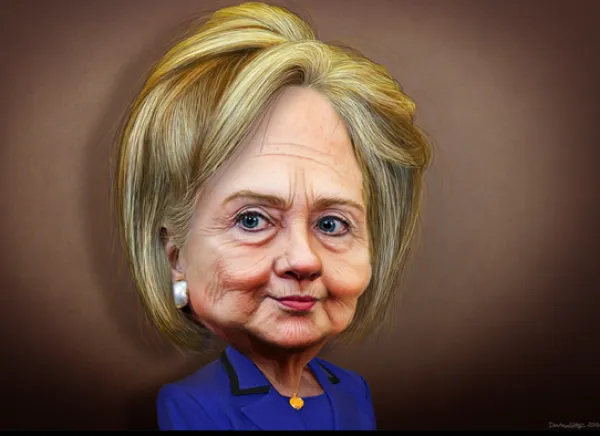
Bernie Sanders has a mathematical chance to win. But Hillary seems the likely Democratic nominee.
Donald Trump has an army of delegates. But if he doesn’t win on the first ballot, Paul Ryan could be the Republican nominee.
Oy!
For a wide variety of reasons, we believe Hillary and Bernie could beat Trump. But we’re not sure about Ryan, who we find absolutely terrifying.
Key is the stripping of our voter rolls. Millions of Democrats have already been disenfranchised. In a close race, that could make the difference.
Also key is the flipping of the electronic vote count, which few on the left seem to be willing to face in all its depressing finality.
Both are explored in our new Strip & Flip Selection of 2016: Five Jim Crows & Electronic Election Theft (introduced by Mimi Kennedy and Greg Palast) at www.freepress.org and www.solartopia.org.
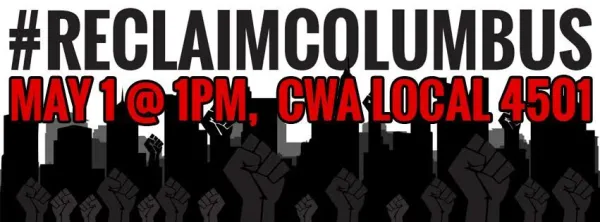
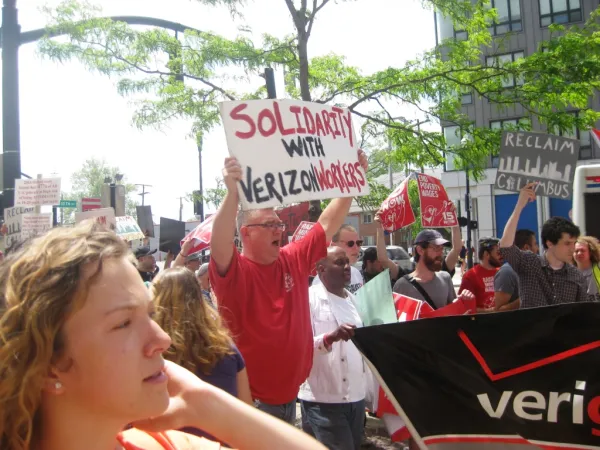
May 1st, (“May Day” - International Workers' Day), the Central Ohio Worker Center and other solidarity organizations will be celebrating collective resistance and #ReclaimColumbus for a dignified voice for workers, students, and community. Inspired by Ohio State students with Reclaim OSU, we will show solidarity highlighting the intersection of JUSTICE, FREEDOM and DIGNITY in Columbus. While The Ohio State University ignores the voice of its students, the community will gather in solidarity with them. Together we will reclaim the voice of workers, allies and Freedom Fighters.
WE WILL NOT BE SILENCED.
1:00 PM - Gather at the CWA Hall near the Ohio State campus celebrate the history of May Day - March up North High Street with stops at Verizon, Wendy's and the Ohio Union - Back at CWA Hall for brief presentations, tabling, announcements and share a meal together.
Facebook page