
Local

A common question I receive is about having a low libido. All genders experience it. Some worry they have forgotten how to have sex. Some wonder about a drop-off and how to satisfy their partner when they just aren't feeling it.
A married woman in her 50s describes, “I want sex, I want to be touched, but it takes me a long time to really get into it. Sometimes before I can get ramped up, he's lost interest and doesn't want to try any more. And, sometimes that's okay. I'm happy to have a good partner and he's not that sexual. Sometimes I really want to try and have sex.”
A partnered woman in her early 40s said, “I once had a weekend fling (totally okay with my boyfriend). I wasn't having sex with my boyfriend and even with this fling, it took him all afternoon of being playful, teasing, seductive to finally flip the switch from OFF to ON. But, once it was on - WOW! I came back to my boyfriend in a heightened state. Then, it didn't last. There just wasn't the time for an afternoon of play to get me to respond.”
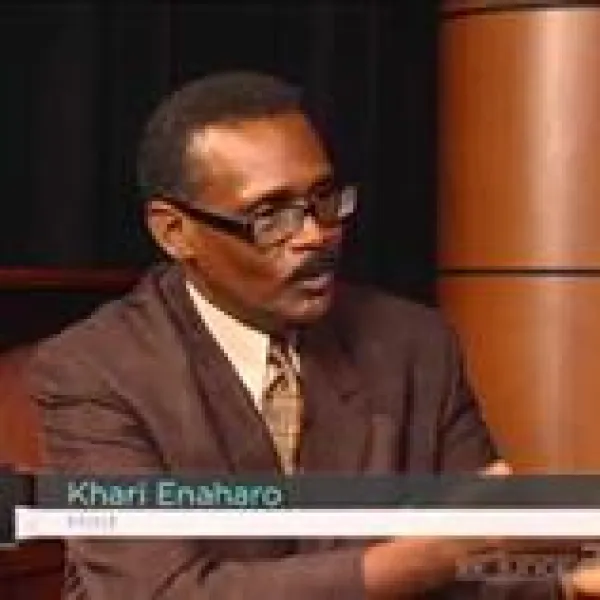
Columbus citizens may believe that city decisions and reforms are made by elected officials or government agencies. Those who watch NBC’s “Spectrum” and other local media may believe there’s a handful of movers and shakers in the community working to affect public policy. These shows span the spectrum from “A” to “B” and back. If you want “C-Z” alternative points of view you need to read The Free Press. People in the loosely affiliated activist community know that there are actually dozens of selfless, dedicated individuals who work tirelessly behind the scenes without notoriety, reward, and in most cases, a paycheck. They work for social justice and positive social change in central Ohio – and all over the planet. These are citizens like you and me, who make a “cause” part of their daily existence, and they often succeed in enacting some of the greatest changes in society for our common good. This column will be devoted to acknowledging those unsung heroes who are almost never invited to appear on the for-profit mainstream talking head shows.
Khari Enaharo
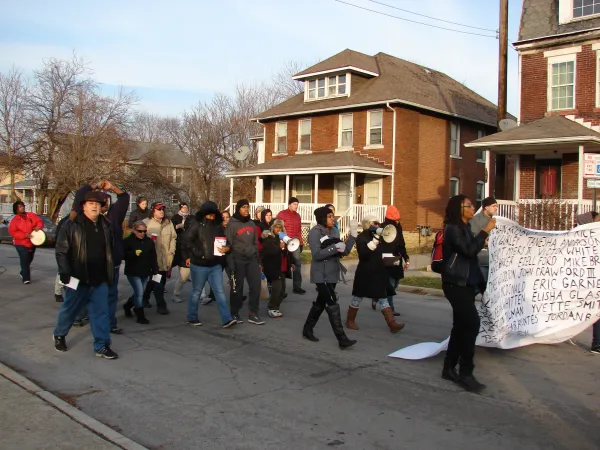
“Black lives matter!” became the rallying cry among activists calling attention to the recent police shootings of black citizens in Ohio and across the country.
Demonstrators against police brutality took advantage of the busiest holiday shopping day of the year by staging a “die-in” at Easton mall on December 20, the Saturday before Christmas. Sixty or so activists gathered in the Easton mall food court, unfurled a banner proclaiming “Black Lives Matter,” and struck death poses on the floor.
That same day, the usual holiday hustle at the Beavercreek Walmart was disrupted as nearly 200 protesters and activists took to the aisles to demand justice for the late John Crawford III, a 22-year old black man shot and killed by the local police department earlier this year, as reported by Reilly C. Dixon on columbusfreepress.com. A dozen protestors were arrested and charged with obstructing official business and criminal trespass.
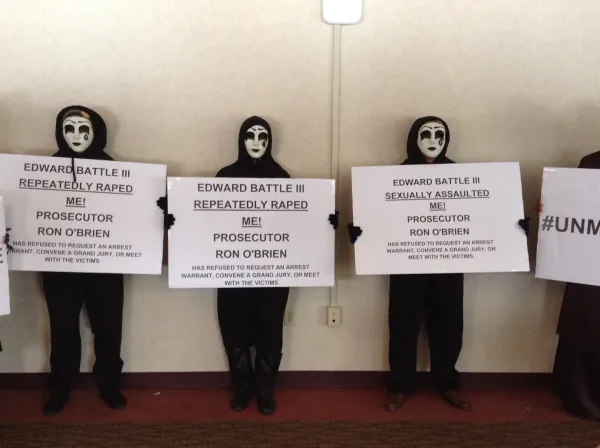
In response to the movement insisting “black lives matter,” three black child victims of rape held a press conference at the Martin Luther King, Jr. Center in Columbus on January 8, 2015. Their faces were covered with masks and it is the policy of The Free Press not to reveal the identity of underage rape victims. They remained silent throughout the press conference.
But, their advocates raised this theme: “Black child victims of rape matter.”
The three underage black girls have accused their uncle of raping them. The press conference was held to call attention to the fact that the rapes have been all but ignored by the Franklin County Prosecutor Ron O’Brien, and the alleged perpetrator is still a free man. Participant Bernardine Kennedy Kent of Parents Advocates of Students in Schools (PASS) insisted that the child rapes were not being properly investigated or prosecuted because of the victims’ race.
Kent Asad Shabazz of the Coalition of Concerned Black Citizens and Minister Donell Muhammad of the Nation of Islam all agreed that if these were three underage white girls, the alleged rapist would have been indicted and jailed.
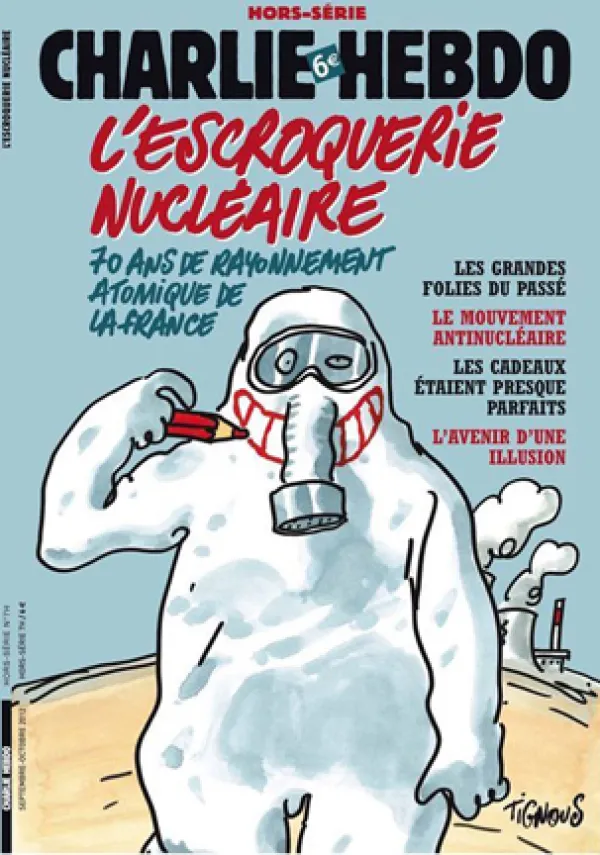
The powerful global response to the terror attack on the French magazine Charlie Hebdo must now face a terrifying reality: It’s a horrible thing when an organ of free speech is assaulted and journalists die.
It will be an apocalyptic thing when it happens to an atomic reactor and whole continents are irradiated, with children first to suffer, a death toll in the millions and eco-economic impacts beyond calculation.
For decades our global security apparatus and its attendant media mavens have pretended that the radioactive elephant in the room of global terror does not exist. But after Fukushima, Chernobyl, Three Mile Island, 9/11, Charlie Hebdo and so much more, a terrible reality has become all too clear.
We have seen four American-designed reactors explode and three melt at a single Japanese site. A severely escalated thyroid cancer rate has followed, with more health disasters yet to come. Some two dozen sibling GE reactors currently operate in the U.S.

An uneasy but hopeful 2015 unfolds as we celebrate The Free Press’ 45th year. We began as an underground OSU campus-based newspaper in October 1970 by activists enraged over the Kent State killings and the senseless Vietnam War. The Free Press has gone through many iterations over the years as a publication and website. Though we’ve always struggled with funding, we’re trying to publish this newspaper twice a month in 2015. If you have a business or service you’d like to promote, please contact our ad sales staff to help support our mission – to comfort the afflicted and afflict the comfortable.
Obama’s left turn: too little, too late?
Looks like Obama has grown a spine at the last minute, knowing he’s a lame duck in his last two years. The president lifted the embargo and recognized Cuba, announced he will veto the Keystone pipeline, changed the enforcement of immigration laws, wants college education to be free….what’s up? He’s finally doing the things the majority twice elected him to do. Maybe next he’ll free Leonard Peltier.
Don’t Gintherize Columbus!

The Ohio Rights Group (ORG) proudly continues its mission of support for the medical, therapeutic and industrial uses of the cannabis plant in Ohio. The group still enthusiastically supports the Ohio Cannabis Rights Amendment (OCRA), which would codify those uses as patient rights into the Ohio constitution.
Although the number of signatures collected so far was insufficient to make the fall 2014 ballot, the proposed amendment remains viable and is still being circulated to gather the 301,105 signatures of registered Ohio voters now necessary for ballot placement. The total count for signatures was lowered from 385,247 following the recent gubernatorial election in which the turnout used to calculate this requirement was much lower than in 2010. The ORG has so far collected approximately 150,000 signatures for the OCRA, roughly one-third to one half of those required. The law governing ballot initiatives also mandates signatures from 44 counties of Ohio’s 88 counties to exceed 5 percent of that county’s gubernatorial vote. This benchmark has been met for 30 Ohio counties, or almost 70 percent of that requirement.
I think some of you have wondered where I've been, at least I'd like to hope so. Indeed, I've missed the intermittent hate mail and compliments from people nowhere close to my intended audience (fellow nonwhite revolutionary socialists under 35 where are youuuuuuuuu). Initially, my hiatus was borne out of dirty rotten old-fashioned opportunism. I was figuring that if I was going to write for free, I might as well do it on my own platform. But I would also be selling myself short, because to be real wid it, I was also getting a low-key case of drapetomania.