
Arts
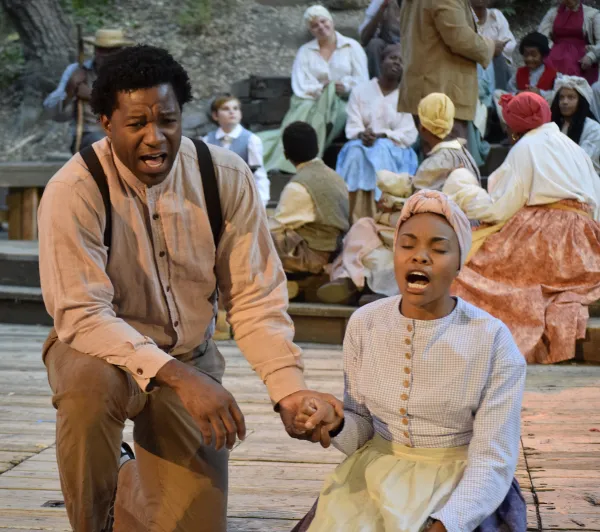
Will Geer’s Theatricum Botanicum’s production of Tom is artistic director Ellen Geer’s adaptation of Harriet Beecher Stowe’s 1851 abolitionist novel Uncle Tom’s Cabin. Geer, who also directed, added post-Civil War scenes depicting Stowe (Melora Marshall), who is still fretting over slavery. These additional 1886 vignettes enable the playwright to presciently ponder the plight of Blacks after the Reconstruction Era, but also in our own times wherein police and vigilante violence, institutionalized racism, the racist Trump candidacy, and more continue to beset and bedevil African Americans. These Stowe sequences, which are stowed away and interwoven into the fabric of the play - which is mostly a dramatization of the original book - also allows Tom to explore feminist issues, particularly the role of women in literature. After all, Stowe was, as Lincoln (perhaps apocryphally) called her, “the little lady who made this great war.”
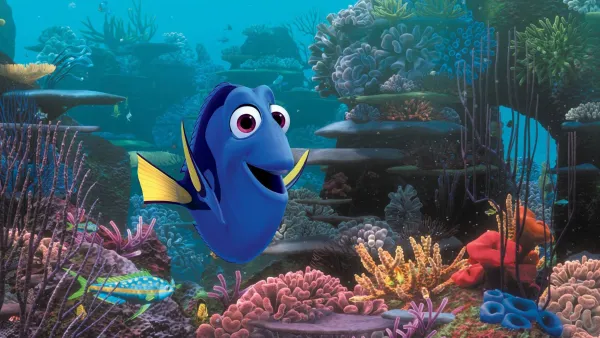
Young viewers can learn valuable lessons from Finding Dory: lessons about perseverance and learning to celebrate their individuality. Let’s just hope these future drivers don’t pick up any ideas about traffic safety.
A climactic scene has Dory, the blue tang fish, and Hank, her octopus pal, driving a truck the wrong way down a freeway while other vehicles swerve frantically to avoid them. Funny? Maybe for the kids in the audience, but adults’ enjoyment might be tempered by memories of the countless tragedies wrong-way drivers have caused in real life.
Beyond teaching the dubious message that reckless driving is harmless fun, the scene may strike some as odd for another reason. Namely, it places two marine animals in an environment where they’re completely out of their element. And it’s far from the only scene where this is the case.
Beginning around the halfway point or sooner, the plot takes the plucky but forgetful Dory (Ellen DeGeneres) to the human-run Monterey Marine Life Institute. As a result, she spends most of her time hopping from one water receptacle to the next rather than swimming around in the deep blue sea.
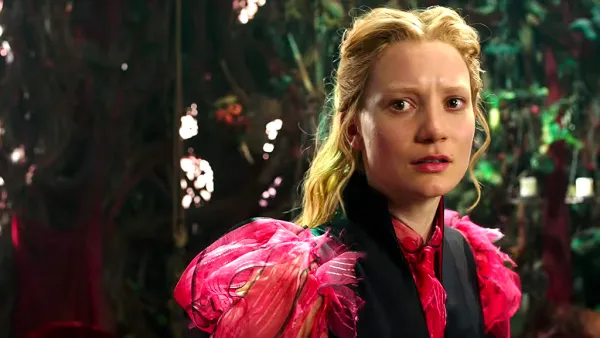
Lewis Carroll’s beloved Alice has returned in a film that offers wondrous imagery but little else.
Alice Through the Looking Glass is the sequel to 2010’s Alice in Wonderland, which already was a sequel of sorts. Directed by Tim Burton, it imagined Alice as a teenage version of the young girl who once found herself in the eccentric world of the Mad Hatter and the Cheshire Cat.
Though admired for its surreal photography and characters, the earlier film was criticized for its ho-hum storytelling. Nevertheless, it was a huge hit, setting the stage for the current release.
Whether or not Looking Glass is equally successful at the box office, it’s sure to draw even more brickbats. Director James Bobin fills the screen with images as odd as anything Burton could have concocted, but the storytelling is blandly uninvolving.

From its opening words of dedication, Janet Phelan’s EXILE hooks the reader with her intuitive grasp of the work’s place in history as she warns those of us awake enough to question the American Dream:
“To the ones who came before, in gratitude And to the ones who will come after, so that you may know the magnitude.”
From this point on Phelan takes the reader on a terrifying early millennium roller-coaster ride through a series of bizarre, seemingly coordinated attacks in some five countries - a ride she barely manages to survive.
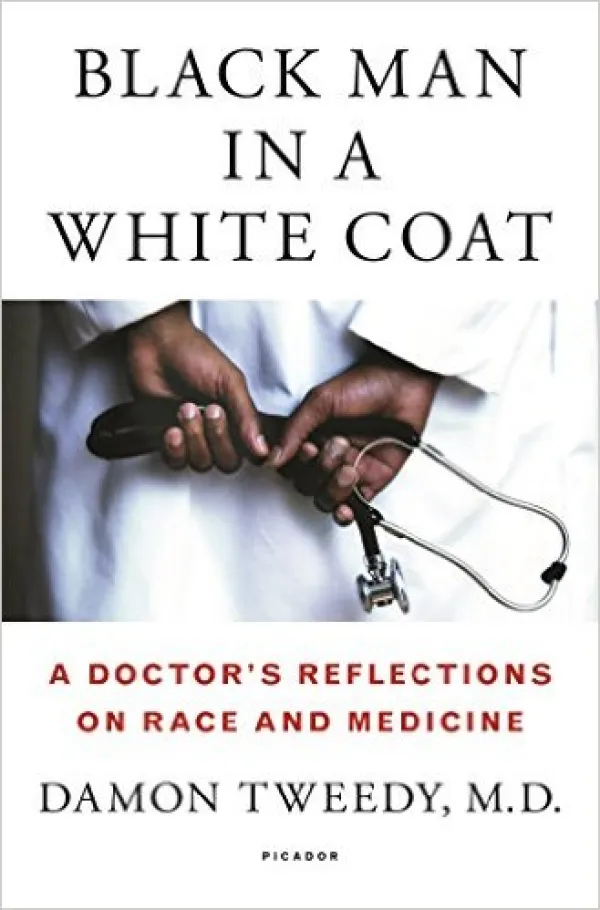
In so many ways, Dr. Damon Tweedy was fortunate. He grew up in an intact home with loving, strict, and steeped-in-the-church parents who were gainfully employed and taught him to aim high. Tweedy’s parents did not even finish high school. His father worked all his life as a butcher in a grocery store; Tweedy’s mother spent forty years working for the federal government. Tweedy also had a great example in his older brother who graduated from college. He had done well in high school and college, but he arrived at Duke University School of Medicine full of apprehension and doubt. Could he cut it? He was from a working class family, attended a middling, state-supported public university, and would be one of a few black scholarship students, recruited in part to diversify the student body, in his classes. His classmates would primarily be middle- and upper-class white students who had attended prominent universities and could afford to be at Duke. Tweedy studied his tail off that first half of the semester. When he received his midterm grades, he was in the top half of all of his classes, and his doubts began to recede.
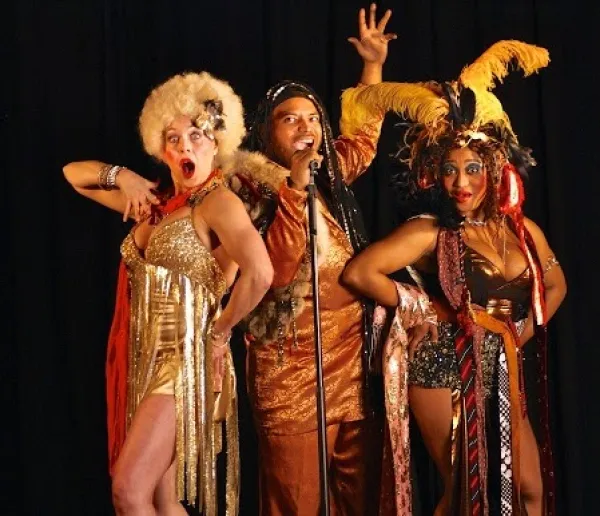
Shadowbox Live has staged several music retrospectives that were both entertaining and enlightening. The result is that troupe patrons have a leg up anytime the conversation turns to Joe Cocker, Pink Floyd or even the Beatles.
With its current musical revue, Front Street Funk, the emphasis is more on “entertaining” than on “enlightening.” I can’t say I walked away with much new insight into the genre that gave “Papa” a “Brand New Bag.”
Then again, that could be partly my fault. Maybe I missed some of the information the show doled out between tunes because I was so busy tapping my foot, watching fellow patrons dance and, at one point, actually dancing myself.
Yes, you heard that right: Audience members were dancing. One thing that distinguishes this show from its predecessors is that Shadowbox sets aside floor space for patrons who can’t resist the call of the syncopated beats, wah-wah guitars and joyous horns.
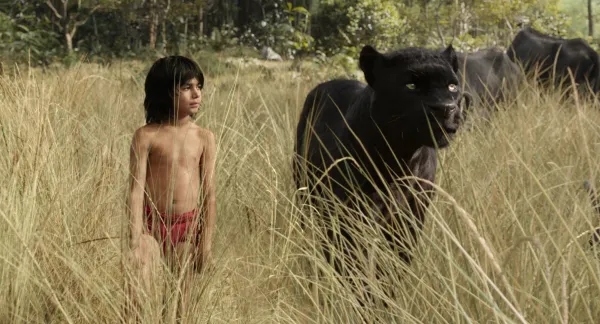
Orphan struggles to survive in mesmerizing ‘Jungle Book’
The best movie I’ve seen so far this year is about a boy who was raised by wolves. It may also be the most harrowing movie of the year to date.
Disney’s The Jungle Book tells the story of Mowgli (Neel Sethi), who lives with the wolf pack that took him in as an infant. Though he clearly doesn’t fit in with the other “cubs,” he’s loved and protected by adopted mother Raksha (Lupita Nyong’o) and the rest of the clan. He’s also watched over by Bagheera (Ben Kingsley), the stern panther who brought the orphaned child to the wolves in the first place.
Mowgli’s odd but comfortable existence is upset during a dry spell that brings the human-hating tiger Shere Khan (Idris Elba) to the local watering hole. Honoring the truce that’s enforced when the water level is low, Shere Khan spares the boy’s life but claims the right to kill him at a later date—or to take revenge on the rest of the wolf pack if he’s denied this privilege.

What would turn a happy, fun-loving dad into an eternal grouch? As far as filmmaker Jen Sanko is concerned, the culprit is Rush Limbaugh.
Sanko makes her case against Limbaugh and other purveyors of right-wing rage in The Brainwashing of My Dad, one of 16 films featured in the Gateway Film Center’s upcoming Documentary Week. (See schedule below.)
As demonstrated by the family’s home movies, Sanko’s father, Frank, was a joy to be around when she was growing up. In his later years, however, he discovered Limbaugh and became a perpetually pissed-off “dittohead.”
Frank even moved out of his wife’s bedroom so he could listen to the commentator’s rants well into the night. Eventually, he added Fox News and various websites to his daily diet of conservative vitriol.
Deciding a film was the best way to investigate her father’s metamorphosis, Sanko started a Kickstarter campaign to raise the necessary funds. The response surprised her. Along with money, strangers offered stories of their own family members who had been changed by right-wing media.
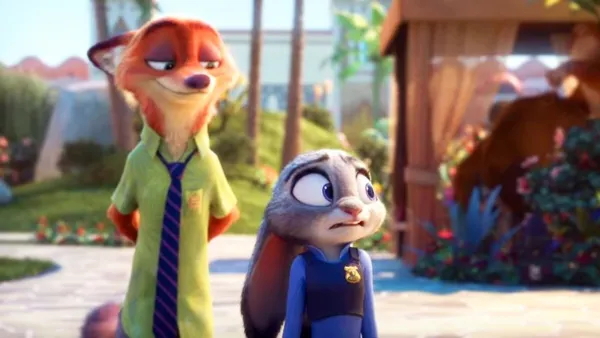
Two wildly imaginative worlds open up on area movie screens this week. Both mix gorgeous animated photography with important life lessons for kids old enough to appreciate them.
The more mainstream offering is Disney’sZootopia, the story of a plucky rabbit who’s determined to become the first member of her species to pin on a badge.
Judy Hopps (voiced by Ginnifer Goodwin) grows up in an anthropomorphic world where all animals—predators and prey alike—have learned to live in peace with each other. Even so, not all of the old differences have been forgotten. When Judy prepares to leave her hometown to join the Zootopia Police Academy, her parents warn her to watch out for big-city foxes.
Wouldn’t you know it, her first day on the job brings her into contact with Nick Wilde (Jason Bateman), a sly fox who makes his living with schemes that fall just short of illegality.
Frustrated that her chief (Idris Elba) has assigned her to the parking patrol, Judy is determined to prove she’s capable of real police work. But her efforts backfire when she gets involved in a chase that nearly demolishes a neighborhood inhabited by tiny rodents.
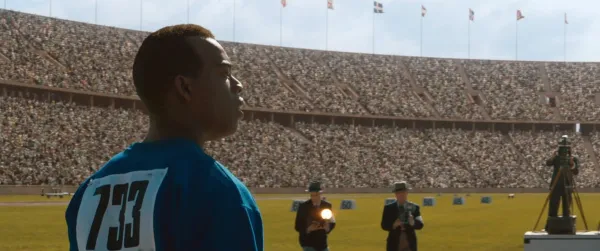
Speaking to a reporter before a screening of Race at OSU’s Mershon Auditorium, one of Jesse Owens’s daughters said several changes were made to the script for the sake of historical accuracy.
That’s nice to hear. The tale of Owens’s participation in the 1936 Olympics in Berlin is intrinsically so dramatic and inspiring that it would be a shame to sully it with blatant inaccuracies.
As you probably know, Owens was the African-American track and field star who symbolically thumbed his nose at Hitler’s theory of Aryan superiority at the pre-World War II Olympics. For Central Ohioans, he also was a hometown hero. After racking up an impressive record as a high school athlete in Cleveland, he came to Ohio State and fell under the tutelage of track coach Larry Snyder.
This is where director Stephen Hopkins’s film takes up the story. Snyder (Jason Sudeikis) calls Owens (Stephen James) into his office and demands to know whether he’s ready to work hard. He also begins plying him with the notion that track records are made to be broken, but medals are forever. In no time, it seems, the two are setting their sights on the 1936 Olympics.