
News
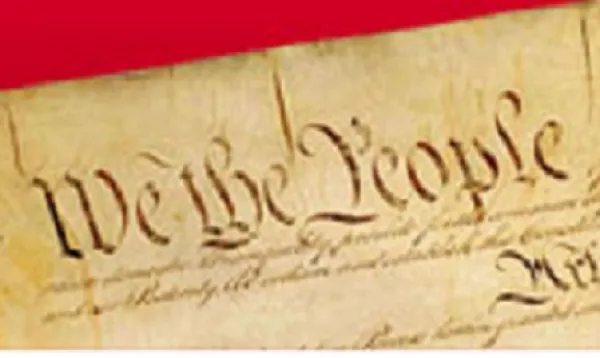
Two lawmakers in the Ohio House of Representatives have introduced a non-partisan resolution calling on state and federal legislators to support an amendment to the U. S. Constitution “that would abolish corporate personhood and the doctrine of money as speech.”
State Reps. Kent Smith (D8 Euclid) and Nickie Antonio (D13 Lakewood) today announced the introduction of House Companion Legislation to Senate Resolution 187.
House Companion Legislation corresponds to Ohio Senate Resolution 187 introduced in 2015 by Senator Mike Skindell (DLakewood). Both resolutions follow the spirit and the letter of the 28th amendment to the U.S. Constitution advocated by Move to Amend (MTA), a national nonpartisan coalition of hundreds of organizations and hundreds of thousands of individuals.
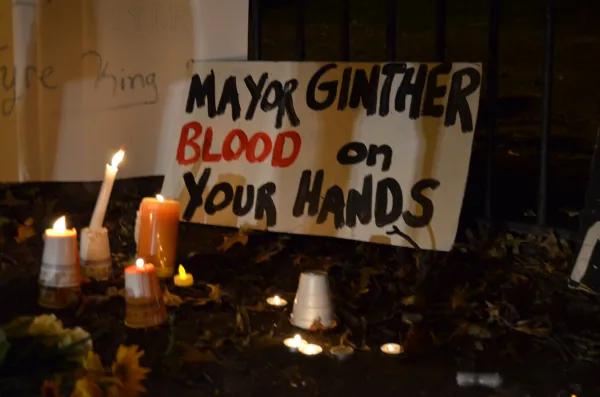
Students and community people gathered on OSU's south Oval at 5pm today to mourn the death of Tyre King, shot to death by Columbus police last night, September 14. Police stated that the 13-year-old had a BB gun. NBC 4 news reported that Bryan Mason, the officer who shot King, had been involved in another fatal shooting in 2012. News reports throughout the last 24 hours have offered differing facts regarding the shooting. Activists were skeptical of the information about the incident given at the Columbus Mayor's press conference and that there would be any repercussions for the officer's actions. Signs at a memorial at the site of the incident clearly indicate the community's distrust in the city of Columbus and Columbus police and or that anyone will be held accountable.

Finally, the major for-profit media is approaching consensus that it’s easy to hack U.S. political elections. Even candidates Hillary Clinton and Donald Trump are raising unprecedented doubts – from very different directions – about the reliability of the upcoming vote count.
Ultimately, there is just one solution: universal hand-counted paper ballots, with carefully protected voter registration rolls, and a transparent chain of custody.
The corporate media and the Democrats are obsessed with the “Russians.” Donald Trump rants about a mythological army of voters voting multiple times.
But the real threat to our election system comes from private for-profit corporations that register voters, control voter databases, then count and report the vote with secret proprietary software and zero transparency, accountability, or recourse.

If you’re an Ohio medical marijuana aficionado, you know about HB 523. After 20 years of intransigence, the Ohio General Assembly has passed its first pro-cannabis bill.
Lawmakers fast tracked HB 523 after the humiliating November 2015 defeat of the Responsible Ohio ballot issue and to preempt its successor, Ohioans for Medical Marijuana sponsored by the Marijuana Policy Project. The bill evolved from a series of town hall meetings and task force hearings to introduction as House Bill number 523 in April 2016. Testimony was heard before committees of both the Ohio House and Ohio Senate, with House passage in early May and Senate passage two weeks later. Ohio Governor John Kasich penned his name on June 8, 2016. The“Marijuana-authorize use for medical purposes-controls” Act goes into effect on September 8, 2016.
This Act has its good and bad, as well as its devilish unknowns:
The Good
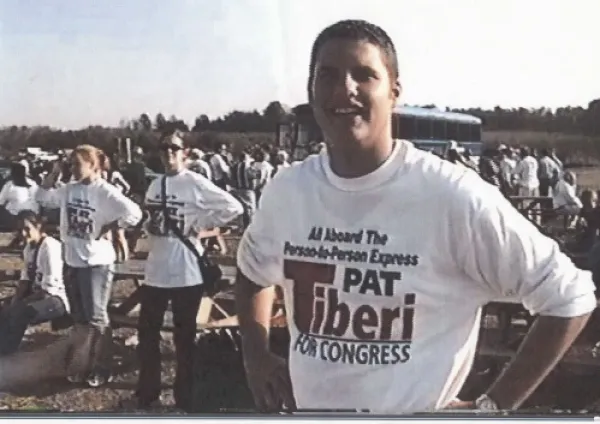
Who is Zach Klein and where did he come from?
On the heels of Represent Columbus’ Issue One, which was perhaps the most partisan political event in memory, the all-Democratic City Council launched a divisive propaganda campaign falsely claiming the issue was a Republican plan. City Council member Mike Stinziano initiated an attack against Represent Columbus co-chair Whitney Smith at a council meeting, pointing out that she is a Republican.
Issue One, the initiative attempting to expand and reform Columbus City Council that was defeated at the August 2ndspecial election, actually had support from the Green, Libertarian, Socialist parties as well as many disgruntled Democrats
The one-party Columbus City Council and its One Columbus PAC, led by Mayor Andrew Ginther’s aide Bryan Clarke, attacked Issue One as being a “Republican power grab” led by “the Party of Trump” associated with the “Koch brothers.”

The recent killing of Henry Green has spawned protests and a deeper look into the practices and tactics of the Columbus Police. Witnesses stated that there appeared to be no reason for the two officers to shoot Green, who had no criminal record. Police claimed Green brandished a gun. The Franklin County Coroner said Green was shot seven times.
The question of whether the Columbus Police Department disproportionately targets Blacks for violence is best answered with direct evidence, including statistics. A new “police accountability tool” created by the website Mappingpoliceviolence.org is useful in this debate.
Mappingpoliceviolence has studied police violence throughout the nation from January 2013 to June 2016. The group’s focus is on the police forces in the 100 largest cities in the country, where 28 percent of all people are killed by police. The Black population of these major cities is 21 percent but Blacks comprise 39 percent of all people killed by police.

One thing is clear about the Smart City grant. Columbus and its sprawl is about to become a petri dish to “creatively reengineer our urban transportation networks” so to avoid global warming and connect the underserved to good jobs. This is the altruistic vision some national pundits have consecrated Columbus with.
The grant is heady stuff for “Test City USA.” A $150 million public and private work-in-progress to test sci-fi transportation technology such as driver-less cars. A plan to build neighborhood hubs with electronic vehicle charging stations that will also have bikeshare and carshare services.
The US Department of Transportation and host of corporate partners – including Microsoft co-founder Paul Allen’s Vulcan Inc., which chipped in $10 million – chose Columbus over 78 other cities, such as Austin, San Francisco, Portland and Denver.
And while our traffic congestion and its pollution doesn’t compare to Denver’s problems, Central Ohio needs to reengineer its transportation and do it in a hurry. For the last several years anyone who commutes into Columbus has painfully dealt with ongoing major road construction to end the outerbelt’s bottlenecks.

They called her the luckiest dog in the world, or so read the ad for an adorable puppy who had just been rescued from a kill shelter in Athens County and was now residing at a shelter in Columbus. We visited her on New Year’s Day 2010. My husband knew if he put her in my arms, I’d be hooked, and I was. We took her home and named her Rosie for the Buckeye’s glorious Rose Bowl victory that same day.
Rosie grew into a spotted black and white mutt about the size of a border collie. She was an athletic Frisbee dog: no toss too long, too crooked or too high. Like all dogs, she chased squirrels and barked at mailmen. She ran through the woods scaring up birds and sniffed deeply in the grass for scents only a dog could know. She led the proverbial dog’s life.

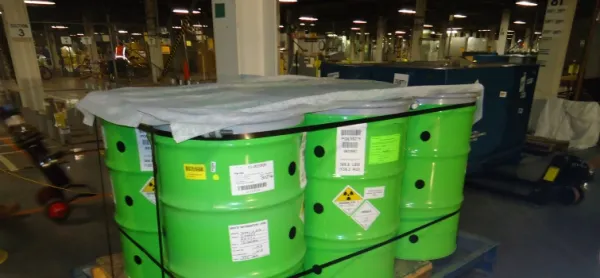
Radioactivity is on the loose at nuclear sites in Southern Ohio and Kentucky. Two plants that are supposed to process rusting cylinders containing radioactive and chemically dangerous substances are not operating. These facilities need to be restarted without delay.
The Nuclear Free Committee of the Ohio Sierra Club has written to legislators in Ohio, Kentucky and Illinois and to others, sharing our concerns about the stoppage of work at the Babcock & Wilcox Conversion Services at the Portsmouth, Ohio and Paducah, Kentucky Nuclear Sites. The Portsmouth site is just outside the town of Piketon in Southern Ohio.