
News
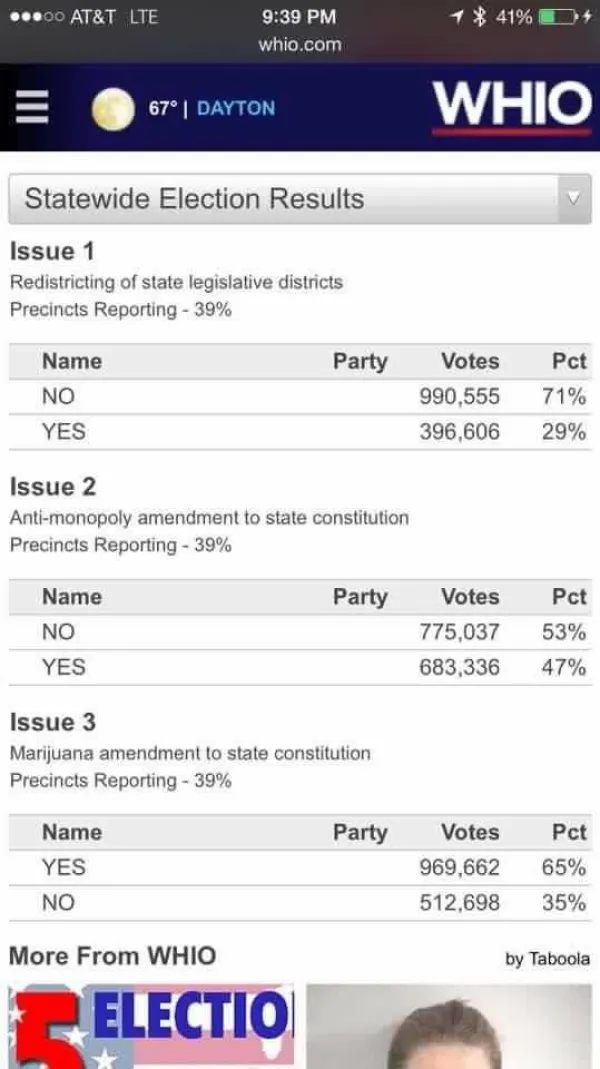
According to the Ohio Secretary of State, the people of Ohio defeated a November 3 proposition to legalize marijuana by a tally of nearly 2:1.
The official vote count is not plausible.
The assertion that the election was probably stolen fits a well-established Ohio pattern of official manipulation of electronic poll books and voting machines.
Issue 3’s promoters should demand a recount, though the system is rigged and they would certainly be stonewalled. As in 2004, critical election records are likely to not materialize even though they are legally required to be maintained.
Given evidence at very least from Cincinnati, Dayton and at least three pre-election statewide polls, the margin of defeat approaches the range of virtual statistical impossibility.
The controversial measure would have established an oligarchy of ten licensed growers operating regulated indoor grow sites of up to 300,000 square feet each. The pro-marijuana activist community was divided on the measure (disclosure: Bob voted against it, Harvey voted for it).
Here are some basic facts:

Official vote counts in Ohio indicate a major defeat for the nation’s first corporate-sponsored marijuana legalization referendum.
The Drug War has been a forty-year lynching….
…the corporate/GOP response to the peace and civil rights movements.
It’s used the Drug Enforcement Administration and other policing operations as a high-tech Ku Klux Klan, meant to gut America’s communities of youth and color.
It has never been about suppressing drugs. Quite the opposite.
And now that it may be winding down, the focus on suppressing minority votes will shift even stronger to electronic election theft.
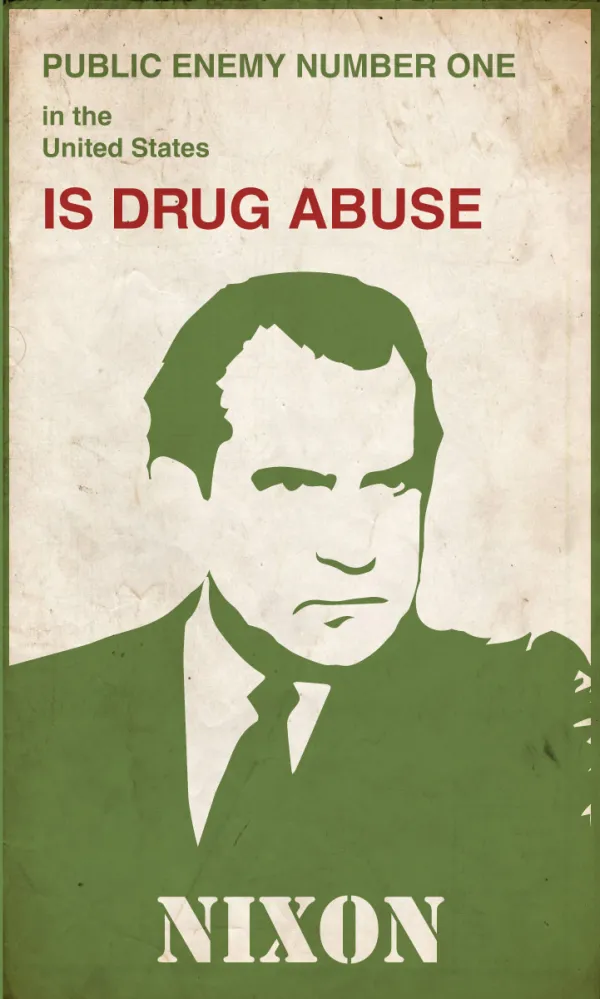
The Drug War was officially born June 17, 1971, (http://www.drugpolicy.org/new-solutions-drug-policy/brief-history-drug-war) when Richard Nixon pronounced drugs to be “Public Enemy Number One.” In a nation wracked by poverty, racial tension, injustice, civil strife, ecological disaster, corporate domination, a hated Vietnam War and much more, drugs seemed an odd choice.
In fact, the Drug War’s primary target was black and young voters.
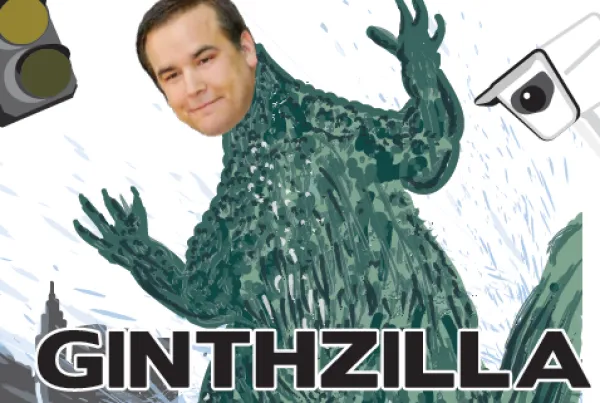
Last month, The Free Press reported on how the Ginther Express was losing its steam. As events have unfolded, the Ginther train has left the tracks and is doing nothing but damage to those around it. The first casualty is former Mayoral candidate James Ragland, who announced he would be supporting Andrew Ginther, the candidate he had criticized so harshly in the primary. Ragland went from saying “if you can look outside your front window and things are getting better then perhaps Andy is right” and calling for Ginther’s apology for the school data scrubbing scandal, to saying “it has become clear to me that in spite of our many differences, Andy understands my views on these issues, accepts them, and has asked for my help in bringing solutions to the table to solve them…”
Ragland’s about face caused immediate damage to the reputation he had been cultivating, and he received heavy criticism from friends, former supporters and advisors for this reversal. Most people commenting believe he hurt himself, more than helped Ginther.
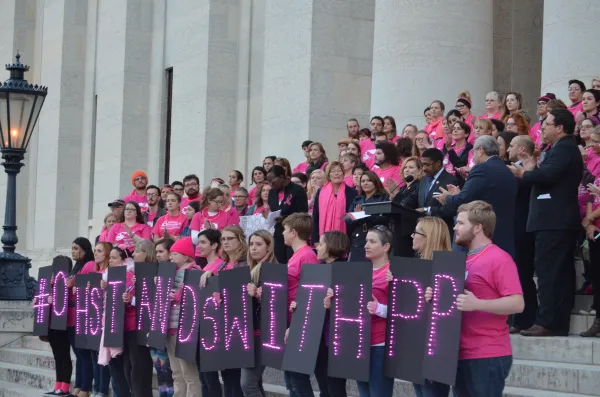
The young woman hands me a hot pink tee shirt and a clipboard. “Please sign your support for funding Planned Parenthood.” She smiles broadly and continues, “I’m testifying tomorrow!” Chelsea Golferman was referring to the Ohio House of Representatives hearings which began Tuesday, October 20 for House Bill 294 to defund Planned Parenthood. In spite of the House panel limiting individual testimony to 90 seconds, women are signing up to testify that Wednesday.
“I first went to Planned Parenthood because I couldn’t afford to go to a private practice,” Golferman says. “I kept going because I got good health care. And I’ve never had an abortion.” You hear that a lot from women and families who use Planned Parenthood as a healthcare resource.
Demonstrators gathered on the steps of the Ohio Statehouse on that warm autumn evening to make clear the importance of Planned Parenthood in Ohio. It was a good turnout; several hundred people, young, old, women and men, mostly white that evening though Planned Parenthood is a mainstay for diverse and ethnic communities.

New map shows most states would be corridors for high-risk, high-level radioactive waste shipments
Expert Tele-Briefing 2 pm (Eastern), Tues., Oct. 27 (See end of press release for call-in details)
Washington, D.C. – Thousands to tens of thousands of high-level radioactive waste shipments would cross through 45 states and the District of Columbia, if plans for the country’s first nuclear waste repository at Yucca Mountain in Nevada move forward. Today, Beyond Nuclear, in coalition with NIRS and dozens of grassroots groups nationwide, released maps of the likely routes radioactive waste shipments would use. The groups want residents in these corridor communities across the country to weigh in with Congress about the dangers.
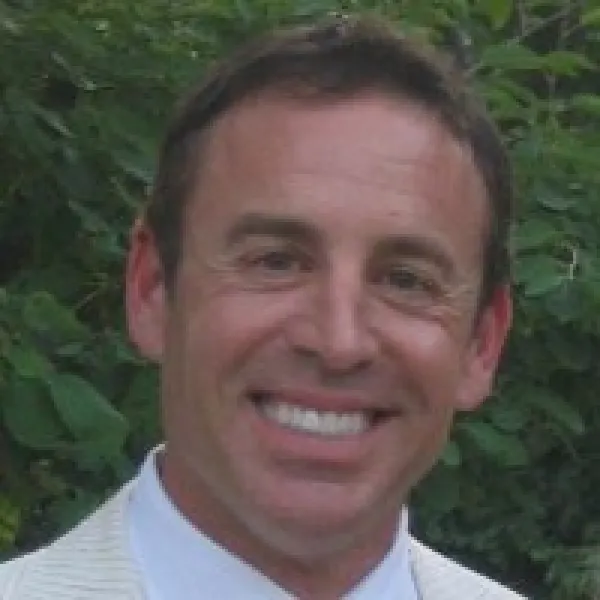
Just who in the heck is Rick Kirk?
If Issue 3 indeed becomes law, and you reside in Franklin County and a marijuana user, Kirk is going to be growing your legal green, selling you your legal green, and taking your monetary green.
Kirk is one of the 20 primary investors aligned with ResponsibleOhio, the “AstroTurf” effort behind Issue 3. The Columbus-based strategy group has said it will spend at least $20 million to get the investor-backed constitutional amendment passed.
After getting injured while trying to make the Dallas Cowboys, Kirk embarked on a career in construction and eventually founded Hallmark Campus Communities, now headquartered in the Empire Building at 150 E. Broad Street. He’s the company’s CEO and also ResponsibleOhio’s lead investor for the Franklin County potentially massive indoor grow site planned for Grove City on Seeds Road (of all places), and just off I-71.
According to the U.S. Securities and Exchange Commission, Kirk initially paid $4 million to become Franklin County’s future marijuana Kingpin. A pittance compared to what his investment could eventually return.
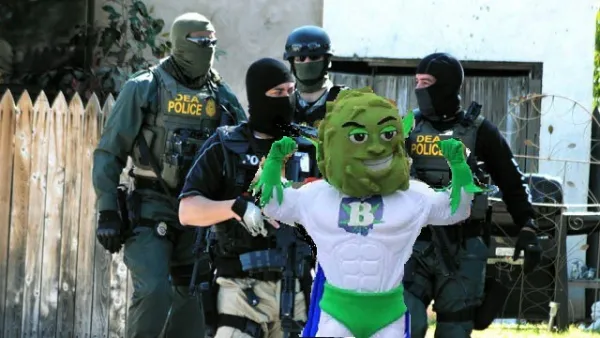
As the day of days nears for Ohio medicinal and recreational users of marijuana, questions and rumors about how exactly Issue 3 could affect their lifestyle are circling like clouds after a bong session.
Of course Issue 3 has to pass first, yet the fact Ohio marijuana users finally have a chance to vote for legalization is historical (at least for them).
And victory is possible as a Quinnipiac poll released October 8th shows 90 percent of Ohio voters support legalization for medicinal use and 53 percent support recreational use. But if it does pass, its fate is still in doubt as Issue 2, a constitutional amendment put forth by the Ohio legislature, could invalidate economic monopolies and was initiated in direct response to Issue 3.
A Kent State University poll released October 15th shows Issue 2 supported by 54 percent with 26 percent undecided, however.
Nevertheless, tried-and-true Ohio marijuana activists who for three decades have fought for legalization are concerned what the future will truly be if the Issue 3 passes and Issue 2 does not.
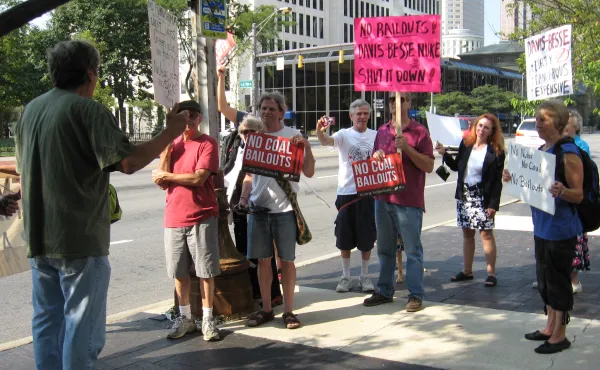
On August 31, the Public Utilities Commission of Ohio (PUCO) began conducting evidentiary hearings on FirstEnergy’s request for a bailout for their Davis-Besse nuclear power reactor and three Ohio coal plants.
Over 20 protesters were outside, on Broad Street in downtown Columbus, to greet them. This is the third rally that protesters have held at the PUCO, telling them to SAY NO! to nuclear and coal bailouts.
The Ohio Consumers Counsel has estimated that ratepayers will pay an extra $3 billion in electric charges if PUCO grants this request. That’s one big bailout! FirstEnergy claims that this request will save ratepayers $2 billion. Are we supposed to believe that they are requesting a change that would cause them to lose $2 billion in customer payments?