
Duty to Warn

He sat with them for an hour in prayer. Then he pulled his gun out and started shooting.
And today our national numbness is wrapped in a Confederate flag. The young man who killed nine members of Charleston’s Emanuel African Methodist Episcopal Church on Wednesday night was an old-school racist. “I have to do it,” Dylann Storm Roof is said to have explained. “You rape our women and you’re taking over our country. And you have to go.”
Roof’s roommate told ABC News the next day that he was “big into segregation and other stuff” and “he wanted to start a civil war.” And this is America, where we have the freedom to manifest our lethal fantasies.
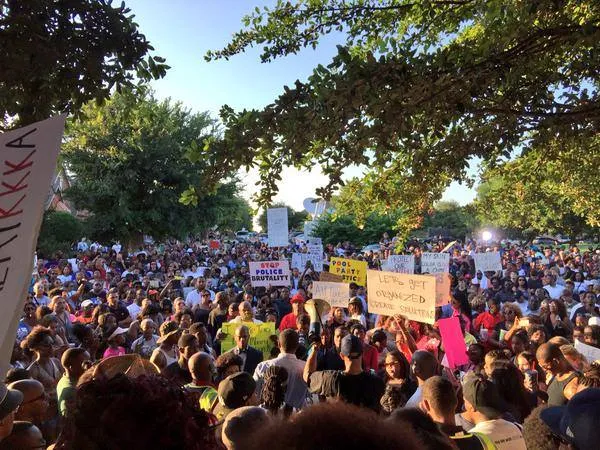
“He came into the call out of control, and as the video shows, was out of control during the incident.”
And cellphone videos continue to unravel America’s “law and order” paradigm. You might almost call it the cellphone revolution, as random video clips keep exposing a dark side of our social order that used to be so easy to deny. YouTube has become the gateway to our collective conscience, such as it is.

The abortion debates is the last place I would have looked for inspiration in methods of handling the major political and social problems of the world. Politically I've always thought of abortion -- the topic of abortion, that is -- as part of a fraud. A so-called democracy is limited to two political parties, both of which serve corporate monopolies, both of which invest primarily in war preparations, both of which cavalierly sacrifice the future habitability of the planet as well as the immediate survival of numerous species, both of which advance income inequality, both of which strip away our civil liberties -- and yet, the two of which are depicted as diametrically opposed, supposedly offering us a world of difference at the polling place. And how is this done? Easy, one of them is pro- and the other anti- abortion! I can't count how many people have listed everything they oppose about a presidential candidate and then begged me to vote for that same candidate in order to determine the abortion issue in the U.S. Supreme Court.
Yes, I saw the glum faces of prosecutors in the courtroom a few days ago, when the judge sentenced CIA whistleblower Jeffrey Sterling to three and a half years in prison -- far from the 19 to 24 years they’d suggested would be appropriate.
Yes, I get that there was a huge gap between the punishment the government sought and what it got -- a gap that can be understood as a rebuke to the dominant hard-line elements at the Justice Department.
And yes, it was a positive step when a May 13 editorial by the New York Times finally criticized the extreme prosecution of Jeffrey Sterling.
But let’s be clear: The only fair sentence for Sterling would have been no sentence at all. Or, at most, something like the recent gentle wrist-slap, with no time behind bars, for former CIA director David Petraeus, who was sentenced for providing highly classified information to his journalist lover.

Exclusive: Russia will celebrate the Allied victory over Nazism on Saturday without U.S. President Obama and other Western leaders present, as they demean the extraordinary sacrifice of the Russian people in winning World War II – a gesture intended to humiliate President Putin, writes ex-CIA analyst Ray McGovern.
****
President Barack Obama’s decision to join other Western leaders in snubbing Russia’s weekend celebration of the 70th anniversary of Victory in Europe looks more like pouting than statesmanship, especially in the context of the U.S. mainstream media’s recent anti-historical effort to downplay Russia’s crucial role in defeating Nazism.
Though designed to isolate Russia because it had the audacity to object to the Western-engineered coup d’état in Ukraine on Feb. 22, 2014, this snub of Russia’s President Vladimir Putin – like the economic sanctions against Russia – is likely to backfire on the U.S. and its European allies by strengthening ties between Russia and the emerging Asian giants of China and India.

Seven prominent national security whistleblowers Monday called for a number of wide-ranging reforms — including passage of the “Surveillance State Repeal Act,” which would repeal the USA Patriot Act — in an effort to restore the Constitutionally guaranteed 4th Amendment right to be free from government spying.
Several of the whistleblowers also said that the recent lenient sentence of probation and a fine for General David Petraeus — for his providing of classified information to his mistress Paula Broadwell — underscores the double standard of justice at work in the area of classified information handling.
Speakers said Petraeus’s favorable treatment should become the standard applied to defendants who are actual national security whistleblowers, such as Chelsea Manning, Edward Snowden and Jeffrey Sterling (who has denied guilt but who nevertheless faces sentencing May 11 for an Espionage Act conviction for allegedly providing classified information to New York Times reporter James Risen).

Madison's Music: On Reading the First Amendment, a new book by Burt Neuborne, at first appears an unlikely work to serve much purpose today. Who wants to celebrate slave owner James Madison's view of freedom as embodied in a long outdated Constitution in desperate need of updating or rewriting? And who wants to hear it from a former legal director of the ACLU who just signed a petition supporting the hiring of Harold Koh, defender of drone murders and presidential wars of aggression, to teach human rights law at New York University, a petition by a bunch of stuffy corrupted professors countering the moral stand being taken by students?
“Sir, you are an idiot.”
Wow, an insult wrapped in such old-fashioned politeness. I let the words hover and reach, as I always do, for peace: that is to say, for clarity, connection, common humanity.
Last week I raised the idea of unarmed policing, as practiced in half a dozen countries around the world. I wasn’t calling for immediate gun surrender but, rather, the diversion of human energy away from short-sighted, violent responses to conflict situations — at pretty much every level of society, from interpersonal to geopolitical — and to the complex, courageous, creative task of building a culture of peace.
Being called an idiot for making such a plea is to be expected, of course — it happens all the time, and I relish it because it means my words have reached people on the other side of the great political divide. That’s what building peace is all about.
The cellphone video “reality footage” just doesn’t stop. Black men are shot, killed, handcuffed. The shortcomings of their prematurely terminated lives soon become public knowledge, vaguely justifying the shocking wrongness of the officer’s action — always poisoning the grief.
The family, the loved ones, the sympathetic sector of the American (and global) public demand “justice.” Even when they get it, or sort of get it, in the form of an arrest or some official expression of regret, the victim — the human being they valued — is still dead.
Nothing changes.
At least it seems as though nothing changes, but of course change, in the form of outrage, revulsion, disbelief — and, ultimately, awareness — is stirring in the collective mind. How it will manifest in the form of specific social policy is, of course, unknown. The status quo, after all, has plenty of defenders — and they’re armed.
“I wanna be ready . . .”
And suddenly the glass case shattered. You know the one, perhaps. I’d been agitated by it for the past hour or so, sitting as I was maybe 25 rows back from the stage at Chicago’s ornate Auditorium Theater, watching the Alvin Ailey troupe dance their hearts out, moving their bodies with such lithe precision and grace.
A huge hunger, a wanting, a hope stirred in the cage inside my breast. “Appreciating” a “performance” wasn’t enough. Oh God. This great inner wanting yearned for a freedom we don’t much talk about these days, in our relative affluence and comfort, but the music and the movement of the Alvin Ailey American Dance Theater, with its roots in Africa, in Gospel revival — in growing up black in America — went so much deeper than that. I didn’t want to feel separated from the dancers, some disengaged spectator watching fine art in motion behind the glass case of culture. That felt so wrong.