
Human Rights
Wednesday, May 9th, 2012, Youngstown OH- OSP Hunger Strike Ends. After long negotiations with Warden David Bobby on Monday, May 7th, the hunger-striking prisoners at Ohio State Penitentiary (OSP) began eating again. Two of the men held out through Tuesday, unsatisfied with the agreement. The warden met with them separately, and they agreed to come off the strike. Warden Bobby reported that "by lunch time today, everyone was eating." This was confirmed by two prisoner sources.
At this point, details on agreements are unclear, but sources inside say that the hunger strikers are satisfied and feel they achieved results. One source described the demands and the Warden's response as "reasonable". Without going into detail, the main concerns were in regards to commissary costs, state pay rates, phone costs, length of stay, and harsh penalties for petty conduct reports. The Warden said that he discussed "many things" at Monday's meeting with strike representatives, "many things beyond the main demands" but he would not share any of the details.
At this point, details on agreements are unclear, but sources inside say that the hunger strikers are satisfied and feel they achieved results. One source described the demands and the Warden's response as "reasonable". Without going into detail, the main concerns were in regards to commissary costs, state pay rates, phone costs, length of stay, and harsh penalties for petty conduct reports. The Warden said that he discussed "many things" at Monday's meeting with strike representatives, "many things beyond the main demands" but he would not share any of the details.
Youngstown OH- Prisoners at Ohio State Penitentiary (OSP) continue the hunger strike they started on Monday April 30th, in solidarity with May Day.
The number of prisoners refusing food has fluctuated from 24 to 48 over the last week, as some prisoners joined late. Communication with the super max prisoners has been limited since the beginning of the strike, but a clear list of grievances and demands has emerged from at least two sources.
The two primary demands are:
1. Improved commissary practices and increased state pay. The prison commissary can set prices at up to 35% mark-up on basic necessities like shampoo, food, and soap. These prices fluctuate unexpectedly, and are often prohibitive to prisoners without outside support, as state pay is only $9 a month.
The number of prisoners refusing food has fluctuated from 24 to 48 over the last week, as some prisoners joined late. Communication with the super max prisoners has been limited since the beginning of the strike, but a clear list of grievances and demands has emerged from at least two sources.
The two primary demands are:
1. Improved commissary practices and increased state pay. The prison commissary can set prices at up to 35% mark-up on basic necessities like shampoo, food, and soap. These prices fluctuate unexpectedly, and are often prohibitive to prisoners without outside support, as state pay is only $9 a month.
Cece McDonald is a 23 year old black trans woman who was out with friends one summer night in 2011 in Minneapolis, MN. As they passed in front of a bar, they were attacked by white people who were obviously racist and transphobic, based on a swastika tattoo and language used that night. The fight left Cece severely wounded by a glass to her face and one of the attackers dead.
The fight began when the white supremacists began yelling racial and transphobic slurs at the friends at about 12:20am. The attack became physical when one of the white supremacists put a gash in Cece’s face with a glass, damaging Cece’s saliva gland. It is believed by prosecutors that Cece then fatally stabbed one of her attackers.
Cece was charged with two counts of 2nd degree murder. Upon her arrest, Cece was denied adequate medical treatment for her wound, interrogated for hours, and put in solitary confinement. The woman who assaulted Cece was not arrested or charged.
The fight began when the white supremacists began yelling racial and transphobic slurs at the friends at about 12:20am. The attack became physical when one of the white supremacists put a gash in Cece’s face with a glass, damaging Cece’s saliva gland. It is believed by prosecutors that Cece then fatally stabbed one of her attackers.
Cece was charged with two counts of 2nd degree murder. Upon her arrest, Cece was denied adequate medical treatment for her wound, interrogated for hours, and put in solitary confinement. The woman who assaulted Cece was not arrested or charged.
Recent events in northern Ohio underscore the new COINTELPRO assault on activism. On Tuesday, May 1, federal authorities arrested five "anarchists" charging them with conspiracy in trying to bomb property used in interstate commerce, according to the Associated Press (AP). The target of this alleged plot was a bridge running through the Cuyahoga Valley National Park, 15 miles south of downtown Cleveland.
Media immediately identified the men as linked to the nonviolent anti-corporate Occupy Cleveland movement. The next day, Cleveland Mayor Frank Jackson refused to renew the permits for Occupy Cleveland's downtown encampment site. The American Civil Liberties Union (ACLU) of Ohio questioned why the Mayor would revoke the permit the day after the arrests. "Individuals are responsible for their own actions, not the groups they affiliate with," said James Hardiman, ACLU's Ohio Legal Director.
Media immediately identified the men as linked to the nonviolent anti-corporate Occupy Cleveland movement. The next day, Cleveland Mayor Frank Jackson refused to renew the permits for Occupy Cleveland's downtown encampment site. The American Civil Liberties Union (ACLU) of Ohio questioned why the Mayor would revoke the permit the day after the arrests. "Individuals are responsible for their own actions, not the groups they affiliate with," said James Hardiman, ACLU's Ohio Legal Director.
On Monday, April 30, at least twenty five prisoners at Ohio State Penitentiary (OSP) began a hunger strike. They are demanding that the Warden meet and negotiate with them for improved conditions in Ohio's super-max prison. These hunger strikers say they intend to continue to refuse food until their demands are met. Another, larger group of prisoners will show symbolic solidarity with the hunger strikers, and workers outside of prison by also refusing food on a one-day fast tomorrow, for May Day, the international day of worker solidarity and resistance.
Information about the hunger strike is limited at this time, because super-max prisoners have very constrained access to communication with the outside world. The hunger strikers are asking supporters of their cause to participate by calling Warden David Bobby (330 743-0700) and ODRC director Gary Mohr (614-752-1164). The hunger strikers are asking people to encourage Warden Bobby to meet with the prisoners and take their demands seriously.
Information about the hunger strike is limited at this time, because super-max prisoners have very constrained access to communication with the outside world. The hunger strikers are asking supporters of their cause to participate by calling Warden David Bobby (330 743-0700) and ODRC director Gary Mohr (614-752-1164). The hunger strikers are asking people to encourage Warden Bobby to meet with the prisoners and take their demands seriously.
As the World Bank promoted its Seven Principles of Responsible Agricultural Investment (RAI) at its annual conference in Washington D.C. from April 23-26, food sovereignty activists with Via Campesina, National Family Farm Coalition, and other groups called attention to the bank’s role in land grabs.
On April 24, protesters with Occupy Wall Street joined New York’s Ethiopian community and others to target a major farmland investment conference the bank had at the Waldorf Astoria. Bank officials met with large money managers like the Canadian Pension Fund, TIAA-CREF and PensionDanmark [sic].
The World Bank’s policies for land privatization and concentration have paved the way for corporations from Wall Street to Singapore to take upwards of 80 million hectares of land from rural communities across the world in the past few years, according to a press release from National Family Farm Coalition.
On April 24, protesters with Occupy Wall Street joined New York’s Ethiopian community and others to target a major farmland investment conference the bank had at the Waldorf Astoria. Bank officials met with large money managers like the Canadian Pension Fund, TIAA-CREF and PensionDanmark [sic].
The World Bank’s policies for land privatization and concentration have paved the way for corporations from Wall Street to Singapore to take upwards of 80 million hectares of land from rural communities across the world in the past few years, according to a press release from National Family Farm Coalition.
I am a psychologist in Toledo, Ohio, and one of the people who was involved in 2009-2010 regarding filing an ethics complaint against Dr. Larry James, Dean of the School of Professional Psychology at Wright State University. The complaint was based on information regarding Dr. James’s role as Chief Psychologist at Guantanamo in early 2003, when some of the worst abuses were occurring.
The Ohio Board of Psychology rejected our 50-page complaint with one sentence: “It has been determined that we are unable to proceed to formal action in this matter.” We then filed suit in Franklin County Common Pleas Court on April 13, 2011, in an attempt to force the Board to investigate. The judge has yet to rule on any motions in the case.
I’m taking this opportunity to bring you up to date as I am again asking for your help. A group of psychologists from around the country, the Coalition for an Ethical Psychology, are continuing to attempt to hold the American Psychological Association (APA) responsible for the official document that APA produced which condoned the role of psychologists in national security interrogations.
The Ohio Board of Psychology rejected our 50-page complaint with one sentence: “It has been determined that we are unable to proceed to formal action in this matter.” We then filed suit in Franklin County Common Pleas Court on April 13, 2011, in an attempt to force the Board to investigate. The judge has yet to rule on any motions in the case.
I’m taking this opportunity to bring you up to date as I am again asking for your help. A group of psychologists from around the country, the Coalition for an Ethical Psychology, are continuing to attempt to hold the American Psychological Association (APA) responsible for the official document that APA produced which condoned the role of psychologists in national security interrogations.
BANGKOK, Thailand -- An outraged Muslim female photographer in Thailand says "the French government is crazy" to punish women who hide their face and body underneath a burqa in public.
Demanding "liberty" for Islamic fashionistas, Ampannee Satoh, 28, has created photographs of herself posing in front of the Eiffel Tower, the Arc de Triomphe and elsewhere in France while concealed in the enveloping cloth.
"I don't like the law in France," Ampannee said in an interview in Bangkok.
"The government rule, I don't like because I have liberty to choose a hijab or burqa or anything, because everybody has liberty," she said.
"There are those who do not understand, and who see that a burqa represents terror and lack of freedom."
She said "Muslim women are bullied" in France and their "freedom" is "stolen" by the law which went into effect on April 2011.
"The French Republic lives in a bare-headed fashion," French Prime Minister Francois Fillon declared while announcing the law.
Under the law, the public wearing of a burqa, niqab, or similar face covering is punishable by a 150-euro fine.
Demanding "liberty" for Islamic fashionistas, Ampannee Satoh, 28, has created photographs of herself posing in front of the Eiffel Tower, the Arc de Triomphe and elsewhere in France while concealed in the enveloping cloth.
"I don't like the law in France," Ampannee said in an interview in Bangkok.
"The government rule, I don't like because I have liberty to choose a hijab or burqa or anything, because everybody has liberty," she said.
"There are those who do not understand, and who see that a burqa represents terror and lack of freedom."
She said "Muslim women are bullied" in France and their "freedom" is "stolen" by the law which went into effect on April 2011.
"The French Republic lives in a bare-headed fashion," French Prime Minister Francois Fillon declared while announcing the law.
Under the law, the public wearing of a burqa, niqab, or similar face covering is punishable by a 150-euro fine.
3200 prisoners stuck in Ohio prisons with little or no hope of being released, despite being eligible for parole. These prisoners were sentenced to prison prior to the passing of Senate Bill 2 (SB2), which took effect in 1996. According to the law and the practices of the Parole Board before that time, these men and women had a reasonable hope of one day returning to society. Little did these prisoners know what was going to happen.
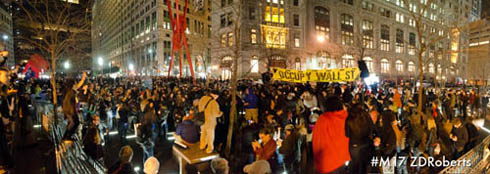
[New York Monday March 19] Our photographer ZD Roberts was beaten by New York City cops with nightsticks while covering Occupy Wall Street's attempt to re-take Zuccotti Park Saturday night.
Zach yelled several times, "I'm PRESS! PRESS!" yet was slammed on the head twice after he'd been thrown to the ground when the police shoved back the protesters. Zach, whose photos of Occupy Wall Street have been seen all over the world on the front page of The Guardian, showed his press badge, an act for which his hair was grabbed, head pulled back and slammed again with a club.
If you remember, Zach was arrested while covering the story three months ago. His trial is coming up (he refused to cop a plea).
We've covered the world … but who thought that the toughest combat assignment would be New York?
Here's Zach's story and comment in his own words and photos:
My head hurts. The NYPD did this to me.
Zach yelled several times, "I'm PRESS! PRESS!" yet was slammed on the head twice after he'd been thrown to the ground when the police shoved back the protesters. Zach, whose photos of Occupy Wall Street have been seen all over the world on the front page of The Guardian, showed his press badge, an act for which his hair was grabbed, head pulled back and slammed again with a club.
If you remember, Zach was arrested while covering the story three months ago. His trial is coming up (he refused to cop a plea).
We've covered the world … but who thought that the toughest combat assignment would be New York?
Here's Zach's story and comment in his own words and photos:
My head hurts. The NYPD did this to me.