
THE G-20 IN PITTSBURGH
by Tom Over 9-23-09
<br><br>
On Tuesday, Sept 22, activists from Philadelphia, New York City, Pittsburgh and other cities held a mock funeral procession to demand better policies for addressing the AIDS pandemic, a day ahead of the arrival of delegates for the G-20.
<br><br>
The approximately 50 participants in the New Orleans-style funeral march drew a mix of interest, irritation, and amusement from onlookers in the business district of downtown Pittsburgh.
<br><br>
At the head of the funeral march where pallbearers carried a cardboard coffin, a man shouted into a microphone while someone else carried a portable amplifier, “when people with AIDS are under attack, what do we do ?” and marchers shouted in unison, “fight back!”
<br><br>
Amidst the early afternoon bustle of an weekday, the demonstrators repeated this call-and-answer and similar chants as the funeral march made its way around the perimeter of the David L. Lawrence Convention Center, the site of the G-20 Summit later this week.
<br><br>
Erica Goldberg works with ACT UP Philadelphia. She said global health is not on the agenda of the G-20 Summit.
“One of the things that some of the G-20 nations have promised us is funding for the global fund to fight, TB, malaria, and HIV/AIDS. This is all really important, especially if we want to meet the United Nations’ Millennium goal of eradicating these diseases by 2015. As of right now, this won’t be met. We have to hold our leaders accountable. They are the ones making decisions for the poorer countries,” Goldberg said.
<br><br>
She commented on the timing of the demonstration. “We wanted this to be the first thing they (the G-20 delegates) see. They’re coming here tomorrow. We’re holding them accountable. This needs to be on the agenda.”
<br><br>
She said AIDS activists chose Sept 22, two days before the official start of the G-20 Summit, and one day before the arrival of the delegates, so as to not have to compete with other protests. Also, she said the AIDS activists figured there would be less of a chance of conflict with police if they staged their protest earlier in the week.
<br><br>
“We hope that this will hit the papers tomorrow, that it’s the first thing they see when they walk in, that they have this on their conscience and know we’re not going away,” Goldberg said. She urges people to contact legislators about supporting the Global Fund to Fight AIDS, Tuberculosis, and Malaria.
“President Obama, as much as I love him, went back on his promise to fulfill the funding,” Goldberg said.
<br><br>
She commented on how drug companies factor into all of this. “ Medication does not need to be this expensive. They can definitely lower their prices. We have big drug interests lobbying to prevent AIDS medication from getting” to developing nations.
<br><br>
Goldberg said debt cancellation for developing nations is a factor that comes into play.
“When you don’t cancel debts of nations and they have to pay back loans to the IMF and the World Bank, they won’t have the funds necessary for getting AIDS medication, or they might get the medication but can’t pay the health professional because of their debt.
<br><br>
She said vested interested motivated by huge profits stand in the way of doing a better job of addressing tuberculosis, malaria, and HIV/AIDS. “We have the power, the ability, and the medication.”
World News
BANGKOK, Thailand -- U.S.-backed Thailand and China-assisted Cambodia signed an extended 13-point peace agreement on August 7 silencing their five-day border war, but the stench from uncollected corpses and fear of their shadowy ghosts are haunting troops and residents along their disputed frontier.
"Both sides agree to a ceasefire involving all types of weapons, including attacks on civilians and civilian objects and military objectives of either side, in all cases and all areas," the document signed in Kuala Lumpur, Malaysia, stated.
"There shall be no troop movements, including patrols, towards the other side's position.
"Both sides agree not to increase forces along the entire Cambodia-Thailand border," which curves 500 miles long and has been disputed for the past 100 years because of squabbling over vague and imprecise French colonial maps.
The new ceasefire agreement also "includes military activities to enter the other side's air space and territory, or positions."

The Israeli human rights organization B'Tselem released a comprehensive report on July 27 describing the Israeli war on Gaza as genocide. However, the delay in publishing such an indictment is troubling and adds to an existing problem of politically motivated decision-making processes that have, in their own right, prolonged the ongoing Israeli war crimes.
The report accused Israel of committing genocide, a conclusion reached after a detailed analysis of the military campaign’s intent, the systematic destruction of civilian life, and the government-engineered famine. This finding is significant because it adds to the massive body of legal and testimonial evidence affirming the Palestinian position that Israel's actions in Gaza constitute a genocide.

BANGKOK, Thailand -- Cross-border rocket attacks on the morning of July 29, by U.S.-armed Thailand and China-assisted Cambodia, "violated" a ceasefire brokered by President Trump who linked it to possibly lowering his 36 percent U.S. import taxes on exports from the two Southeast Asian nations.
Thai and Cambodian army commanders however met for lunch on July 29 and appeared to put a halt to their six days of bloodiest fighting in a decade.
Thailand blamed Cambodia for violating the first day of the ceasefire on July 29 by firing their dreaded Soviet-era, truck-mounted, multi-rocket artillery which unleashed unguided warheads onto Thai soil, prompting Thailand to retaliate with higher precision artillery.
Beyond the battlefield, the fighting may be bolstering the hawkish, highly politized, Royal Thai Army's influence which appears to be gaining some domination over Bangkok's fractured elected coalition government after officials indicated the military was being allowed to unilaterally make decisions where and when to open fire.
President Trump is whining during his vacation in Scotland for not getting a thank you note after he claimed that two weeks ago the US gave $60 million worth of food to the Palestinians in Gaza, adding that he deserved to be thanked for this. Fact checks, Mr. Trump did not specify where these funds have come from or to whom they have been sent but last month. However, The Guardian revealed that the US had authorized a $30m grant to the controversial Gaza Humanitarian Foundation (GHF).
First of all, I have lived in America for nearly 50 years, and I don't recall any presidents before him, Republican or Democrat, who required a "thank you" for any aid they provided in times of need. Why should Gazans thank this crybaby for something they have not received? Unless it came out of his pocket, why should there be a thank you to him anyway? 47 is very good in spreading misinformation.
A former security contractor for Gaza's controversial new Israel- and US-backed aid distribution sites for GHF has told the BBC that he witnessed colleagues opening fire several times on hungry Palestinians who had posed no threat including with machine guns.

Israel is aggressively implementing plans to shape Palestine's future and the broader region, sculpting its vision for the 'day after' its genocide in Gaza.
The latest, bizarre iteration of this strategy proposes fragmenting the occupied West Bank into so-called 'emirates,' starting with the 'emirate of Hebron.'
This unexpected twist in Israel's protracted search for alternative Palestinian leadership first surfaced in the staunchly pro-Israeli US newspaper, the Wall Street Journal. It then quickly dominated all Israeli media.

If one thinks that arming Ukraine against Russia or having Israeli soldiers and also American contractors slaughter Gazan civilians are not supportive of any United States actual interests, last week could easily be written off as yet another descent into Hell on the part of the United States. Americans and others should have the right to criticize how the Israelis wage war without being denounced and criminalized by governments that have been corrupted from the inside, most often by money, but that is exactly what is going on in the US and in select countries in Europe. Watching children being targeted for killing and complaining about it does not make one an anti-Semite even though the Israeli government exploits that issue precisely as a tool to avoid any consequences for its horrific behavior. Here in America, it’s past time for the White House and Congress to rid themselves of their obscene and unseemly obsession with judging overseas developments using the optics of Israel loyalty tests.
BANGKOK, Thailand – Thailand's struggle with democracy resulted in three very different prime ministers in three days with Phumtham Wechayachai becoming the newest caretaker leader last week, after a court suspended former Prime Minister Paetongtarn Shinawatra for alleged "ethical misconduct."
So, who is Acting Prime Minister Phumtham ("POOM-tom")?
Mr. Phumtham, 72, is a veteran politician who was a commerce minister and caretaker prime minister in 2024 and Ms. Paetongtarn's defense minister during 2025.
Some generals in the U.S.-trained military were wary of Mr. Phumtham when Ms. Paetongtarn appointed the civilian as defense minister, because in 1976 he joined an anti-military leftist student movement and was nicknamed "Big Comrade" for voicing speeches against the return of military dictator Thanom Kittikachorn.
When the military violently crushed the university students' protests -- officially killing 46 students amid estimates of more than 100 dead -- Mr. Phumtham fled into the countryside with hundreds of others who were welcomed by Thailand's hardened China-backed communist guerrillas.

BANGKOK, Thailand -- Thailand's politically powerful Constitutional Court suspended Prime Minister Paetongtarn Shinawatra on July 1 after accepting a case of alleged "ethical misconduct" against her because she criticized a Royal Thai Army commander in her leaked phone call with Cambodia's de facto leader Hun Sen during their deadly border feud.
Ms. Paetongtarn's suspension came after the two countries briefly clashed on May 28 and Thai troops shot dead a Cambodian soldier in the Emerald Triangle where eastern Thailand, northern Cambodia, and southern Laos meet.
Ms. Paetongtarn apologized to the public and insisted she had "no ill intentions" when she clumsily tried to "negotiate" with Cambodia's battle-hardened Senate President Hun Sen .
The Constitutional Court gave her 15 days to defend herself.
Meanwhile, to run this increasingly troubled Southeast Asian nation, she appointed her Deputy Prime Minister Suriya Juangroongruangkit to become caretaker prime minister while the court decide during the next several weeks.
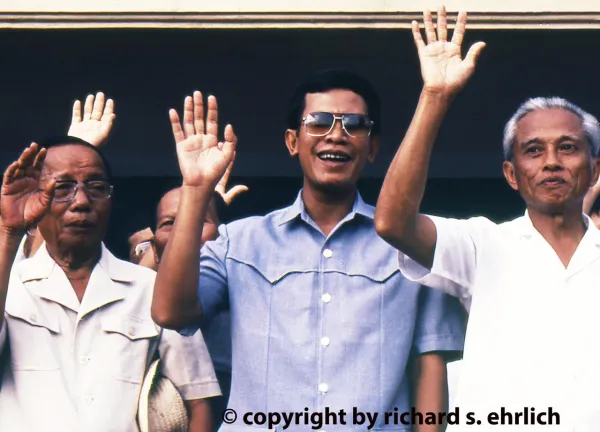
BANGKOK, Thailand -- In a spectacular and dangerous political breakup between Asia's two most powerful de facto leaders, Cambodia's Hun Sen publicly ended his "betrayed" friendship with Thailand's Thaksin Shinawatra and, in revenge over their deadly border dispute, said Mr. Thaksin allegedly duped Bangkok's judicial authorities by wearing a neck brace and arm sling as fake props to avoid prison.
Cambodian Senate President Hun Sen livestreamed his bombshell allegations which shocked Thais and sharply increased the political vulnerability of Bangkok's teetering coalition government headed by Mr. Thaksin and his daughter, Thai Prime Minister Paetongtarn Shinawatra.
"Now that I’ve been betrayed, I feel I must reveal what the Thaksin family did to betray their nation," Mr. Hun Sen said on June 27 at a local government meeting.
Directing his anger and allegations at Mr. Thaksin, Mr. Hun Sen warned: “If you act arrogantly, I will expose everything you told me.
"Discipline your children. You have a child as prime minister, and I have a child as prime minister. But don’t mistake me for someone you can cross.
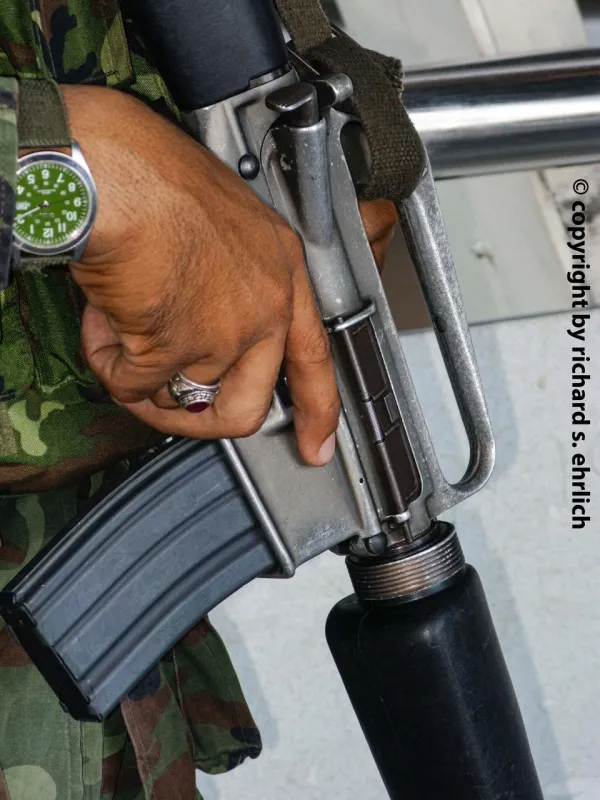
BANGKOK, Thailand -- Thailand's embarrassed and disgraced Prime Minister Paetongtarn Shinawatra resisted demands on June 25 that she resign, shrugging off warnings by politicians, analysts and the media of a possible military coup after she criticized a Royal Thai Army commander during a leaked phone call with Cambodia's de facto leader Hun Sen.
"Analysts said another coup would create more problems than it would solve. It would be a disaster for the country, which has still not fully recovered from the consequences of the previous coup in 2014," the conservative Bangkok Post warned in a June 20 editorial.
"Despite assurances from the army chief about protecting democracy, concerns are mounting over a possible military intervention," Bloomberg news reported on June 20.
Ms. Paetongtarn faces a no confidence vote in parliament on July 3, and a hearing at the Constitutional Court on July 8 inquiring into her leaked conversation with Hun Sen.
Either action could end her prime ministry.