
Global

Newly popular Democratic politician hero and nominee for a seat in the U.S. Congress Alexandria Ocasio-Cortez used to have these words on her website:
“A Peace Economy
“Since the invasion of Iraq in 2003, the United States has entangled itself in war and occupation throughout the Middle East and North Africa. As of 2018, we are currently involved in military action in Libya, Syria, Iraq, Afghanistan, Yemen, Pakistan, and Somalia. According to the Constitution, the right to declare war belongs to the Legislative body, not the President. Yet, most of these acts of aggression have never once been voted on by Congress. Alex believes that we must end the forever war by bringing our troops home and ending the air strikes and bombings that perpetuate the cycle of terrorism and occupation throughout the world.”
Now they’re gone. Asked about it on Twitter, she replied:
“Hey! Looking into this. Nothing malicious! Site is supporter-run so things happen -we’ll get to the bottom of it.”

Alexandria Ocasio-Cortez’ platform is dramatically better than many may realize. It tackles the greatest evil in existence in a way that no other big-2 congressional candidate’s website does and which most do not even mention. And in doing so, it makes serious much of the rest of her socialist platform in a way that even presidential candidate Bernie Sanders did not — a way promoted by the peace movement, the Poor People’s Campaign, and Black Lives Matter.
War and war preparations eat up 60% of the funding that Congress members decide on each year. Most candidates, including most progressives, refuse to mention that, even while (in some cases) proposing to somehow fund massive human and environmental programs. When he ran for president, Bernie Sanders was willing to accept the endlessly repeated label of “Tax Increaser” rather than say he’d cut a small fraction of the military to pay for everything he wanted.

“We are people who believe in the worth of every human being,” Elizabeth Warren said the other day, and I wondered for a moment what life would be like if that were true.
The more crucial question, however, is: How can we make it true?
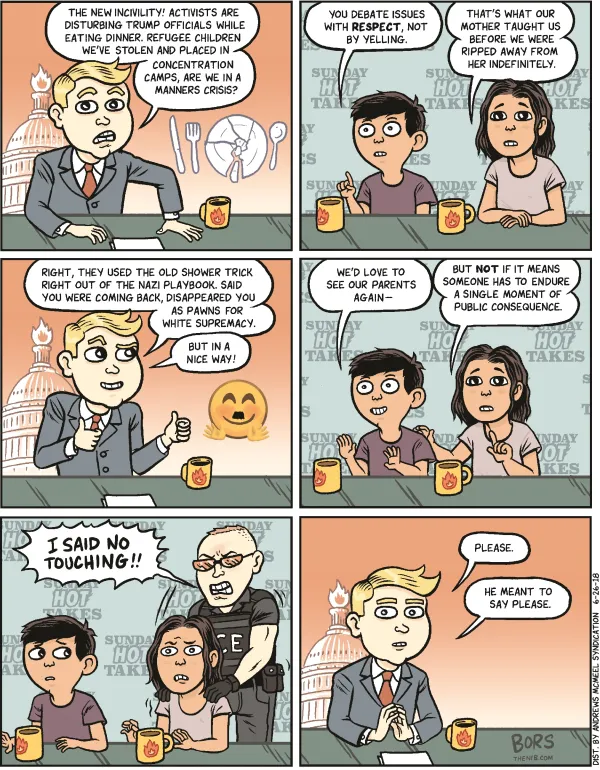
Warren had just returned from McAllen, Texas, where she visited an “immigration processing center” — a place where desperate human beings are stirred into the border bureaucracy and separated into categories — immigrants, refugees, criminals — and where children, including babies, are torn from their parents’ arms, possibly forever.

BANGKOK, Thailand -- A U.S. Pacific Command (PACOM) search and rescue team and Thai Navy SEALs were unable on June 28 to find 12 Thai boys and their soccer coach in a dark, monsoon-flooded cave in northern Thailand after they disappeared in its six-mile (10-kilometer) maze of stalactites more than five days ago.
A British rescue team also joined in the search, supporting nearly 1,000 Thai military and civilian personnel, but incessant rain has flooded the cave so deeply that scuba divers found it difficult to swim through narrow, jagged passageways.
The tragedy at the cave has become a national fixation with non-stop television coverage on the plight of the 13 missing people, the rising flood waters inside the cave, the inability of scuba divers to wedge themselves through twisted rock formations, and other hazards.
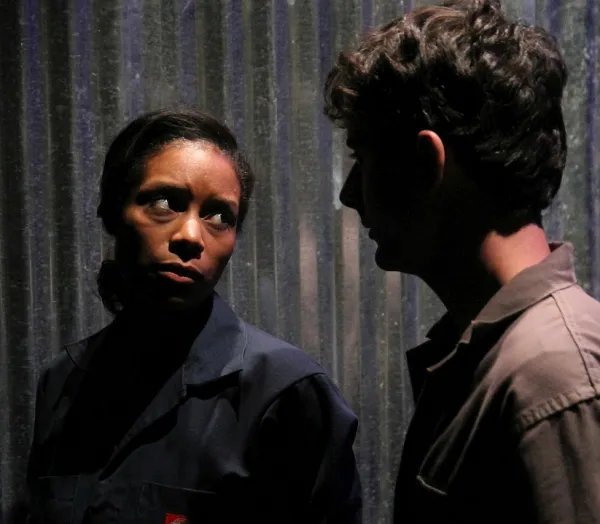
Naomi Wallace’s genre (and gender) blending Slaughter City is a cross between a Clifford Odets type of play about the working class and a Rod Serling TV episode set in “a fifth dimension beyond that which is known to man… as vast as space and as timeless as infinity… the middle ground between light and shadow, between science and superstition, and it lies between the pit of man's fears and the summit of his knowledge… the dimension of imagination.”
Indeed, imagine Waiting for Lefty combined with the Twilight Zone and you’ll get a sense of this two-acter presented by the Coeurage Theatre Company. Slaughter City takes place (mostly) circa 1991 in a meat packing plant. In its depiction of and concern for assembly line workers and union issues, Slaughter is in the vein of the Proletarian Dramas by people’s playwrights such as Odets, John Howard Lawson, Marc Blitzstein and Bertolt Brecht. Slaughter’s dialogue refers to the Industrial Workers of the World, scabs, the horrendous 1911 Triangle Shirtwaist Factory fire, strikes and other blue collar subjects Joe Hill, Paul Robeson or Woody Guthrie might have sung ballads about.

Aerial view of the outlet of tiny Hazeltine Creek (normally 6 feet wide) as it empties into Quesnel Lake (a once world-famous salmon fishery) at the head of the 600 mile-long Fraser River estuayr that is now contaminated with 2.5 billion gallons of toxic sulfide mine waste (including sulfuric acid) that was discharged in 2014. The brown color represents the trunks of the huge trees that were up-rooted during the deluge. The diameter of some of the trees measured half the width of the original creek.
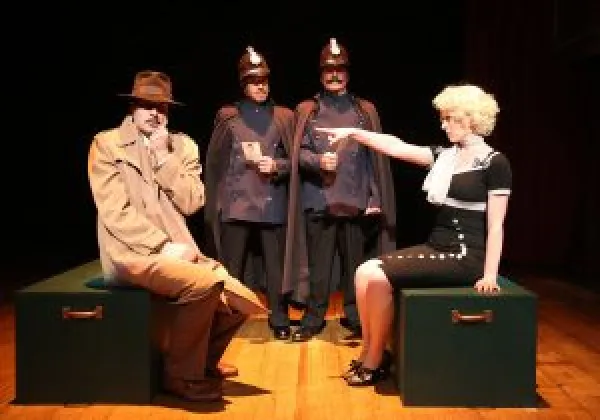
Review Fun Fact: “Mr. Memory” was based on an actual vaudeville-like act.
You don’t have to be the British music hall savant “Mr. Memory” - or a man who knew too much - to remember that Alfred Hitchcock was nicknamed “the Master of Suspense.” But if Hitch had directed the Patrick Barlow stage adaptation of The 39 Steps - which toured England and scored the Olivier Award for Best New Comedy in 2007 then ran on Broadway for two years - instead of his spy movie of the same name, the famed British movie director might have been called “the Master of Silliness.”
Remarks at Peace Resource Center of San Diego, June 23, 2018.
There are three things that are almost always underestimated: the U.S. military budget, altruism, and sadism.
First, the military budget.