
Global
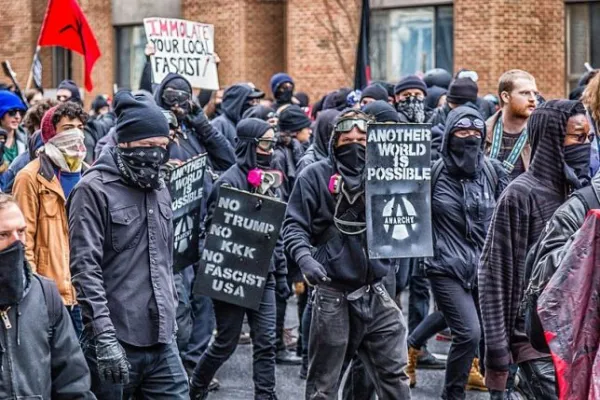
“A nation can survive its fools, and even the ambitious. But it cannot survive treason from within. An enemy at the gates is less formidable, for he is known and he carries his banners openly. But the traitor moves among those within the gate freely, his sly whispers rustling through all the galleys, heard in the very hall of government itself. For the traitor appears not a traitor — he speaks in the accents familiar to his victims, and wears their face and their garment, and he appeals to the baseness that lies deep in the hearts of all men. He rots the soul of a nation — he works secretly and unknown to undermine the pillars of a city — he infects the body politic so that it can no longer resist. A murderer is less to be feared.” -- Cicero, 42 B.C.

Attending the plucky Avi Avital’s rapturous rendition of Venetian composer Antonio Vivaldi’s 1725 “The Four Seasons” was my first time hearing Los Angeles Chamber Orchestra and being inside of Zipper Concert Hall at 200 S. Grand Avenue in Downtown L.A. The 406 seat, wood- lined sonic sanctuary features large, disc-like lights floating over the stage, resembling flying saucers. This was apropos for at times the music emanating from LACO and its guest soloist had an ethereal, unearthly character.
But before Avital took the stage, lengthy announcements were made lauding the late patron of the arts Hanna M. Kennedy, then two Vivaldi Concertos for Two Violins - one in G minor, the other in A minor - were played. The former featured violinists Josefina Vergara and Sarah Thornblade, while in the latter Margaret Batjer and Tereza Stanislav engaged in spirited string slinging, dueling with one another. Both Vivaldi concertos, which took about nine minutes and then thirteen minutes to complete, were expertly executed. Actually eyeballing the bow slingers Batjer and Stanislav face off against one another was fun and interesting to observe.

“…and the ones who call the shots won't be among the dead and lame;
And on each end of the rifle we're the same” -- John McCutcheon
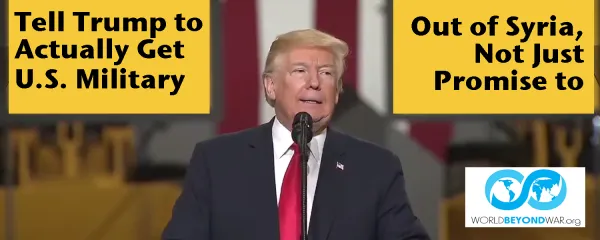
U.S. President Donald Trump has announced his intention to remove all U.S. troops from Syria.
If that happens it will fulfill part of the demand that World BEYOND War has been making since Trump promised nine months ago to get “out” of Syria “like very soon.”
Removing troops from the ground — all of them, not just some — and ceasing base construction, if it happens, will be a start.
Even more important is ceasing to bomb from above.
In addition, alternative approaches need to be launched, including unarmed peaceworkers, a weapons ban for the region, a disarmament program, major actual humanitarian aid (and an end to sanctions that harm ordinary people), and diplomacy.
The fact that politicians and the parties they belong to generally do more harm than good is simply no reason not to encourage the good and discourage the bad.
Opposition to this withdrawal of troops is coming from a variety of disturbing quarters for a range of unconvincing reasons.

Christmas Day. Very late on this day and into the morning of the 26th in 1776, George Washington led a surprise night crossing of the Delaware River and bloody pre-dawn attack on unarmed hung-over-from-Christmas troops still in their underwear — a founding act of violence for the new nation to proudly remember as the progenitor of either the crimes of its “special” forces all over the globe or of peace on earth, I can never recall which.
A more useful memory is certainly that of the 1914 Christmas truce, which was actually more than one truce that year and in the subsequent years of the Great War. This is a true story of people not just managing to speak to each other but actually becoming friends with not just people they had a disagreement with but people who a moment before and for a longtime running had been trying to murder them. It’s a story of war enemies figuring out that the actual enemy is not any people but war itself. And they did it on Christmas. Maybe we can do something good on Christmas too.
Remarks in Albuquerque, New Mexico, December 12, 2018
There’s action happening now in the U.S. Senate on ending U.S. participation in the war on Yemen. There’s a big loophole in the bill. There’s the matter of selling Saudi Arabia its weapons. There’s the House of Misrepresentatives to worry about. There’s the veto threat. There’s the question of getting compliance out of a president you’ve pretty well promised never to impeach, at least not for any of dozens of documented offenses unrelated to Russia. All that being said, the current action is a very good thing, and New Mexico’s senators have thus far been on the right side of it.

Sign this petition to The City Council of Charlottesville, Virginia:
Divest all public money from weapons companies, major war profiteers, and fossil fuel companies.
Sign Here.
The City of Charlottesville has approximately $3 million invested in fossil fuel companies ($1.4 m in energy company bonds, plus approximately $1.6 m through funds invested in by Charlottesville’s retirement fund). It may have about the same in weapons companies, as it has $1.1 m directly invested in four “aerospace and defense” companies: Boeing, Heico, Honeywell, and Moog. Boeing and Honeywell are two of the biggest war profiteers including through the wars of Saudi Arabia that even the U.S. Congress is now turning against.
Yes, is the unfortunate answer to the obvious question: The whole time that Charlottesville has discussed possibly considering finding the nerve to take down a couple of its many offensive statues, has it been investing public dollars in the mass killing of dark skinned people and the general destruction of a habitable planet?
For further information: berniedelegates@rootsaction.org
December 13, 2018
Former Sanders Delegates Vote Overwhelmingly
To Relaunch Bernie Delegates Network for 2019
Former Bernie Sanders delegates to the 2016 Democratic National Convention have voted to reconstitute the independent Bernie Delegates Network.
The vote was 408 “yes” to 23 “no” in response to this question: “Do you favor a relaunch of the independent Bernie Delegates Network in 2019?”
Organizers called the vote “a landslide” and said they will proceed with relaunching the nationwide network in early January.
The election was conducted online over a five-day period ending December 11. Former delegates were given a unique code that could only be used to vote once.

BANGKOK, Thailand -- Tibet's government-in-exile cheered the U.S.
Senate's passage of an act demanding U.S. diplomats, journalists and
other Americans be allowed to freely visit Tibet, but Beijing warned
President Trump if he signs it into law, "China-U.S. ties and
cooperation in major areas" could suffer retaliation.
The Reciprocal Access To Tibet Act of 2018, now awaiting President
Trump's signature, includes preventing Chinese officials receiving
U.S. visas if they are involved in blocking Americans from Tibet.
"The Act interferes in China's domestic affairs with reckless
disregard for facts, and goes against the basic norms of international
relations," said Chinese Foreign Ministry spokesman Lu Kang.
"We urge the U.S. administrative bodies to take immediate measures to
stop it being signed into law, so as to avoid impairing China-U.S.
ties and cooperation in major areas," Mr. Lu said in Beijing on
December 14.
China's retaliation may include denying some U.S. officials from
receiving visas to China, reported Beijing's Global Times.

“One of the saddest lessons of history is this: If we've been bamboozled long enough, we tend to reject any evidence of the bamboozle. We're no longer interested in finding out the truth. The bamboozle has captured us. It is simply too painful to acknowledge -- even to ourselves -- that we've been fooled.” -- Carl Sagan,"The Fine Art of Baloney Detection" (February 1, 1987)
This morning, just as I was about to start writing my weekly Duty to Warn column, I glanced through the Duluth News-Tribune and couldn’t help but notice a full-page ad on page A3. The ad was titled “Rallying to Address Opioid Addiction”. The color-printed ad likely cost well over a thousand dollars and was paid for by an entity that I had never heard of before called “Rx ALI Minnesota” (Rx Abuse Leadership Initiative). The group was apparently a fresh new “alliance” of “concerned” corporate entities that were suddenly interested in the opioid crisis that is affecting all portions of America.