
Global

The Collapse of the War Systemis the hopeful and predictive title of a 2007 book by John Jacob English, who’s actually Irish, and it may prove a valuable stepping stone for many trying to partially back their way out of support for endless war yet not prepared to acknowledge the more coherent and empirically substantiated wisdom of complete abolition. Whether any of the authors of the following books which I routinely recommend to people had read English’s book I do not know, but it also makes a nice lead-up chronologically and logically to them:

These words did in G. Harrold Carswell nearly five decades ago:
“I am Southern by ancestry, birth, training, inclination, belief and practice. And I believe that segregation of the races is proper and the only practical and correct way of life in our states. I have always so believed and I shall always so act.
“I shall be the last to submit to any attempt on the part of anyone to break down and to weaken this firmly established policy of our people.
“If my own brother were to advocate such a program, I would be compelled to take issue with him and to oppose him to the limit of my ability.

– Senator Jeff Flake, Arizona Republican, September 28, 2018

The Ohio Linux Fest (OLF) will be at the Ohio Convention Center this October 12-13. OLF is like a Comfest for people who love computers, and specifically the free software known as GNU/Linux (winks at Richard Stallman).
OLF is also for people who prefer the term open-source, work at corporations and just call it Linux. If you didn't get the point of distinction, I could spend this article explaining the distinctions between copy-left, copyright, MIT vs. BSD and GPL 2 v 3 and you would probably not have any better idea of why you should care. So instead just take my word for it that there are good reasons for people who work with technology to care about these things and read on.
OLF certainly caters to people who are already familiar with Linux and know what a kernel is, but it is also a kid friendly community event. If you are Linux curious you will still find a lot to learn with various introductory sessions that will hold your hand while introducing you to new concepts.

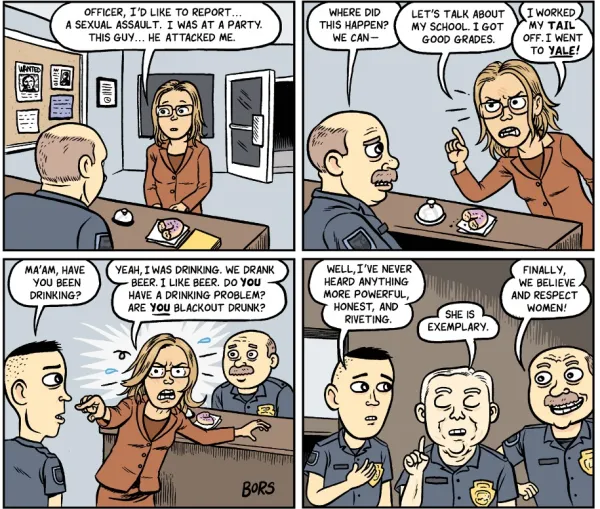
Never before has the Republican Party so explicitly shown its true colors. It is now so far off to the right the Clintons look like raging communists. The all-male Republican membership of the Senate judiciary committee refused to interview a female sexual assault victim themselves. They hired a prosecutor to interrogate the victim and say next to nothing to the accused. Senators whom had previously railed against Trump lost all moderate credibility when they leapt to the defense of a Supreme Court nominee accused of sex crimes and perjury. The entire party has been astoundingly flagrant in its disrespect and disregard for women.

Read this headline: “To Avoid Repeating Catastrophic Mistake of Iraq Invasion, Senate Bill Would Forbid Attack on Iran Without Congressional Approval.”
Consider these facts:
The Senate voted to let Bush attack Iraq.
So did the House.
The pair of them continue to fund the U.S. military occupation of Iraq to this day.

I stumbled upon Moroni for President purely by chance and boy, am I glad that I did. It just so happened to fit into my schedule covering the LA Film Festival so I popped into the ArcLight Theatre, not knowing what I’d see. Based on its name, I thought it might be a satire based on Trump about a moron running for the White House. But to paraphrase an old saying, don’t judge a film by its title. It turned out that Finnish filmmaker Saila Huusko and Dutch co-director Jaspen Rischen’s directorial debut was actually a documentary about someone named Moroni Benally, who indeed was actually running for president.

As an opera reviewer who doesn’t know much about the legendary Maria Callas I greatly enjoyed Tom Volf’s extremely informative documentary Maria By Callas. The film consists entirely of archival footage, clips of the soprano on TV talk shows and in the news, performance/concert vignettes, home movies and sound recordings. I don’t believe there’s a single solitary shot of original material per se by Volf but he has done a masterful job assembling this compilation film that is worthy of the genre’s creator, Soviet director/editor Esther Shub.
(For some reason, from time to time some of the footage is glimpsed as if we are looking at the frame of a motion picture - which may want us to reflect on the fact that we are watching films of Callas? Who knows?)

‘When I despair, I remember that all through history the ways of truth and love have always won. There have been tyrants, and murderers, and for a time they can seem invincible, but in the end they always fall. Think of it – always.’ M.K. Gandhi
As we remember Gandhi Jayanti on 2 October, the Mahatma’s 149th birthday and the International Day of Nonviolence, there is plenty of room for despair.
Never before has the Earth and its many inhabitants been under siege as they are now, more than 100 years after Gandhi started warning us of the predicament in which we are embroiled and presenting his strategy for addressing it before it spiraled out of control.