
Global

In the wake of the Brett Kavanaugh confirmation, as white male privilege reclaims its desperate grip on our future, the U.N.’s Intergovernmental Panel on Climate Change report comes out, informing us that we haven’t got much future left in which to avoid . . . I mean implement . . . serious change
Meanwhile, the midterm elections percolate.
Our quasi-democracy —rife as it is with voter suppression and mainstream media determination to trivialize the issues at stake —remains, nonetheless, the country’s primary means of manifesting public values. Inconvenient as it is to the powerful, this thing called voting is how collective humanity expresses its will —and I believe this will, to paraphrase Martin Luther King, bends toward sanity.
I hope so.
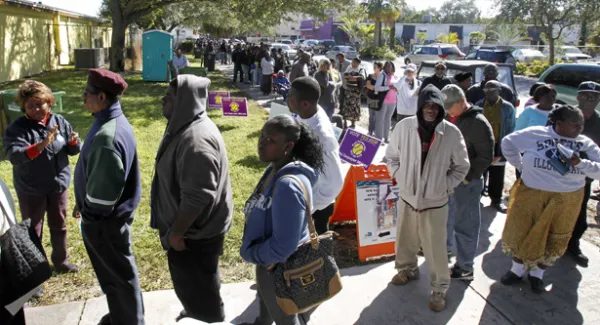
Are you ready to be a poll worker?
To stop Trump’s dictatorial rise, a real opposition party would be mobilizing Americans to vote AND to protect the right to cast verifiable ballots while making sure they’re actually counted.
That means becoming poll workers, registration protectors, vote count monitors and much more.
A real opposition party would now be organizing massive nationwide grassroots trainings for a reliable election. Are the Dems doing that?
Trump’s Republicans enter 2018 with a 5-10% structural advantage. They’ve stripped voter registration rolls and flipped electronic vote counts since at least 2000.
This year just voting will again not be enough.
Progressives MUST become poll workers, bring voters to the polls, monitor vote counts after the balloting, and refuse to concede close elections.
Strip/flip tactics gave Republicans the presidency in 2000, 2004 and 2016. In 2014 and 2016, they took six US Senate seats when their candidate trailed in the exit polls and/or “won” by less than five points.
Those six seats gave Trump control of US Supreme Court, his mega-tax cut for the super-rich, and much more.

“6000 to 32,000 hospital workers would need to be vaccinated (with an influenza vaccine)before a single patient death would be averted.” (That is, the Number Needed to Vaccinate (NNV) for hospital healthcare workers to prevent one patient from dying because of influenza contagion from an un-vaccinated worker is as high as 32,000!) -- https://journals.plos.org/plosone/article?id=10.1371/journal.pone.0163586
"It is difficult to get a man to understandsomething, when his salary depends upon his not understanding it!" – Upton Sinclair

Very few Americans know who Sheldon Adelson is and fewer still appreciate that, as America’s leading political donor, when he speaks the Republican Party listens. By virtue of his largesse, he has been able to direct GOP policy in the Middle East in favor of Israel, which might well be regarded as his true home while the United States exists more as a faithful friend that can be produced at intervals whenever Israel finds itself in need of a bit of cash or political cover.
Adelson’s recent successes in translating his political donations into policy favorable to Israel have included shifting the US Embassy to Jerusalem, cutting aid to Palestinians, ending the Iranian nuclear monitoring agreement and closing the Palestine Liberation Organization’s diplomatic office in Washington. All those Trump Administration measures were reportedly worked out privately by Adelson speaking directly with the president.

Director Michael Michetti’s adaptation of Oscar Wilde’s 1890 Gothic novella The Picture of Dorian Gray - about the costs of eternal youth and beauty - is a highly stylized, exceedingly strange play. Large swathes of Picture border on avant-garde theatre, especially in Act II. The sinister plot and its presentation are likely to make some theatergoers uncomfortable (leave the kiddies at home for this one!) and to enthrall others as a most apropos choice for the Halloween season.
The tragic trajectory of The New York Times inches full throttle
towards the fate of the Pravda when the communist Soviet Union fell in
1991. Cracks in the iron curtain splashed a disinfecting dose of
sunlight on mother Russia. The propaganda agenda of the Pravda entered
the mainstream consciousness of this nation’s populace. The partial
collapse of this bogus broadsheet’s readership ensued.
In recent years, the adjective ‘fake news’ has entered the English
language lexicon. It is difficult to pin-point precisely when the
global mass media transformed from its heyday function as a
disseminator of current affairs and facts into a totalitarian machine
staffed by partisan ‘presstitute’ puppets.
There is safety in numbers. The Times spearheads a brutal brigade of hound dog
harlots. Corruption of mainstream Western media is endemic. This
wickedness pervades the oligopoly mockingbird media throughout America’s television, radio, print and

The speed that hackers were able to breach security on dozens of electronic voting machines at one of the United States’ largest cybersecurity conferences underscores the long-standing problem with computerized electronic voting systems in our country. At the annual DefCon cybersecurity conference this July, hacker managed to break into every voting machine within minutes, according to an article in The Hill.[1]
Thomas Richards, a security consultant, said “It took me only a few minutes to see how to hack it” referring to the Premier Election Solutions voting machine currently used in Georgia.[2]
Computerized voting in the United States was promoted by an interlocking industrial complex of political operatives, technicians and vendors.

Horror movies are a genre I usually avoid because they’re often too scary for me and give me nightmares. However, Spell’s spellbinding Scandinavian cinematography, shot on location in Iceland, plus good, quirky performances make the well-made feature-length debut of co-writer/director Brendan Walter worth seeing. Benny (Barak Hardley, who has a screenwriting co-credit) is an American cartoonist suffering from Obsessive Compulsive Disorder (if you don’t know what OCD is, see “Trump: Lying”). After the apparently drug-related death of his addict live-in lover Jess (Jackie Tohn), the addled Benny impulsively takes off on what seems like a spur of the moment trip to - where else? - Iceland.

BANGKOK, Thailand -- If Thailand's U.S.-backed military government
allows an election next year, the junta leader and his supporters are
expected to dominate thanks to heavy censorship, an appointed Senate,
and restricted or self-exiled opposition politicians.
Prime Minister Prayuth Chan-ocha, who seized power in a bloodless 2014
coup when he was army commander, is widely perceived as manipulating
an extension of his prime ministry.
"Why are you so interested in me?" the often moody Mr. Prayuth asked
reporters who wanted to discuss expectations he would remain in power
after the election.
"I will decide when I will announce. It's entirely up to me. What's
the point of exposing myself to criticism so soon?" he said on
September 19.
"The laws on the election of members of parliament and selection of
senators were announced in the Royal Gazette on September 12, 2018,
paving the way for an election between February and May 2019," said
New York-based Human Rights Watch.
" Thailand's military junta should immediately lift restrictions on

I’m very, very strange. I think democracy would actually be a good thing, not just grounds for bombing other countries. As long as we’re stuck with electing supposed representatives, I want to make that system approximate as closely as possible actual democracy. This attitude results in some bizarre positions. For example, I want candidates to lay out a detailed policy platform with hard commitments to particular actions. Even weirder, I don’t really care what a candidate looks like or what he or she does consensually in bedrooms or what political party, if any, he or she swears obedience to — er, excuse me, belongs to.
U.S. politics is remarkably devoid of content, in general, and especially at the higher levels, and especially on unpopular positions supported by both big parties. Almost never will a candidate for the U.S. Congress outline a basic desired budget. Virtually none has a position on the level of military spending. Very few Democrats, and not that many Republicans, have any foreign policy platform at all. Campaign websites are dominated by personal stories, vague “principles,” and fluff.