
Global

In order to shed some clear illumination on what is really at stake in Alabama's December 12 US Senate Election, I am submitting this pair of letters from two key Alabamans regarding Roy Moore. Alabama may be a long way geographically from California, but these two letters brings us closer together!
The first, from the first accuser of Roy Moore going back to sexual manipulation when she was 14 and he was a 32 year old Assistant District Attorney, recently ran in Alabama.
The second, that of his former Law Professor, Guy Martin, was also published his in Al.com, the largest newspaper media group in Alabama, on Sept. 21, just before the Alabama Primary. We acknowledge the high principles of the journalism displayed by Al.com, in their originally publishing these two letters, and thank the editors there for their courage and their integrity in leading this effort, and making clear, as they put it recently, that they don't want to be "on the wrong side of History."
Letter from Leigh Corfman to Roy Moore:
http://www.al.com/…/…/11/roy_moore_leigh_corfman_accuse.html
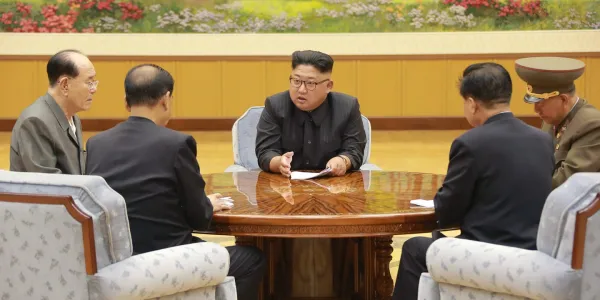
 he most dangerous thing about the North Korean missile launch is the reaction of the unprincipled, under-informed, white identity extremist sitting in the Oval Office. If there’s a nuclear war coming out of this manufactured “crisis,” the buck will have stopped with him. Not that President Trump doesn’t have other fools egging him on to risk global chaos and destruction in response to an imaginary, inflated threat from an impoverished nation of 25 million people. Sadly, this is not a surprising development after more than sixty years of aggressive US behavior toward North Korea.

We’re supposed to think that the United States is threatened for no reason by irrational subhuman monsters arising out of the less important bits of the earth found beyond U.S. borders.
We’re supposed to think that the bigger the U.S. military is, and the more places it’s based in around the world, the better it can counter those monsters.
We’re supposed to think that other nations don’t have this sort of problem or depend on this sort of solution because the United States does it for them.
We’re supposed to think that selling and giving weapons to the rest of the world makes the world safer.
We’re supposed to think that arms dealing and militarism are economically beneficial.
We’re supposed to think that helping people would cost more, economically, than killing them.
We’re supposed to think that U.S. wars kill few people, most of them soldiers.
We’re supposed to think that wars happen on things called battlefields.
We’re supposed to think that genocide is something different from war and can be prevented with war.
We’re supposed to think that war has always been present in human existence and always must be.

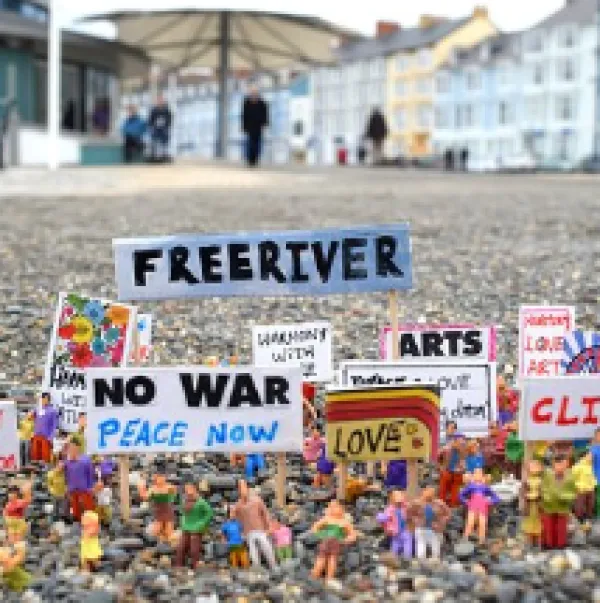
In a time of endless war and triumphant cynicism, I found myself the other day unexpectedly walking through the doors of perception. Yeah, those doors.
“You know the day destroys the night/Night divides the day/Tried to run/Tried to hide/ Break on through to the other side . . .”
The words, the music — the Doors, the voice of Jim Morrison — ignite not just the Summer of Love but a crazy something I don’t dare call hope, because those days of cultural and political revolution overdosed and imploded, didn’t they? War won. The Vietnam War dragged on, millions died (or thousands, if the only death toll that matters to you is that of U.S. soldiers), MLK and RFK were assassinated, the Cold War quietly morphed into the War on Terror and eventually the 911 attacks gave the military-industrialists the “new Pearl Harbor” they needed. Today’s military budget is securely bloated.
Knowing this, I was blindsided by the impact a remarkable exhibition I recently attended with my daughter had on me. And the star of the show was born in 1757.
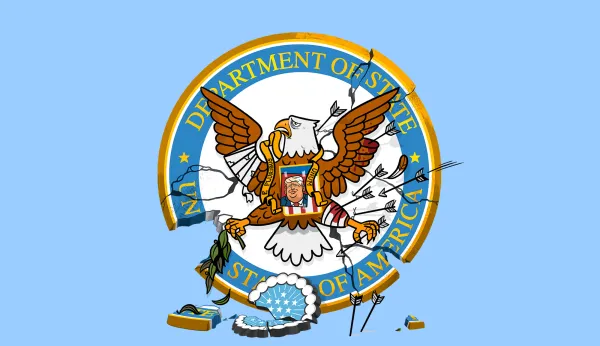
The Stop the War Coalition has just published a short summary of what’s wrong with foreign policy, going through a partial list of current wars one by one.
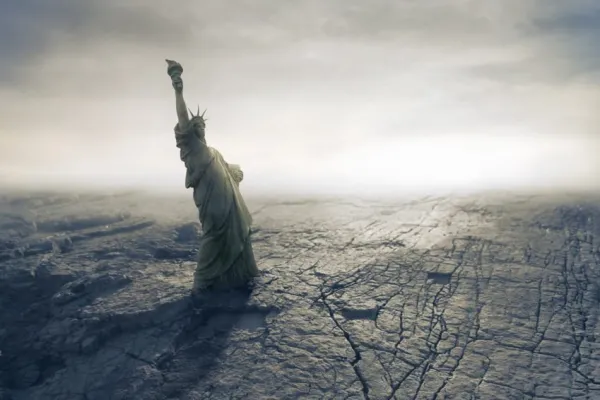
SHIP’S LOG, February 15, 2018 — How the Earthlings have survived is a mystery. Ever since the United States impeached and removed Donald Trump for accidentally live-streaming himself sexually assaulting a tourist (or was it really for refusing to bomb Moscow? unclear) events have spiraled out of control.
Trump is now residing on a private island, making offers by tweet of trillions of dollars to various nations in exchange for their willingness to bomb the United States. No nation is known to have yet accepted. Nor has anyone yet seen Trump’s tax returns. He may or may not have, or have access to, trillions of dollars.
Some of the earthlings believe the impeachment process drove Trump out of his mind, while others blame the water supply on his island abode. But 92% in a scientific survey conducted in 43 countries this week actually volunteered or wrote in: “When was he not out of his mind — WTF?”

Several years ago in Cameroon, a country in West Africa, a Western Black Rhinoceros was killed. It was the last of its kind on Earth.
Hence, the Western Black Rhinoceros, the largest subspecies of rhinoceros which had lived for millions of years and was the second largest land mammal on Earth, no longer exists.
But while you have probably heard of the Western Black Rhinoceros, and may even have known of its extinction, did you know that on the same day that it became extinct, another 200 species of life on Earth also became extinct?
This is because the sixth mass extinction event in Earth’s history is now accelerating at an unprecedented rate with 200 species of plants, birds, animals, fish, amphibians, insects and reptiles being driven to extinction on a daily basis. And the odds are high that you have never even heard of any of them. For example, have you heard of the Christmas Island Pipistrelle, recently declared extinct? See ‘Christmas Island Pipistrelle declared extinct by IUCN’.

BANGKOK, Thailand -- Pope Francis' first-ever visit by a Roman
Catholic pontiff to Buddhist-majority Myanmar which started on
November 27 will be closely watched for his reaction to the country's
bloody military campaign against more than one million ethnic Rohingya
Muslims.
Among the leaders he will meet during his four-day trip is Aung San
Suu Kyi whose silence about the suffering of the Rohingya sharply
contrasts with Francis' August statement lamenting the "persecution of
our Rohingya brothers and sisters."
The pope will also meet the military's Commander-in-Chief Gen. Min Aung Hlaing.
If the Argentine-born pope mentions the Rohingya while in Myanmar, it
will embarrass and dismay his hosts.
But if he silences himself, many others will be deeply disappointed.
During the pope's November 27-30 visit, "he will speak for all
suffering people belonging to all groups present in Myanmar," Fr.
Carlo Velardo, an attache at The Holy See's Apostolic Nunciature or
embassy in Bangkok, said in an interview.

Introduction
When I began this essay I thought I aimed at a rather modest target, but the “story grew in the telling” and reached out further and further to interweave more and more threads, and therefore required much more time and thought than originally foreseen. Yet I believe the effort to have been worthwhile, opening a bit of new territory for socialism. It sets out from one of Rosa Luxemburg’s most enduring postulates and conjugates it with the topic of civil disobedience which, (as far as the author knows, has never been associated this giant of socialist thought.
One of the protagonists of the civil disobedience movement was Rosa Parks, the other “rose” to whom this monograph is dedicated to and honored in the title, for being as a quintessential representative of civil disobedience as understood and practiced by Gandhi and King.
A further disobedient rose worthy of recognition is Sandra Harris who reviewed this essay and recommended addressing “class morality.”
A Disobedient Rosa: What Brings the Masses into Motion