Global
The man who murdered police officers in Dallas, Texas, this week had earlier been employed in a massive operation, now in its 15th year, that has killed many thousands of people in Afghanistan. He was trained to kill by the U.S. military using U.S. tax dollars. He was conditioned to believe violence an appropriate response to violence by the examples everywhere to be found in U.S. public policy, history, entertainment, and language.
Murdering police officers because some other police officers committed murder is unfair, unjust, immoral, and certainly counterproductive on its own terms. The Dallas killer managed to get himself killed by means of a bomb delivered by a robot. The police could have waited him out but chose not to, and no one indoctrinated to accept violent revenge will blame them. But that technology will spread among police and non-police killers. The airwaves are reverberating with cries for a race war. Greater militarization of the police, not greater restraint, will follow this incident. More lives will be lost. More screams of agony will be heard over loved ones lost.
The man who murdered police officers in Dallas, Texas, this week had earlier been employed in a massive operation, now in its 15th year, that has killed many thousands of people in Afghanistan. He was trained to kill by the U.S. military using U.S. tax dollars. He was conditioned to believe violence an appropriate response to violence by the examples everywhere to be found in U.S. public policy, history, entertainment, and language.
Murdering police officers because some other police officers committed murder is unfair, unjust, immoral, and certainly counterproductive on its own terms. The Dallas killer managed to get himself killed by means of a bomb delivered by a robot. The police could have waited him out but chose not to, and no one indoctrinated to accept violent revenge will blame them. But that technology will spread among police and non-police killers. The airwaves are reverberating with cries for a race war. Greater militarization of the police, not greater restraint, will follow this incident. More lives will be lost. More screams of agony will be heard over loved ones lost.


For decades, people have tried to fix the Democratic Party. They've imagined that their failings in this regard could be overcome by a greater effort. But it is hard to imagine anyone in the future mounting as significant an effort as did Bernie Sanders and his supporters.
We're cynically told to just wait, because younger people hold better views. But the holding of views, by anyone, has nothing to do with it. And younger people have a pretty consistent record of becoming older people.
Why does the holding of views have nothing to do with it? Because the Democratic Party is bought and paid for and directed from the top down.
Here is a party that pretends to have solved the healthcare crisis with such self-deluding intensity that it refuses to express support for providing universal healthcare.
Here is a party that criminally pushes for more militarism and war including the overthrow of the Syrian government, and that will not admit the existence of occupied Palestine.

One of the many interesting details to be learned by understanding human psychology is how a person's unconscious fear works in a myriad of ways to make them believe that they bear no responsibility for a particular problem.
This psychological dysfunctionality cripples a substantial portion of the human population in ways that work against the possibility of achieving worthwhile outcomes for themselves, other individuals, communities and the world as a whole. In an era when human extinction is now a likely near-term outcome of this dysfunctionality, it is obviously particularly problematic. So why does this happen and how does it manifest?

 he federal lawsuit, titled Katie Johnson v. Donald J. Trump and Jeffrey E. Epstein, accuses Trump and Epstein of rape and other sexual assaults during the summer of 1994, when plaintiff was 13 years old. Attorney Garten denied the accusations and cast doubt on the existence of the plaintiff.
The Chilcot report's "findings" have virtually all been part of the public record for a decade, and it avoids key pieces of evidence. Its recommendations are essentially to continue using war as a threat and a tool of foreign policy, but to please try not to lie so much, make sure to win over a bit more of the public, and don't promise any positive outcomes given the likelihood of catastrophe.
The report is a confused jumble, given that it records evidence of the supreme crime but tries to excuse it. The closer you get to the beginning of the executive summary, the more the report reads as if written by the very criminals it's reporting on. Yet the report makes clear, as we always knew, that even in 2001-2003 there were honest people working in the British, as also in the U.S., government -- some of whom became whistleblowers, others of whom accurately identified the planned war as a crime that would endanger rather than protect, but stayed in their jobs when the war was launched.
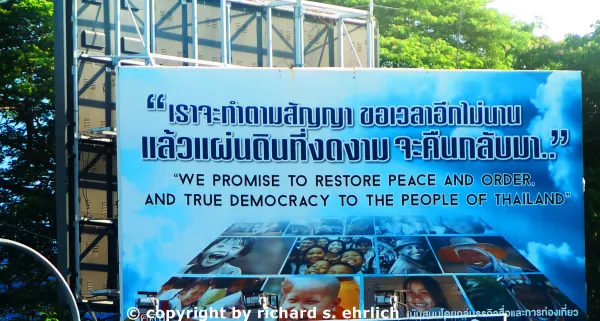
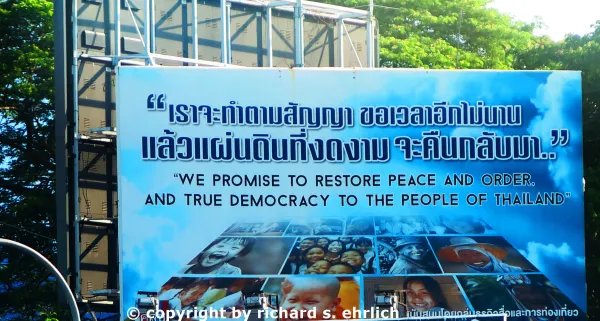
BANGKOK, Thailand -- Thailand's Constitutional Court has upheld a law
that metes out 10 years imprisonment to anyone who voices an opinion
about the junta's favored draft constitution, or campaigns for or
against it before a scheduled nationwide August 7 referendum.
"If the draft constitution does not pass, a new one has to be
written," coup-installed Prime Minister Prayuth Chan-ocha said on June
28, one day before the court ruling.
The court's decision and Mr. Prayuth's orchestration of a new
constitution contrast sharply with dissidents, politicians, local
media, Thai and international human rights groups and others who have
asked that the draft and referendum be open to public debate,
criticism and changes.
Voters decide on the junta's draft constitution on August 7 by
casting a "yes" or "no" vote.
Some see the referendum as a popularity test of the junta as it
enters a third year in power.
Before retiring as army chief and general, Mr. Prayuth led
Thailand's U.S.-trained military in a bloodless May 2014 coup against