
Global
Well actually, turns out the point of the mandatory course recently canceled by the Air Force after officers of numerous faiths complained to the Military Religious Freedom Foundation about it and TruthOut published an exposé in July — was to give officers in the first week of missile-launch training a Bible-verse-studded indoctrination in faux-Just War Theory, cynically known in the ranks as the “Jesus Loves Nukes” training.
“Then I saw heaven opened, and behold, a white horse! He who sat upon it is called Faithful and True, and in righteousness he judges and makes war.”
Less than one month before the September 19, 2006 coup, the American Embassy said Army Commander-in-Chief Gen. Sonthi Boonyaratkalin was unlikely to stage a putsch, according to a "confidential" cable, "06BANGKOK5148," sent to the U.S. State Department, the U.S. Pacific Command in Hawaii, and elsewhere.
"The relative power and influence of the Royal Thai Army (RTA) dwarfs the other services," said the cable, dated Aug. 23, 2006, which was recently published by the anti-secrecy website WikiLeaks.
"As such, the Royal Thai Army Commander, Gen. Sonthi, traditionally wields more real power than the Supreme Commander," it said, describing the general who led the coup, and then shredded the 1997 constitution while setting up a repressive junta.
In 2004, we uncovered the "caging lists" which 're-elected' George Bush.
That was nuthin' too ... compared to the theft of 2012 that is now in the making.
Major TV and print outlets are finally recognizing that the Palast team has the expertise, the cojones and the nose to sniff out mass vote bending.
We are planning our strategy right now for the hard-core, dig deep, multi-state research that we need to get the details, the documents and the proof of the fix of 2012.
So, for the first time in this entire year, I am asking—frankly, I'm pleading—for your financial support to get this investigation going right now.
First, I'm looking for 24 donors to commit to provide $2,000 each, at minimum, to launch the Missing Ballot Investigation. It's tax deductible, it's non-partisan, it's hard-core journalism, "so relevant it threatens to alter history," says the Chicago Tribune. Donate and I'll proudly list you as a producer of our Election year prime-time broadcast.
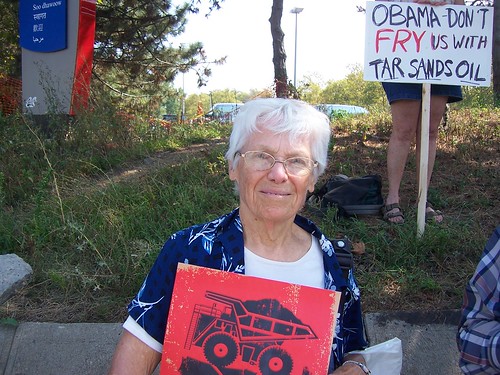
The story of president Franklin Delano Roosevelt saying that during a meeting with activists in the 1930s is apocryphal, but Ellen Baumgartner is a local activist who is holding on to the "make-me-do-it" method for getting Obama to deliver at least some of the changes he promised during his campaign in '08. A couple of weeks after being jailed for civil disobedience in front of the White House during protests against the Keystone XL tars sands pipeline, Baumgartner said she supports Obama's reelection.
"I believe in Obama. I think he has had tremendous challenges. But he has done a number of good things. People are expecting too much of him, because he has inherited a mess. Now, with the Congress being so antagonistic and determined to not give him anything that he wants, it's very discouraging. However, if the choice is between Obama and a Republican of the ilk we have been seeing, it's Obama hands-down."

Kimberly Jackson Morris & Jamira Jamison stood along Cleveland Avenue as President Obama spoke at the Fort Hayes High School about his jobs plan on Sept 13. Not far way were about 20 protestors holding signs and chanting "Barack Obama, yes you can. Say no to the tar sands."
The Keystone XL pipeline would carry tar sands oil from Canada to Texas where it would be refined and shipped to other countries. There were no people of color in the protest, though a Black elder sat nearby on a lawn chair so as to stay in the shade during the hot September day.
Morris said the under-representation of people of color in the environmental movement is a case in point on the importance of education.
"We're not educated on those facts...When you go into lower economic areas, there's no one standing there giving us information about a pipeline."
Locked Out documents the Biblical clash, yes I’m talking David versus Goliath, between the soulless Rio Tinto multi-national mining company and the miners they employ in Boron, California. Rio Tinto goes through the standard union-busting handbook: bargaining in bad faith, demanding massive concessions, all designed to teach the workers a lesson and lock them out of the massive borate mine in the Mojave desert.
When workers continued to work without a contract, the company initiated a lock out on January 21, 2010 and brought in scab non-union replacement workers. The best part of the film is the battle in the first hours of the lock out.
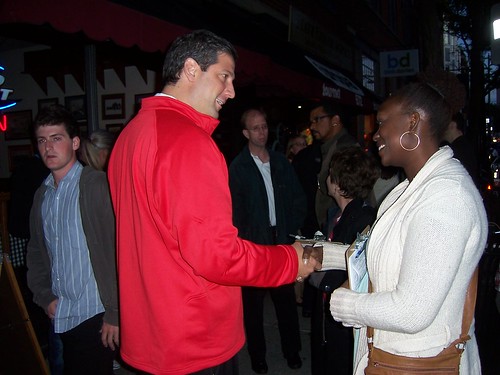
I'm inspired because it seems that ordinary people such as myself can engage with politicians. I'm surprised because Ryan said fracking (if done right) is a way to address Global Warming by using clean natural gas. And I'm confused by his support for a flat tax that is somehow progressive. I didn't know the two were compatible.
First, the congressman's remarks about fracking, then on to taxes and rebuilding US manufacturing.
Tom Over: Why do you support fracking ?

Fukushima's radioactive fallout continues to spread throughout the archipelago, deep into the ocean and around the globe---including the US. It will ultimately impact millions, including many here in North America.
The potentially thankful news is that Fukushima's three melting cores may have not have melted deep into the earth, thus barely avoiding an unimaginably worse apocalyptic reality.
But it's a horror that humankind has yet to fully comprehend.