Global

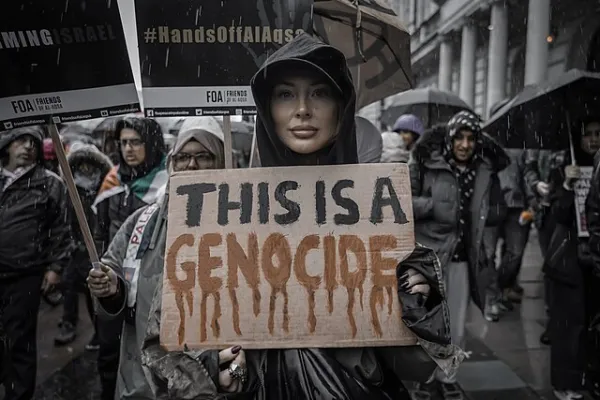
In 2014, we wrote an article titled “The Blind Alley of J Street and Liberal American Zionism.” At the time, Benjamin Netanyahu was in his sixth continuous year as Israel’s prime minister, while President Obama was well into his second term. And J Street, an emerging organization of Jews aligned with the Democratic administration, had momentum as “the political home for pro-Israel, pro-peace Americans.”
From the outset, ever since its founding in 2007, J Street has implicitly offered itself as a liberal alternative to the hardline American Israel Public Affairs Committee (AIPAC), which was established more than four decades earlier. An avowed purpose of J Street has been to seek a humane resolution of the Israeli-Palestinian conflict while maintaining fervent allegiance to Israel as “the Jewish state.”
New York - What exactly is Israel’s strategy in Gaza? Behind all the clamor about antisemitism, films about the 1940’s Jewish Holocaust and western politicians chanting about Israel’s ‘right to defend itself’ lie some ugly facts that are not spoken of in polite society.
I know antisemitism when I see it. While still a boy, I was sent to a rustic summer camp in New Hampshire. At dinner, many of the campers would chant ‘all you guys with long, long noses, come and join the fight for Moses’!
A close Jewish friend of my father bought a resort hotel on New Hampshire’s Rangeley - only to be informed that it refused to rent to Jews. That was the virulent antisemitism of the 1950’s.
At the same time my mother, a renowned journalist writing about the Mideast, and I were repeatedly threatened by pro-Israel thugs who threatened to throw acid in our faces if my mother kept writing about the nearly one million Palestinian refugees driven from the Galilee region in the 1940’s who - according to the US media - did not actually exist. They did. Many are now refugees in Gaza. My mother was forced to stop writing for US newspapers due to the cascade of threats.

BANGKOK, Thailand -- China and the U.S. are competing for liquid real estate, undersea resources, and military advantage among the South Pacific's isolated island nations, and trying to manipulate their economies, airstrips, seaports, and security forces.
China is widely perceived as expanding its Belt and Road network across the Pacific's watery "Blue Continent" to eventually reach North, Central, and South America plus the Antarctica, and empower Beijing's military, markets, international policies, and diplomacy.
On May 2, China scored a victory when the strategic Solomon Islands elected pro-Beijing Prime Minister Jeremiah Manele, 55, formerly foreign minister in the China-friendly government of outgoing prime minister Manasseh Sogavare.
The U.S., Australia, New Zealand and their allies were already worried because the two countries signed a 2022 bilateral Solomon Islands Security Agreement.
Critics feared the China-Solomon Islands pact could allow Beijing to construct a navy base on the islands, 1,200 miles (2,000 kms) northeast of Australia.
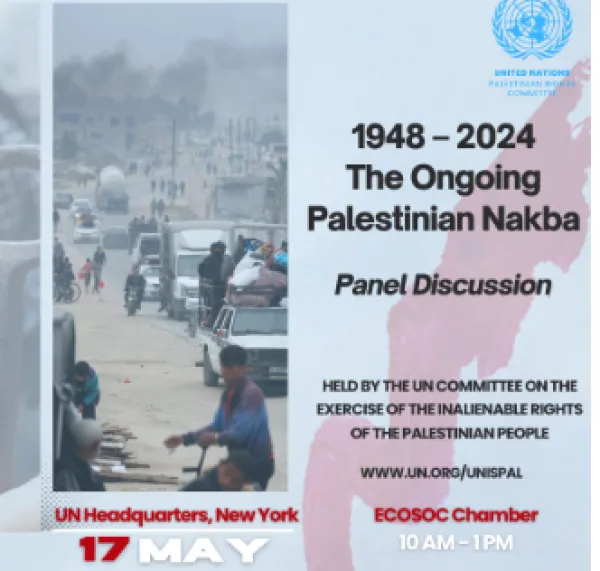
17 May 2024 New York (& UN Web TV)
Please be informed that the Committee will hold the Commemoration “1948 - 2024: The Ongoing Palestinian Nakba” on Friday, 17 May 2024, from 10 a.m. to 1 p.m. (New York time), in-person, at the ECOSOC Chamber. The event will also be livestreamed on UN Web TV.
The event, organized as a panel discussion, will examine the historical context of the 1948 events and the ongoing process of the Nakba over the past 76 years, culminating in the current war on Gaza. It will also present testimony on the current conflict and highlight international obligations and responsibilities.

Israel's response to Hamas attack on October 7th is likely to result in catastrophe for America. The world's population, and the vast majority of the world's governments, find the genocide being inflicted in Gaza to be unacceptable. America's conscientious young adults, not yet infected with ruling class propaganda, have revolted. There is no longer a way to return to the status quo that allowed Israel to dominate Palestine as has been the case since 1947. The world has changed.