Local
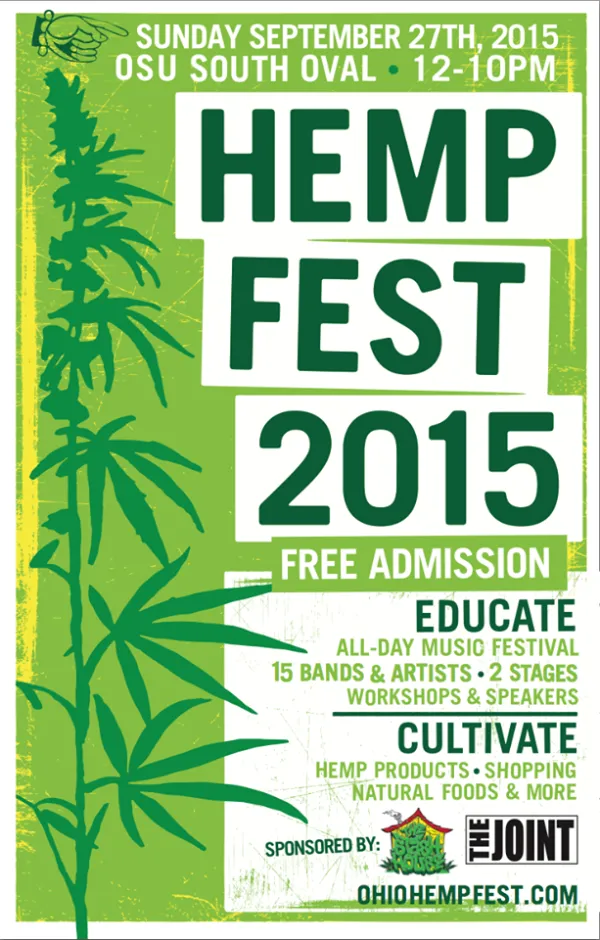
Sun, Sept 27, “High Noon ’til 10pm,” Browning Amphitheater and South Oval at Ohio State University
Purpose: To educate the public on the myriad of potential benefits offered by the Cannabis plant, including the medicinal, industrial, agricultural, economic, environmental, and other benefits and applications. In particular, Ohio Hempfest seeks to advance the cause of Cannabis policy reform through education while advancing the public image of the Cannabis advocate or enthusiast through example.
Sun, Sept 27, “High Noon ’til 10pm,” Browning Amphitheater and South Oval at Ohio State University
Purpose: To educate the public on the myriad of potential benefits offered by the Cannabis plant, including the medicinal, industrial, agricultural, economic, environmental, and other benefits and applications. In particular, Ohio Hempfest seeks to advance the cause of Cannabis policy reform through education while advancing the public image of the Cannabis advocate or enthusiast through example.
Sun, Sept 27, “High Noon ’til 10pm,” Browning Amphitheater and South Oval at Ohio State University
Purpose: To educate the public on the myriad of potential benefits offered by the Cannabis plant, including the medicinal, industrial, agricultural, economic, environmental, and other benefits and applications. In particular, Ohio Hempfest seeks to advance the cause of Cannabis policy reform through education while advancing the public image of the Cannabis advocate or enthusiast through example.

Washington is girding itself for what will be an historic visit by Pope Francis this week. So many are expected to flock into the city that government employees are encouraged to work at home. The pope will address a joint session of Congress, celebrate mass, meet with the president and tend to the impoverished. He may meet with the low-wage workers who serve food to the senators and not just with the senators. He will then go to Philadelphia and New York, give an address on climate change and possibly celebrate mass on Wall Street.
Already the political crossfire has begun, with conservatives assailing the pope for not understanding modern markets. One columnist condemned him as a false prophet, standing against “modernity, rationality, science and … the spontaneous creativity of open societies.”
Get ready: the Republicans may not know it, but they’ve all but certified their ticket for 2016, and they will probably win.
The saturation bloviation that followed this week’s Republican presidential debates missed some monumental moments, including:
(1) There was one (and ONLY one) candidate on the stage that had anything meaningful to say. It was Rand Paul. What he said about war and marijuana was of serious significance.
(2) The GOP hard core on the stage and in the audience certified their obeisance to a free pass for the horrific presidency of George W. Bush, thereby opening the door for his brother, who can almost certainly win if he runs with the guy from Ohio.
Let’s deal first with Rand Paul. Like his father (and unlike virtually anyone else in the GOP) the Senator from Kentucky seems to have some actual principles. Both Pauls have been firmly committed to the legalization of marijuana for many years, and have not wavered.
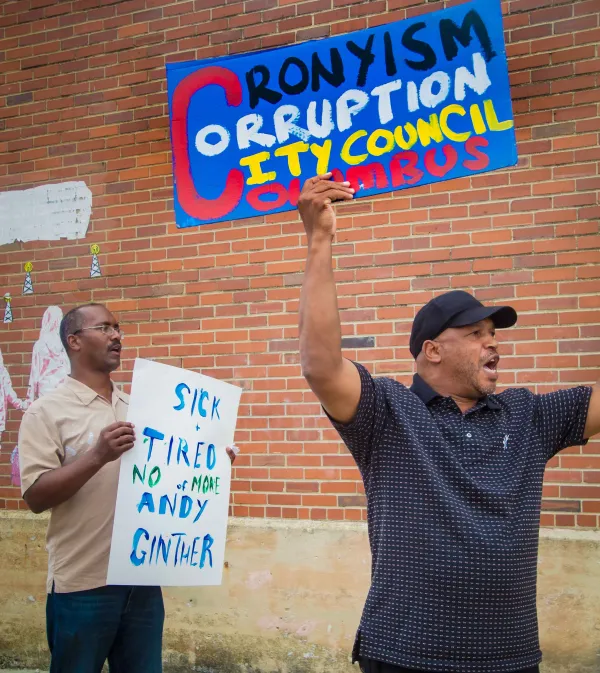
Citizens concerned with corruption and accountability in the City of Columbusheld a non-partisan rally to peacefully protest the corruption at Columbus City Hall on Wednesday, September 9; 5:00pmwhere a fundraiser for Andy Ginther was happening at Strongwater Food & Spirits, 401 W Town St. in Franklinton.
Some of Columbus’s most wealthy elite came face to face with 35-40 concerned citizens outside Mayor Coleman’s Fundraiser for his anointed mayoral Candidate Andrew Ginther.In the wake of the scandal in which former Redflex CEO pleaded guilty to bribing Columbus elected officials to the tune of $20,000 and the recent dropping out of Columbus City Council Pro Tem Michelle Mills, the City of Columbus has become synonymous with the word corruption.
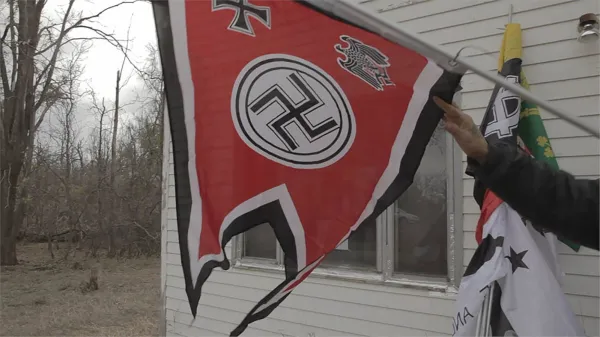
Welcome to Leith is like an updated version of The War of the Worlds. The main difference is that the invaders are modern-day Nazis rather than Martians.
Also, this time it’s for real.
Directed by Michael Beach Nichols and Christopher K. Walker, the documentary shows what happens when a group of anti-Semitic racists attempts to take over a tiny North Dakota town.
In 2012, a true believer named Craig Cobb sets the stage for the invasion by buying up several pieces of local property. He then invites members of the National Socialist Movement to come to Leith, with the hope that they’ll soon outnumber the town’s 24 residents and can start running things their own way.
Needless to say, the sudden appearance of strangers toting guns and flying Aryan banners alarms the residents and turns the community into an emotional tinder box.
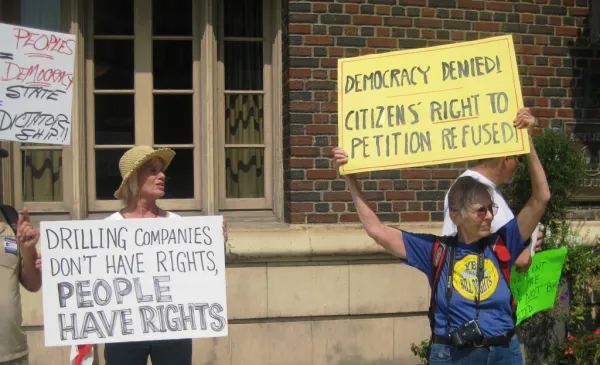
Columbus Metropolitan Club public forum luncheons are usually interesting and informative, if a little sedate. But the atmosphere was lively on Wednesday. As they arrived, attendees were greeted by demonstrators from the Ohio Community Rights Network (OHCRN).
Ohio Secretary of State John Husted was there to speak about Ohio Ballot Issues 1, 2, and 3. The protesters came from across Ohio to denounce Husted's decision to remove three county charter initiatives from the November ballot.
The initiatives include home rule provisions to restrict or ban fracking wastewater injection wells and pipelines in Fulton, Medina, and Athens Counties. "The Secretary of State claimed he was 'unmoved' by the people’s argument defending their right to petition," said Kathie Jones of Medina County. "He claimed that the content of the initiatives are illegal, and therefore cannot be on the ballot. Yet he does not hesitate to place Issues 2 and 3 on the ballot — initiatives to legalize marijuana, which violate federal law.
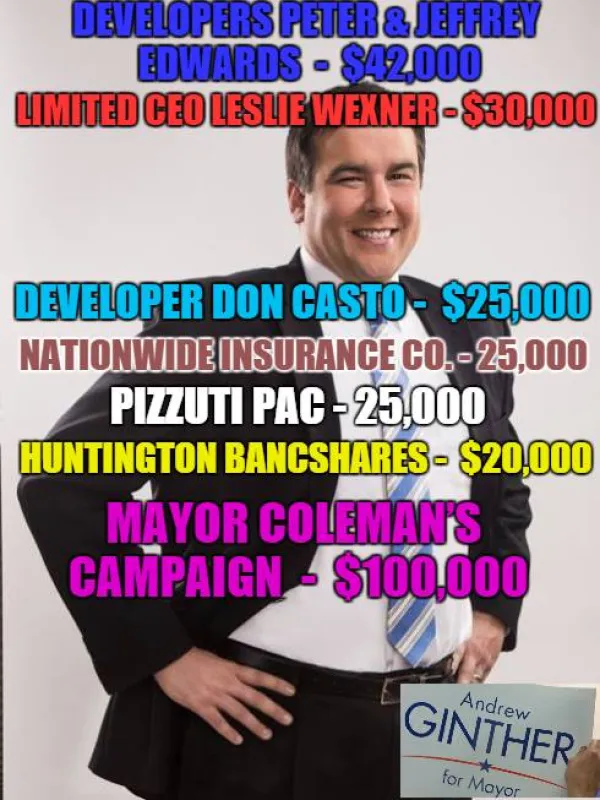
A non-partisan rally to peacefully protest the corruption at Columbus City Hall:
Where: Strongwater Food and Spirits, 401 W Town St, Columbus, Ohio 43215
When: Wed., Sept. 9 5-6:15pm