
The Free Press is bringing back a Reviews section after some absence. We hope to review plenty of events around town. Check back frequently and if what\'s going on is any good.
Arts & Culture
Image

There have been countless productions of William Shakespeare’s masterpiece King Lear, since it premiered circa 1606 at London’s Globe Theatre. The Bard reportedly wrote the lead role for his troupe’s top tragedian, Richard Burbage, but since then many stage and screen stalwarts have portrayed the title character, including Laurence Olivier, Paul Scofield, Anthony Hopkins, Ian McKellan, Al Pacino and but of course, Orson Welles. The first motion picture iteration was lensed by 1909, a 16-minute silent film starring William V. Ranous.
A variety of countries and ethnicities have tackled Lear. The veteran Soviet helmer Grigoriy Kozintsev’s (who co-directed the 1926 adaptation of Gogol’s novel The Overcoat, 1929’s Paris Commune drama The New Babylon and 1964’s Hamlet) final film was a version of Lear made in 1970. In 1974 African American actor James Earl Jones starred in a small screen version that was broadcast by PBS’ Great Performances series. In 2018 the TV movie The Yiddish King Lear was aired, and so on.
So what’s left to say about this oft-produced Shakespearian tragedy?
Image
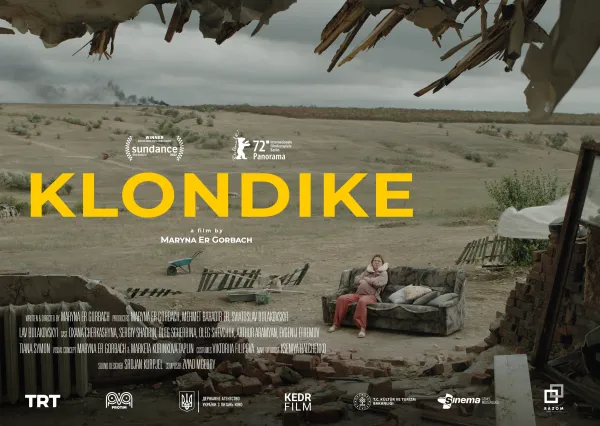
If it’s true, as General William Tecumseh Sherman reputedly observed during America’s Civil War, that “war is hell,” according to Kyiv-born Maryna Er Gorbach’s Klondike, the “hottest seat in hell” (to paraphrase Dante) seems reserved for those ensnared in the civil war in eastern Ukraine’s Donetsk region. One of the grimmest films I’ve ever seen, Klondike is so bleak in its realistic depiction of warfare that it almost makes two antiwar classics that won Best Picture and Best Director Oscars – Lewis Milestone’s1930 All Quiet on the Western Front and Oliver Stone’s 1986 Platoon – look like musical comedies in comparison.
As Oksana Cherkashyna, who stars as Irka, told the audience after a SEEfest screening at the Lumiere Cinema in Beverly Hills, Klondike dramatizes actual events that took place when the war between Russia and Ukraine really “started eight years ago” in 2014, with armed conflict in the Donbas, while what we’re witnessing now is “a full-scale invasion” by the Russian Federation of Ukraine.
Image

Hawaiian Soul was screened on the opening day of the 38th annual Los Angeles Asian Pacific Film Festival, which provides a launching pad for Indigenous Pacific Islander productions in Hollywood. Shorts, documentaries, animation and features by and about the Native peoples of Polynesia, Melanesia and Micronesia, as well as by Asian and Asian-American filmmakers, are being screened at various venues in the world’s movie capital by this filmfest that spotlights South Seas Cinema, taking place May 5-13.
Since 1983 Visual Communications, a nonprofit organization, has presented LAAPFF, dedicated “to develop and support the voices of Asian American and Pacific Islander filmmakers and media artists who empower communities and challenge perspectives.” The L.A. presentation of the outstanding Hawaiian Soul is a perfect onscreen expression of this mission statement by LAAPFF, which provides a perch for works by and about Oceanic talents and topics in Los Angeles. The below is the first in a series of reviews of selections from this year’s Pacific Islander works at LAAPFF.
HAWAIIAN SOUL: ACTIVIST/MUSICIAN GEORGE HELM AND HELMER ʻĀINA PAIKAI
Image

Since 1898, when a Thomas Edison camera crew on location in Honolulu shot the first footage ever filmed in the Pacific Islands, the South Seas Cinema movie genre has been dominated by Haole (Caucasians) male filmmakers lensing productions primarily for the consumption of Haole audiences in order to make money. These motion pictures include Mutiny on the Bounty and The Hurricane, written and directed by, and usually starring, Haoles. This phenomenon – call it “Haole-wood” – is examined in books such as Hawaiian film historian Matt Locey’s White Lens on Brown Skin, dropping this summer (see: https://mcfarlandbooks.com/product/white-lens-on-brown-skin/).
Image

V.I. Lenin proclaimed: “For us, the cinema is the most important of the arts.” The leader of the Russian Revolution said this around 1922, the year Benito Mussolini’s blackshirts rose to power in Italy, and later decreed: “Film work facilitates fascist penetration.” Both extremes of Left and right recognized the central role motion pictures could play in propaganda, in reaching the masses with their messages and agitating them to take action. Albanian director Roland Sejko’s The Image Machine of Alfredo C. is about an Italian cameraman who shot newsreel-type footage for Il Duce’s fascists and then for the Communists in Albania.
The 17th annual South East European Film Festival kicked off with Croatian co-writer/director Antoneta Alamat Kusijanovic’s film Murina, which reminded me of Michelangelo Antonioni’s 1960 L’Avventura. While Antonioni’s classic won Cannes’ Jury Prize, Murina scored the renowned French film fete’s Caméra d’Or (Golden Camera) accolade for best first feature film. If Antonioni’s masterpiece about alienation is largely set in the Mediterranean off of the Italian coast and was shot in black and white, Kusijanovic’s directorial debut of a full-length production was lensed in stunning color in the Adriatic Sea and at remote Croatian isles, located in what had been part of former Yugoslavia.
Image

Thousands of out-of-towners and Angelenos flocked to attend the 13th annual Turner Classic Movies Classic Film Festival, which featured a panoply of motion pictures from across the decades, talents, parties and panels celebrating – and analyzing – the cinema as an art form and “that screwy ballyhooey Hollywood,” where the fete took place on location April 21-24.
The cornucopia of screenings included 1982’s E.T. The Extraterrestrial at TCL Chinese Theatre IMAX, with the Turner Classic Movies channel’s host Ben Mankiewicz interviewing director Steven Spielberg onstage at the fabled movie palace, renowned for its courtyard with stars’ footprints/handprints in cement, where Lily Tomlin was thus immortalized at a Festival ceremony attended by her co-star Jane Fonda. Other extravaganzas shown on the big screen at this venerable venue formerly known as Grauman’s Chinese Theatre included: 1956’s Giant, starring James Dean, Elizabeth Taylor and Rock Hudson; 1939’s The Wizard of Oz with Judy Garland; 1952’s Singin’ in the Rain starring Gene Kelly and Debbie Reynolds; and 1973’s The Sting, featuring Paul Newman and Robert Redford.
Image

As the war in Ukraine makes front page news, a new documentary and film festival are shining a spotlight on this Eastern European nation that has been the setting for three of the greatest productions of all time. Sergei Eisenstein’s 1925 Battleship Potemkin (https://www.imdb.com/video/vi1065917209?playlistId=tt0015648&ref_=tt_ov_vi), about the mutiny aboard one of the warships in the czar’s Black Sea fleet and the mass strike in the port city of Odessa during the 1905 Revolution was shot and set in Ukraine. The famed “Odessa Steps sequence” (https://www.youtube.com/watch?v=4xP-8r7tygo), which still jolts the senses, with the senseless barbaric cruelty of the czarist troops and Cossacks massacring frenzied, fleeing, unarmed civilians – baby carriages, amputees, stone lions and all.
Image

As that sixties’ saying puts it, “the personal is political.” In the case of The Last Boy, which is being presented April 27 on Holocaust Remembrance Day at the renowned Town Hall in Midtown Manhattan’s Theater District, the personal is political and also theatrical to me. That’s because this timely fact-based anti-Nazi drama stars my 21-year-old cousin, who is making an auspicious Broadway debut.
Bret Sherman portrays the title character in The Last Boy, which is “about a group of seven boys who are in the Terezin camp in Czechoslovakia,” notes Sherman. “They are living through this terrible, dark time. But the playwright/director, Steve Fisher, does a really great job of not dwelling on that too much, of the miserable atmosphere they’re a part of. Because at the end of the day, while we can look back at it now and realize that was such a terrible time, and I’m sure the boys realized they were being mistreated, but they obviously didn’t have a ton of information and I don’t think they understood the scope of what was happening,” as Hitler’s “final solution” exterminated millions of Jews and others during World War II.
Image

Like other nationalities, Hollywood has manufactured cinematic stereotypes of the French. Unlike Tinseltown movies such as 1951’s An American in Paris, 1954’s The Last Time I saw Paris, 1964’s Audrey Hepburn-William Holden comedy Paris When It Sizzles, and 1972’s Last Tango in Paris, there are no berets, brioches, baguettes, accordions or on location (or B unit) shots of urban landmarks such as the Eiffel Tower or Montmartre’s Sacré-Coeur Basilica to be found in Parisian Jacques Audiard’s Paris, 13th District. Indeed, the long shots of this arrondissement (district) on the Seine’s left bank consist mostly of hideous high rises – not the charming architecture often associated with the City of Lights.