
Global

OK, I admit it - I’m a cinematic scaredy-cat. Ever since small kid days, horror movies have frightened the hell out of me. The last one I went to see was a 2018 LA Film Festival screening of Spell, which I saw because it was set and shot on location in Iceland, a country I’ve only seen from the sky and am interested in. To tell you the truth, I did manage to get through it sans any nightmares, night terrors and the like - but I still wasn’t prepared for what writer/director/producer Jordan Peele had in store for us in the terrifying Us.
To tell you the truth, I would never have bought a ticket to see this horror-fest, but because I was invited to a private critics’ screening I screwed up my courage, bit the bullet, went to see it - and boy am I glad I did. Us may be creepy, but man, is it GRRREAT!

Nationalists — white or otherwise — need “invasions” on a regular basis in order to stay revved up and equal to the cause. Thus:
“We are experiencing an invasion on a level never seen before in history,” the New Zealand killer (whose name I will not mention, honoring the precedent set by the country’s prime minister, Jacinda Ardern) said in his gonzo manifesto. “Millions of people are pouring across our borders, legally, invited by the state and corporate entities to replace the white people who have failed to reproduce, failed to create cheap labor, new consumers and tax base that the corporations and states needs to thrive.”
This is so ironic, considering . . . uh, history.

This week, war industry employee Hans Binnendijk claimed in the weapons-advertisement conveyance

he Trump Administration has delivered yet another concession to Israel’s embattled Prime Minister Benjamin Netanyahu on the eve of parliamentary elections: the Israeli military occupation of much of the Palestinian West Bank and of the Golan Heights will no longer be referred to in official U.S. government documents as an occupation. America’s so-called Ambassador to Israel is a former Trump lawyer named David Friedman who is more involved in serving Israel than the United States. He personally supports the view that the illegal Jewish settlements are legitimately part of Israel, choosing to ignore their growth even though it has long been U.S. policy to oppose them. He has also long sought to change the State Department’s language on the Israeli control of the West Bank and Golan Heights, being particularly concerned about the expression “occupied,” which has legal implications.
Bases, Europe, Nonviolent Activism
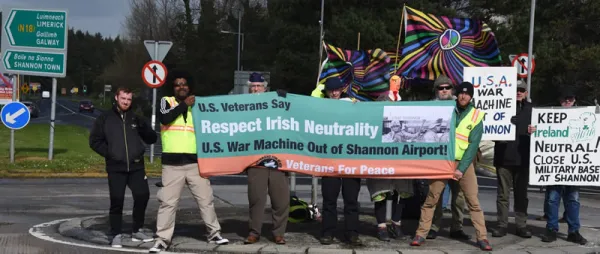
Two U.S. Veterans For Peace Refused Bail at Ennis District Court
Charged with Trespass and Causing Criminal Damage at Shannon Airport
Monday 18 March
Two US veterans were arrested at Shannon Airport on 17 March for entering the airfield to inspect and investigate an OMNI Air International plane on contract to the U.S. military. The two, Tarak Kauff and Ken Mayers, were refused bail at Ennis District Court today.
The plane, tail number N351AX, arrived at Shannon Airport about 8.30 a.m. from Eielson US air force base in Faribanks Alaska, believed to be on its way to the Middle East with up to 300 armed US troops.
At about 10 am Mayers, a former Marine Corps Major and Kauff, a former Army paratrooper, both members of US Veterans For Peace, entered the airfield carrying a large banner that said:
U.S. Veterans say
Loft Ensemble’s lofty, must-see, powerful production of Blues for Mr. Charlie is the latest in a growing list of a revival of works by author/ playwright/polemicist James Baldwin, one of America’s “poet laureates” opposing racism. I believe this Renaissance was launched by Haitian filmmaker Raoul Peck’s Best Documentary Academy Award-nominated 2016 I Am Not Your Negro, with Samuel L. Jackson giving voice to the man who wrote 1962’s The Fire Next Time and so much more.

“Our research suggests that, for those (trolls) with sadistic personalities, (their) ideal self may be a villain of chaos and mayhem”
A 2014 psychology journal article done by a group of Canadian researchers studied the personality traits of internet trolls. The well-designed study was published in the Journal of Personality and Individual Differences. It was titled “Trolls Just Want to Have Fun”.
The article included these comments:
“Trolling correlated positively with sadism, psychopathy and Machiavellianism”;
“Internet trolls engage in the practice of behaving in a destructive or disruptive manner in a social setting on the internet with no apparent purpose”;
“Trolls operate as agents of chaos on the Internet”;
“Cyber-trolling appears to be an internet manifestation of everyday sadism”;
“If an unfortunate person falls into their trap, trolling intensifies for further “merciless amusement”;
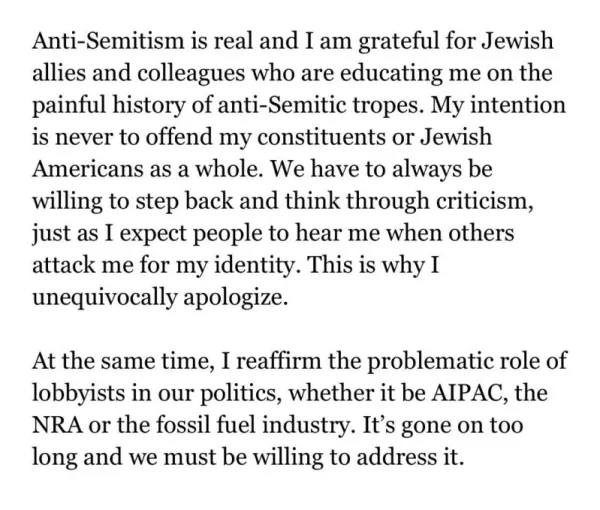
Democrats have gone all atwitter (pun intended), scattering ruffled feathers all over the barnyard as if a fox were after them when the only serious threat to their blinkered preconceptions comes from a bird of different plumage. Not all Democrats are squawking like chickens with their heads cut off (as it were), but enough of the older, backward-looking birds are making enough noise to make the whole party look idiotic.
In plainer language, the Democratic Party remains in the grip of white privilege, which can only be a losing position in a country where there’s no effective challenge to Trump for the white supremacy vote. Want proof? Nominate Biden. But that’s only a prediction. What’s going on right now in the House of Representatives is reprehensible enough as reflexive ideologues swarm to block the smallest whiff of any fresh air.

Most of us are aware and skeptical of “bots” interfering with our daily lives. Some modern examples of this include suspicious insurance calls and obviously fake suitors on dating apps. It seems most of us have encountered them in one way or another.
The creation of these bots came from the modern need for automation — using robots to increase efficiency. This often means removing human responsibility. For instance, we know from the accounting industry that automation has all but erased the need for the human touch in data entry.

When I went to medical school in the late 1960s, one of my wiser pediatric professors told us students: “always listen to the parents of your pediatric patients, because they will tell you what is wrong with the child”.
That truism proved to be valuable in dealing with patients and their family members throughout my career in family practice, and I still believe in its profound truth. Even when dealing with adult patients, I have found that family members often have valuable observations and know important historical facts about the patient that helped me make a more accurate and timely diagnosis.
I have heard many physicians complain that they are sometimes kept from obtaining a thorough medical history because of time constraints imposed on them by their clinics, which can impair the development of the list of potential diagnoses. Important examples of diagnoses that are frequently not considered are the host of vaccine-induced adverse effects – partly because they are largely un-recognized by many pro-vaccine physicians and nurses and partly because they qualify as being iatrogenic.