
Arts
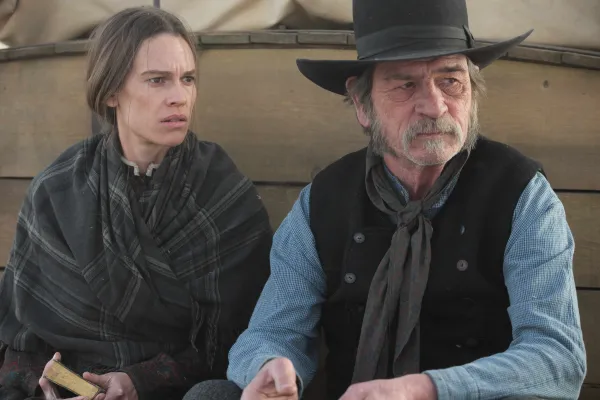
Frontier life was tough in the 1850s, particularly if you were a woman. That’s the prime message of The Homesman.
Winters were harsh. Crops were uncertain. Disease was rampant. Foreplay had yet to be invented.
Directed and co-written by Tommy Lee Jones, and based on a novel by Glendon Swarthout, The Homesman takes place in pre-statehood Nebraska at the end of a particularly brutal winter. In one community, the hardships have robbed three women of their sanity. Their symptoms include hostility, withdrawal and—as depicted in the film’s most horrific scene—infanticide.
The local minister (John Lithgow) decides the solution is to transport the women to a church in Iowa where they can receive care. That leaves the question of who’s going to undertake this difficult journey across the desolate plains.
When the local men are unable to accept the task because their families need them, an unmarried farmer named Mary Bee Cuddy (Hilary Swank) volunteers. The others agree she’s as capable as any man, and they provide her with a mule-driven wagon equipped with a padlocked enclosure.
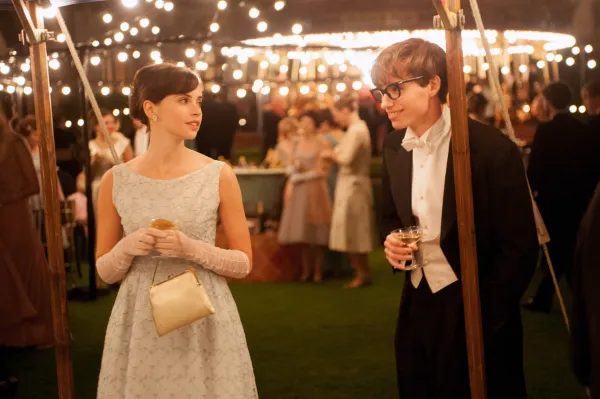
Stephen Hawking is known as the brilliant physicist who slumps in a wheelchair and speaks through a computer-generated voice. In The Theory of Everything, we first meet the Brit when he’s a still gawky university student bicycling wildly through the streets of Cambridge.
He’s already brilliant, however. That becomes obvious when a professor assigns his class a series of 10 questions, “each more impregnable than the last.” Though his fellow students are stymied, Stephen returns with the correct and densely complex equations scribbled on the back of a railway schedule.
Directed by James Marsh (Man on Wire), The Theory of Everything is based on a book written by the scientist’s first wife, Jane Hawking. That helps to explain why it’s more interested in Stephen Hawking the husband and family man than in Stephen Hawking the scientist.
In the first half, both sides of his life are pretty well integrated.
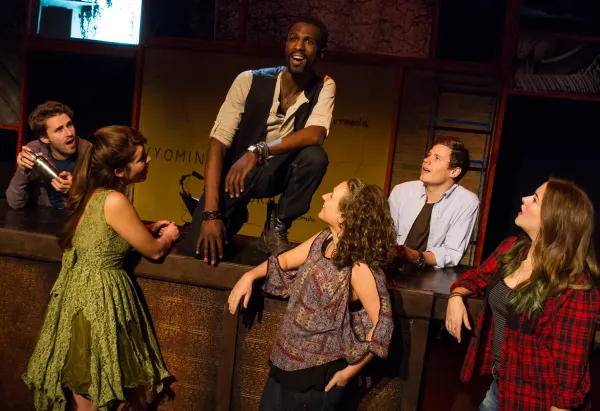
What do you do when you’re 20-something and stuck in a dead-end job or relationship? According to Fugitive Songs, you hit the road.
Lyricist Nathan Tysen says the show consists of songs he and composer Chris Miller wrote for other projects that fell through. After realizing that all of them were about people on the run from one thing or another, they decided to combine them into a “song cycle” that’s united by a general theme rather than characters or plot.
It sounds like a haphazard way to construct a show, which may lead you to believe you shouldn’t expect too much. And after hearing the first handful of angsty but unmemorable songs, you may think you were right.
With song No. 6, though, things start to turn around. “Get me the hell out of Washington Heights,” sings the sonorous-voiced Ezekiel Andrew, playing the part of a man who’s spent too much time in one neighborhood. From that point on, the songs are as well-honed as the singers who deliver them.

I'm a 59 year old artist that's been painting since 1974. I'm self taught and have been labeled "Outsider/Visionary Artist" and I have no qualms over this description being that my desire, drive to create art is driven from personal issues and not from an "art for art's sake" or some preconceived notion of ever making a living from my artistic endeavors. I've often said that I paint because I'm unable to do much else...unfortunately that's closer to the truth than just a self effacing quip. I never acquired enough credits to graduate the low standards, rural high school that I attended. Predictably my only high marks were from Art and Creative writing classes. So it seems I'm the poster boy for ADHD!
Yes, I know that the definitions over this term can be a bit loose and may be over diagnosed but with me, it fits me to a "T." This past summer I underwent six hours of "comprehensive cognitive" testing.

Remember Deep Throat, the mysterious source who helped to unravel the Nixon administration’s Watergate scandal by meeting a reporter in a parking garage? Citizenfour begins with a series of cryptic email exchanges that makes that secrecy precaution seem like child’s play.
“This will not be a waste of your time,” a would-be informant assures documentary filmmaker Laura Poitras. When Poitras and a couple of reporters for a British newspaper finally meet the informant in a Hong Kong hotel, this proves to be the understatement of the decade.
The man is Edward Snowden, a consultant who until recently had been working with the National Security Agency. He has an astounding story to tell about how much the government has infringed on the average citizen’s privacy in its efforts to fight terrorism. As Poitras’s camera watches and the reporters take notes, he proceeds to do just that.
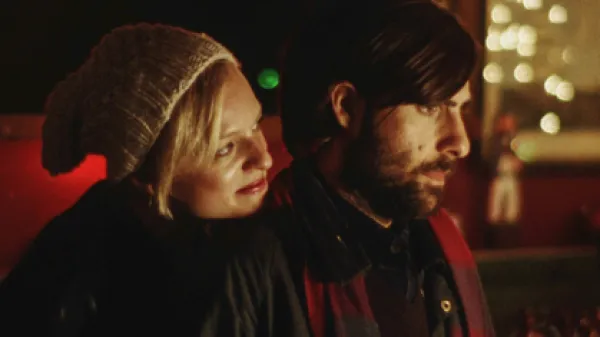
Alex Ross Perry says he was inspired to write and direct Listen Up Philip because he read a novel in which the central character disappears for much of the book. He thought it would be interesting to make a movie in which the same thing happens.
After seeing Listen Up Philip, I think he should have waited for a little more inspiration.
Perry says he also was influenced by a period in his own life when he was forced to travel and thus lost touch with his own friends and relationships: “they were all being put on hold.”
But presumably Perry had been a more devoted friend than title character Philip (Jason Schwartzman), who’s so self-centered and devoid of empathy that he’s basically absent from other people’s lives even when he’s physically present. In light of that shortcoming, what difference does it make to them—or to us—if he decides to go away for a while?
The young writer is feeling stifled by his life in New York and by the expectations that follow the success of his first novel. So when established author Ike Zimmerman (Jonathan Pryce) invites him to spend time at his secluded upstate home, Philip readily accepts.
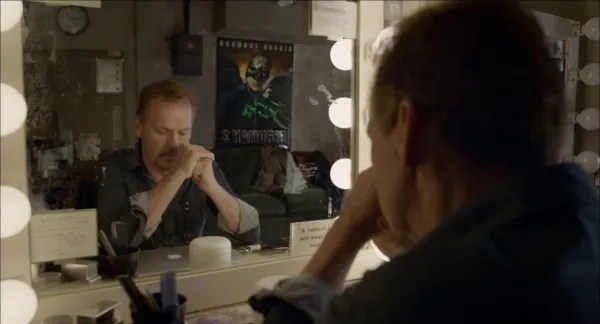
In 1948, Alfred Hitchcock released Rope, a murder mystery with an intriguing gimmick: The film was shot in long takes that mimicked the continuous action of live theater.
In 2014, Alejandro Gonzalez Inarritu has attempted the same high-wire act with Birdman (or, The Unexpected Virtue of Ignorance). Actually, the Mexican director/co-writer (Biutiful) has gone his predecessor one better. While Hitchcock was forced to introduce a new shot at 20-minute intervals to coincide with the changing of reels when the film was screened, Birdman appears to have been made in one unedited take.
It wasn’t, obviously, but Inarritu’s bold attempt to carry off the illusion (with help from Oscar-winning cinematographer Emmanuel Lubezki) adds an extra measure of eccentricity to a film that already defies convention.
In a role that partially mirrors his own career, Michael Keaton stars as Riggan Thomson, an actor whose popularity peaked when he played a superhero named Birdman in a trio of blockbuster hits. (Keaton, of course, had his greatest success playing the Caped Crusader in 1989’s Batman and its 1992 sequel, Batman Returns.)
Vishal Bharadwaj take a bow. What a superb movie. When a non- Indian friend of mine who does not understand Hindi finds it "Brilliant", I can safely say that you have done your job as an artist in a “brilliant” manner. By transcending the boundaries of nations and languages you managed to touch a chord.
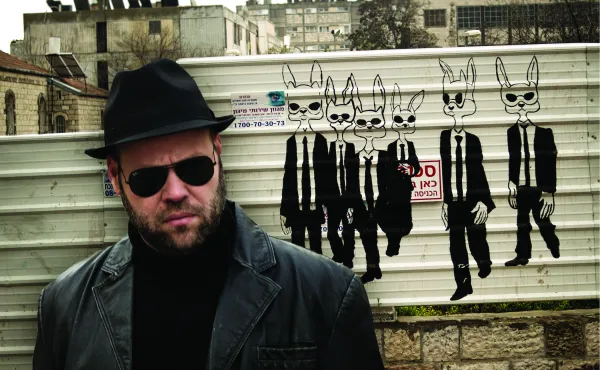
Did you know “The Last of the Red Hot Mamas” was Jewish?
Sophie Tucker (1887-1966) was regarded as a pioneer among female entertainers, performing material that was risqué for her time. Yet she was the product of a particularly strict Jewish upbringing. “She grew up in an Orthodox family,” said Emily Schuss, director of the Columbus Jewish Film Festival. “But obviously she then kind of went off that path a little bit to become an entertainer.”
Tucker’s life and career are celebrated in The Outrageous Sophie Tucker, a documentary featured in the 10th of the series’ less-serious offerings, Schuss said, but certainly not the only one.
For example, there’s It Happened in St. Tropez, which Schuss described as a “really light French comedy.” These and other films should appeal to viewers of all backgrounds, she said. “The films are really diverse this year,” Schuss said. “You know, a lot of people think, ‘Oh, they’re just going to show a bunch of Holocaust movies,’ but we really don’t.”
Not that the most tragic of 20th annual “Doc Sunday,” The Outrageous Sophie Tucker will be followed by Rescue in the Philippines: Refuge From the Holocaust.

Celia C. Peters is an avant-garde director and award-winning screenwriter creating compelling stories of authentically diverse characters. Peters is a member of New York Women in Film and Television and the Writers Guild of America. She was awarded a 2012 residency at Hawthornden International Retreat for Writers in Midlothian, Scotland. Her psychologically inspired, character-driven screenwriting has been both prize-winning [Godspeed, 2011 African American Women in Cinema Film Festival; Roxë15, 2004 SFBFF] and recognized in competition.
Her filmmaker credits include the experimental performance piece, “Poem in Motion (2011),” the short documentary “Rethinking Beauty (2011),” and “Editing Uptown (2010),” a featurette on the nationally distributed DVD of the indie film, “Uptown.” In 2007, Peters produced a half-hour segment, “The State of Hip-Hop” for WHUT/PBS and her short film “Breakthrough (2006),” was broadcast nationally on BET’s The Best Shorts series.