
Arts

A recent college graduate complains that she’s still struggling to find a good job despite her shiny new degree. Meanwhile, she faces the even bigger challenge of paying off $140,000 worth of student loans.
“It’s syphoning off my future,” she says of the massive debt.
The woman’s all-too-common predicament is explained in Ivory Tower, a thoughtful documentary that examines just how college came to be such an overwhelming expense. Directed by Andrew Rossi (Page One: Inside The New York Times), the film goes so far as to suggest that America’s ever-rising cost of higher education is unsustainable.
It wasn’t always this way, the film recalls. As recently as the 1960s, education at a state university was so cheap that just about anyone could afford it. But then came the 1970s, and conservative politicians such as Ronald Reagan started pushing government to stop subsidizing students’ education.

According to Christian doctrine, Calvary is where Jesus died for our sins.
By naming his new film Calvary, writer-director John Michael McDonagh is suggesting a dark metaphor: Father James (Brendan Gleeson), an Irish Catholic priest, is being called on to die for the sins of others.
Specifically, for the sins of the Catholic Church.
The first scene finds James in the confessional booth opposite a man who tells him that as a boy he spent five years being raped by a priest. James asks if he’s sought counseling to deal with his trauma, but the man isn’t interested in healing. He wants vengeance.
On the following Sunday, the man vows, he will meet Father James on the beach and kill him. Why take his anger out on James? The man explains that his attacker has long since died, and anyway, killing a bad priest would accomplish nothing. The only way to send a message about the horror he endured is to kill a good priest like James.

In 1990, in the Badlands of South Dakota, a team of paleontologists found the biggest and most complete Tyrannosaurus rex fossil that had ever been discovered.
Then, about two years later, all hell broke loose.
It sounds like the plot of a new Jurassic Park sequel, but it’s actually the description of Dinosaur 13, a documentary by Columbus native Todd Douglas Miller. If you think big government poses more of a potential threat than a big, extinct carnivore, you’ll find it scarier than anything Steven Spielberg could have dreamed up.
The team was led by brothers Peter and Neal Larson and included Susan Hendrickson, the first person to stumble upon the fossil. According to the participants’ accounts of that fateful August day, they instantly realized the momentousness of their discovery.
Over the next couple of weeks, they carefully unearthed the giant fossil and began carting it back to their headquarters at the Black Hills Institute of Geological Research in Hill City. There they began the painstaking task of separating the pieces from each other and the surrounding rock.

Presumably, you’ll be able to see The Hundred-Foot Journey without sitting through the intro that preceded preview screenings. Lucky you.
In the short teaser, producers Steven Spielberg and the “a-ma-zing!” Oprah Winfrey talked about the flick’s cross-cultural significance. This was obviously meant to whet viewers’ appetites, but it could well have backfired by making Journey sound like a self-righteous sermon.
Fortunately, the new film from director Lasse Hallstrom (Chocolat) manages to leaven its message with humor. Even more fortunately, the humor avoids the cultural stereotypes that marked, for example, the recent Million Dollar Arm.
“Papa” (Om Puri), son Hassan (Manish Dayal) and the rest of their family are depicted as intelligent but lovably quarrelsome human beings who happen to operate a restaurant in Mumbai, India. In the opening scenes, Hassan’s mother is shown infusing him with the love of cooking before a tragic fire takes her life and forces the family to relocate.

If The Miracle Worker had a male lead, Matt Clemens would be perfect for the part.
In the past year, I’ve seen two theater productions that forced me to upgrade my opinions of the musicals in question. The first was Sunday in the Park With George at Short North Stage; the second was CATCO’s current staging of Dirty Rotten Scoundrels.
The one thing the productions have in common is that Clemens was cast as the male lead. To be sure, both shows have many other fine attributes, but it’s hard to overestimate the actor’s contributions. Not only does he sing like an angel—a fallen angel in the CATCO show—but he imbues his characters with enormous appeal.
In Scoundrels, David Yazbek and Jeffrey Lane’s stage adaptation of a 1988 movie, he plays a huckster named Lawrence who poses as a prince in order to prey on wealthy women vacationing on the French Riviera. Despite this morally bankrupt occupation, Clemens somehow convinces us Lawrence is a basically decent guy who’s worthy of our attention. Neat trick.

Cancer took the life of film critic Roger Ebert in 2013, 14 years after it claimed former TV co-host Gene Siskel.
Unlike Siskel, however, Ebert did not sneak off into the great beyond. Even after thyroid cancer necessitated the removal of Ebert’s lower jaw—taking away his ability to eat, drink or speak—he remained a public figure with help from a prosthetic chin and a computerized voice.
Director Steve James (Hoop Dreams) recaps Ebert’s storied career in Life Itself, a documentary named after the critic’s 2011 memoir. Because James began his documentary only five months before Ebert’s death, it also serves as a record of his harrowing final days.
It may be due to the unexpectedly short time James had with Ebert that Life Itself comes off as a bit messy. Though it follows a generally chronological outline, some segments seem to be stuck here and there for no particular reason.

Borgman reminds me of a movie I kind of liked. But it also reminds me of a movie I hated.
The flick I liked was the recent Under the Skin, starring Scarlett Johansson as an alien who uses sex to lure men to their doom. The flick I hated was 2007’s Funny Games, in which two creeps take over an upper-middle-class household and begin treating the family in a most sadistic manner.
Borgman has eccentricities all its own, but it contains elements of both films. Like Under the Skin, it’s about a mysterious figure whose malevolent actions are never quite explained. And as in Funny Games, the individual’s target is a well-to-do family.
Written and directed by Alex van Warmerdam (Voyeur), the subtitled Dutch film begins with a scene that sets the off-kilter tone: A priest leads a Communion ceremony, then grabs a shotgun and leads a small posse into the woods. There they locate and attack the underground bunker of a grizzled man who goes by the name of Camiel Borgman (Jan Bijvoet).
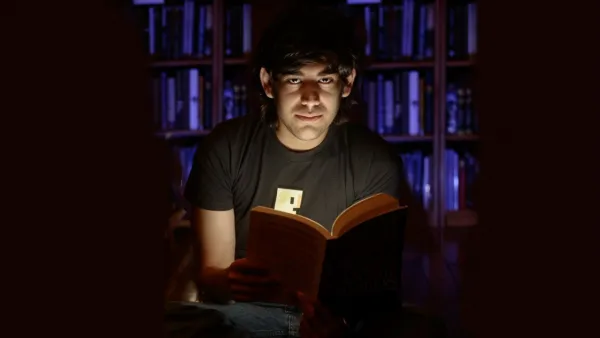
The Internet’s Own Boy: The Story of Aaron Swartz begins with a quote from Thoreau that asks how citizens should react to unjust laws. The philosopher of Walden Pond asks whether we should simply obey them or try to change them, obeying them in the meantime.
Or, he concludes, “shall we transgress them at once?”
Thoreau makes it clear that he favors the latter approach, and the same could be said for the subject of Brian Knappenberger’s documentary, Aaron Swartz.
Before his suicide last year at the age of 26, Swartz was known as one of the computer age’s brightest whiz kids. His many accomplishments included playing central roles in the founding of Reddit, an online news site, and Creative Commons, an alternative to restrictive copyright laws.
Since his death, Swartz has been considered a martyr in the fight against those who seek to compromise Internet access for the sake of profit.

It’s surprising that the Gateway Film Center isn’t screening Citizen Koch as part of its Nightmares on High Street series. If your politics are anywhere to the left of, say, Antonin Scalia’s, the documentary is as scary as any horror flick.
The title alone should bring shivers to those who see the PAC-funding Koch brothers as all-powerful manipulators of public opinion. Some even blame them for the recent defeat of the Columbus Zoo levy, thanks to misleading information put out their organization, Americans for Prosperity.
Well, maybe they’re not that powerful. Post-election analysis shows that voters had many problems with the levy, even if they weren’t dumb enough to fall for the group’s propaganda.
But filmmakers Carl Deal and Tia Lessin demonstrate that the Kochs and other deep-pocketed conservatives do pack a formidable punch. And it’s gotten even more formidable thanks to the Supreme Court’s 2010 Citizens United ruling, which made it possible for wealthy individuals, corporations and other organizations to contribute essentially unlimited amounts of money to the task of shaping public opinion.