
The Free Press is bringing back a Reviews section after some absence. We hope to review plenty of events around town. Check back frequently and if what\'s going on is any good.
Arts & Culture
Image
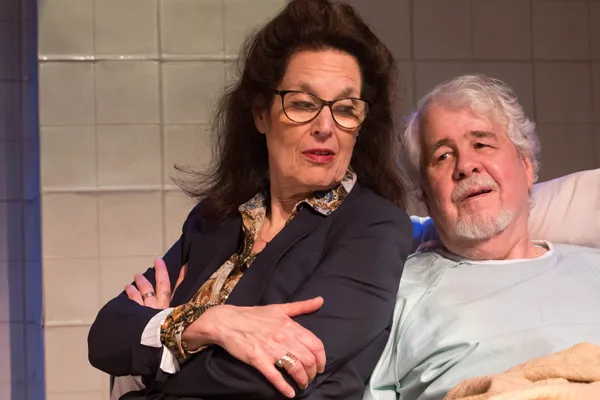
Rogue Machine, which earned the Best Season Ovation Award for 2017, is known for pushing the theatrical envelope with edgy, often hard-hitting shows. These hot potato topics range from Western colonialism in Africa in Lorraine Hansberry’s Les Blancs to racism at home in Mexican Day, Dutch Masters and One Night in Miami to contemporary anti-fascism in Daytona to psycho-sexual angst in bled for the household truth and Cock, et al.
But with its world premiere of 100 Aprils Rogue Machine is tackling its heaviest topic yet: Genocide. Playwright/co-star Leslie Ayvazian's one-acter takes a deep dive into the 1915 ethnic cleansing of Armenians and the trans-generational PTSD that is passed down to its characters in a 1982 psychiatric ward of a hospital. Well, it’s not exactly a musical comedy - in dramatizing the mass murder of Armenians 100 Aprils is unrelentingly depressing.
Image
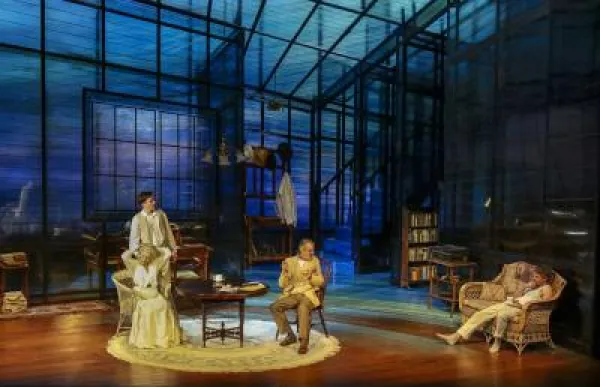
The Bristol Old Vic Production of Long Day’s Journey Into Night is a masterful rendition of Eugene O’Neill’s masterpiece about the human condition. The British cast is led by the venerable thesp Jeremy Irons, who won an Oscar for 1990’s Reversal of Fortune, and Lesley Manville, who was Academy Award-nominated this year for portraying Daniel Day-Lewis’ sadistic sister in Phantom Thread.
The approximately three and a half hour two-acter is the stuff of Greek tragedy and Shakespearian drama, as it follows the descent of the Tyrone family into the long night of the soul. All of the onstage action is set at the Tyrones’ coastal cottage in Connecticut, where the fog rolls in and out as a foghorn sounds in the background. (Ask not for whom the foghorn tolls - it tolls for thee!) Joining James (Irons) and Mary Tyrone (Manville) are their sons, James Jr. (Rory Keenan, who has appeared often at Dublin’s fabled Abbey Theatre) and Edmund (Matthew Beard), who proceed to tear one another - and their selves - to pieces, like birds of prey in a familial feeding frenzy over faults and flaws, real or imagined.
Image
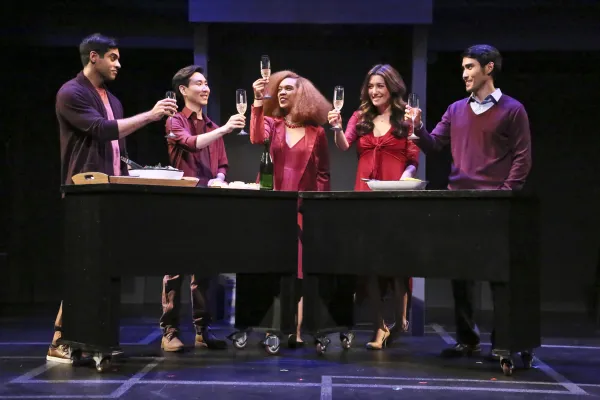
Nathan Ramos’ As We Babble On is a mildly entertaining dramedy about five characters who aren’t anywhere near as edgy as they and their playwright fancy them and their one-acter to be. The lead character is - as his name Benji (a popular movie moniker for mutts) suggests - wishy-washy, one of those often ineffectual individuals who frequently shoot themselves in the foot. Compensating for his inadequacies, Benji (Will Choi) inks superheroes for a comic book company. But this doesn’t make up for his being self-sabotaging when it comes to work or re-encountering a former boyfriend, Vish (Sachin Bhatt, who is quite touching as a hunk who’s not as sure of himself as good looks might seem to guarantee one to be in our superficial society). Having a weak protagonist does not bode well for a play.
Image

Did you know that according to the 2010 Census, 1.2 million people in the U.S. are Pacific Islander heritage? With 286,145 Polynesians, Micronesians and Melanesians residing in California - which of course is located on the Pacific Coast - the Golden State is second only to the Aloha State in terms of Pacific Islander residents. As of 2010 Hawaii had 355,816 people of Pacific Island heritage, including about 200,000 Hawaiians, who are defined as individuals tracing at least part of their ancestry to the original Polynesian inhabitants of Hawaii prior to the 18th century arrival of the English explorer Captain Cook. (Simply living in Hawaii does not make one a Hawaiian the way residing in, say, New York, makes one a New Yorker.)
Image
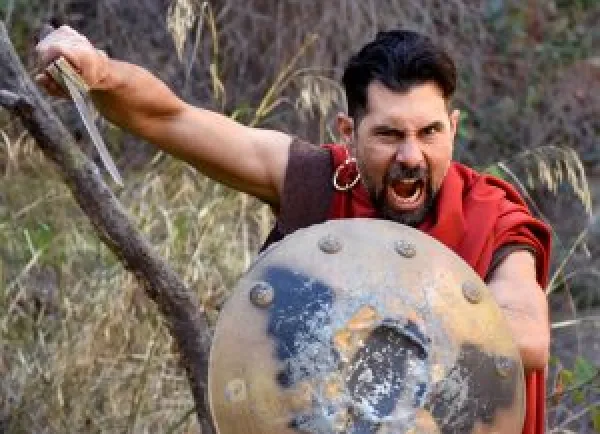
Calendar shmalendar - the way this critic knows summer has arrived is by attending the premiere of Will Geer’s Theatricum Botanicum’s repertory season at its airy Topanga Canyon amphitheater. A joyous annual ritual for me is making the trek out to this woodsy nook north of Malibu where WGTB extends the conventional notion of the stage.
Audiences are familiar with theatrical terms such as “the fourth wall” and “theater in the round.” But ensconced on a hillside amidst a forest, WGTB gives us what could be called “three dimensional theater.” This year’s exceptional opening production, William Shakespeare’s Coriolanus, is an excellent case in point. The tragedy’s mise-en-scène is barely constrained to the stage per se, as the ample-sized (and talented) company makes full use of the slopes behind the boards and the surrounding sylvan glade. They troupers troop up and down the aisles, gather and cavort behind the bleacher seats and so on, making full use of the Topanga landscape. Corio’s choreo gives new meaning to Shakespeare’s dictum in As You Like It that “all the world’s a stage.”
Image
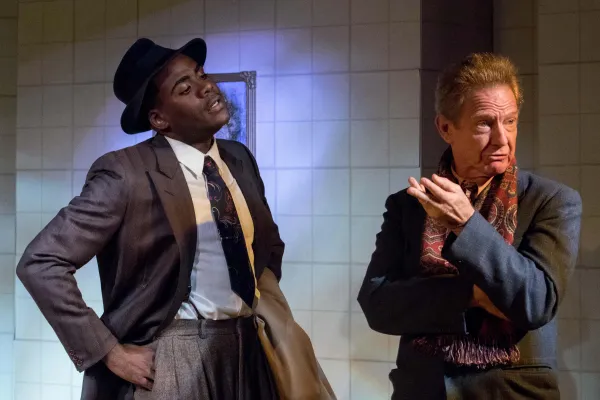
The personal is extremely personal in Rogue Machine’s Mexican Day. Tom Jacobson’s insightful script intimately, intricately interweaves ethnicity, class, sexuality and more in his story depicting a landmark Civil Rights struggle in late 1940s Los Angeles, when a sort of “apartheid light” was still being practiced in a not so angelic City of the Angels. This segregation is the source of the title of Jacobson’s play, which is part of a trilogy.
At least three of the drama’s thespian quartet depicts actual historical personages in Jacobson’s two-acter. First and foremost is the renowned African American equal rights activist Bayard Rustin (Donathan Walters, who recently understudied Bigger Thomas and The Black Rat at Antaeus Theatre’s gut-wrenching production of Richard Wright’s Native Son). In the late 1940s, Rustin - who eventually became a key organizer of 1963’s legendary “March on Washington for Jobs and Freedom” wherein Dr. King made his “I have a dream speech” - is dispatched to L.A. to desegregate Bimini Baths, an actual hot springs oasis with mineral waters that had existed in what is now L.A.’s Koreatown.
Image
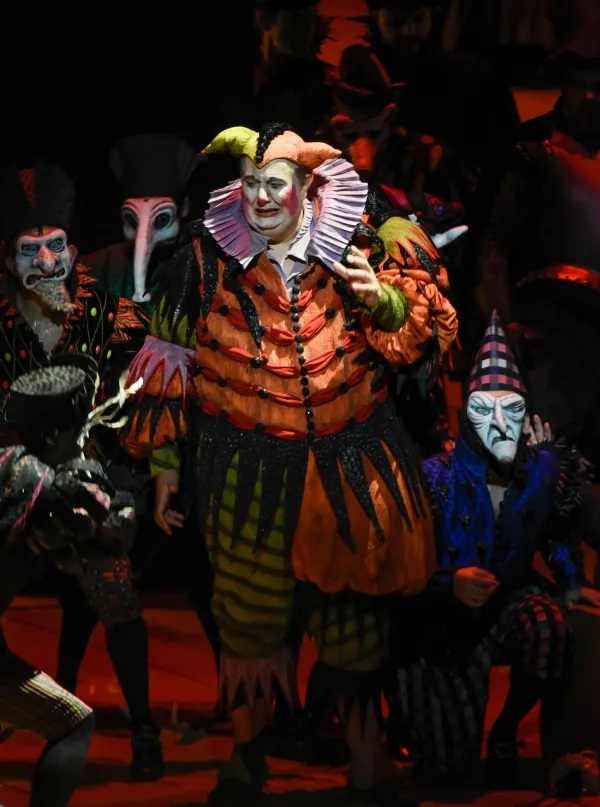
Along with William Shakespeare’s Richard III, Giuseppe Verdi’s Rigoletto are the stage’s most famous disabled characters. Like Victor Hugo’s Quasimodo, they are hunchbacks who share with King Richard, as the Bard wrote, being “rudely stamp'd… deformed, unfinish'd…” and unable to “strut before a wanton ambling nymph.” (Verdi’s 1851 opera, with a libretto by Francesco Maria Piave, is actually based on an 1832 play by Hugo, Le Roi s’amuse, which was banned after a single performance because it criticized royalty.)
Rigoletto is a figure of fun - not only because cruel people take perverse delight in mocking the disabled (like Trump despicably mimicking a NY Times reporter with a disability), but because Rigoletto is also the court jester of the Duke of Mantua. (In LA Opera’s May 27-June 3 performances, Italian baritone Ambrogio Maestri was Rigoletto while from May 12-19 Spanish baritone Juan Jesus Rodriguez played the part. New Jersey tenor Michael Fabiano was the Duke May 27-June 3, while Mexican tenor Arturo Chacon-Cruz had the role May 12-19.)
Image
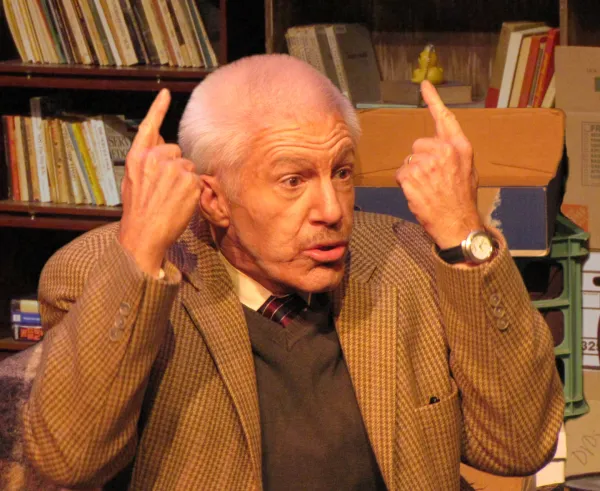
Actor/playwright Tom Dugan’s superb award winning one-man show Wiesenthal is a must-see for anyone who loves great acting, writing, drama, human rights and/or Jews, plus hates fascism, crimes against humanity, war and atrocities. For almost 90 minutes sans intermission Dugan flawlessly incarnates Simon Wiesenthal, the greatest postwar Nazi hunter, who as a private entity tirelessly helped track down up to 1,100 Hitlerian war criminals and torturers from his cramped office in Vienna.
Dugan’s mesmerizing saga is set there, although as the title character he spins tales that transport us throughout Europe’s concentration camp archipelago (which Simon describes as “when barbarism met technology”) to Buenos Aires where the Final Solution’s über-bureaucrat, Adolf Eichmann, was hiding out and back to Austria, where Anne Frank’s captor lived in plain sight. Indeed, Wiesenthal’s peregrinations take us through the heart of darkness that, he fears, is harbored somewhere deep within the inner labyrinths of all men.
Image

Most plays I review are full-length narrative works, so this critic is used to that familiar format, just like I prefer to read complete novels or nonfiction books over reading short stories. So I wasn’t a fan of short dramas and comedies - that is, not until I went to see the Actors’ Gang’s Angels, Devils and Other Things, and their head spinning show made a true believer out of me. Where else can one find a purgatory presided over by a sort of maitre d’ deciding who gets seats at the great bistro in the sky - or down below?
Image
Brad Zimmerman’s My Son the Waiter, which “Zimmy” wrote and stars in, opens with a string of Borscht Belt jokes. They’re funny, especially for those members of the tribe who grew up with this ethnic humor. Along with much of this show, these one-liners, quips, witticisms, etc., provide a red carpet for strolling down a mirthful memory lane back to when Jewish comics such as Shecky Greene and Buddy Hackett regaled mostly urban audiences vacationing at hotels in the mountains of upstate New York.
The comedian/actor/auteur also good-naturedly kibitzes with ticket buyers. But after about 10 or 15 minutes of Zimmerman’s shtick the nostalgic spell begins to wear off, and we shift gears from high hilarity down to the mildly entertaining. Some may enjoy Zimmy’s zingers and amusing anecdotes. Others might find them to be “Meh.”