
The Free Press is bringing back a Reviews section after some absence. We hope to review plenty of events around town. Check back frequently and if what\'s going on is any good.
Arts & Culture
Image
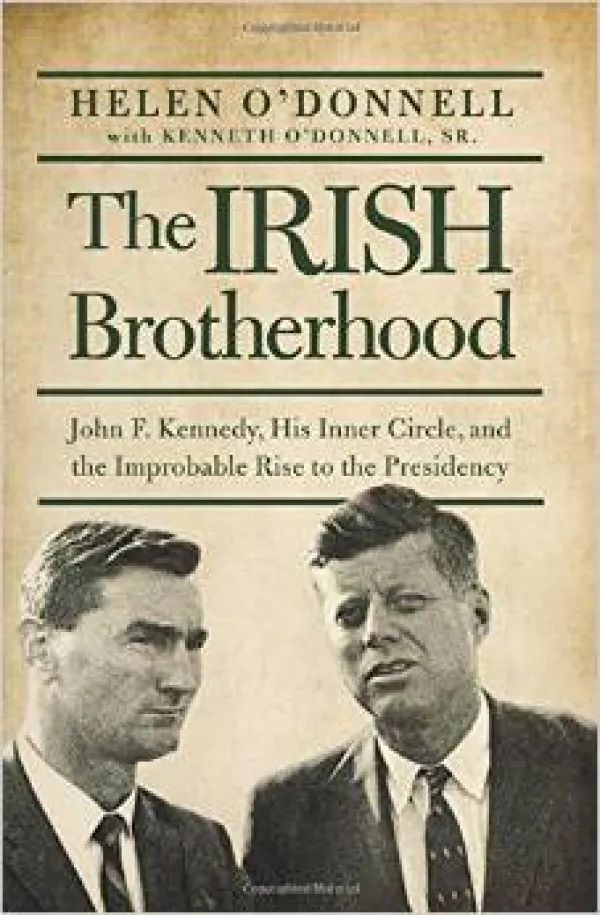
I have been fascinated by Jacqueline Kennedy Onassis since I was a young girl. This fascination at times has spilled over on other members of her family, including the president. Yet even I wonder if there is anything new to say about the Kennedy Family, especially the charmed threesome of John, Robert and Jackie. In penning The Irish Brotherhood, Helen O’Donnell has shown us that there is a most interest aspect of the late president’s political life that has received short shrift.
Image
One may wonder what there is new to say about the civil rights movement. In the immediate aftermath of Barack Obama’s first election it seemed to some as though the entire movement completed its mission and could be summed up like the ubiquitous tee shirt seen after the votes were counted: Rosa sat so Martin could walk so Jesse could stand so Barack could win so our children can fly. Oh yeah, and as Julian Bond, long time freedom fighter and a founding member of the Student Non-Violent Coordinating Committee (SNCC), would add “and the white kids came down and saved the day.” The truth of the matter is, however, that the many, many books about the 1960s freedom movement have barely scratched the surface. Arguably there are as many stories as there were participants.
Image
Book Review: A Chosen Exile: A History of Racial Passing in American Life By Allyson Hobbs
Image
As someone who has a master’s degree in political science, I am somewhat embarrassed
to say that my first reaction to the congressional hearings on Watergate was one of extreme
annoyance: the networks cancelled all regular programming in favor of televising the hearings.
This meant that all the soap operas I watched were effectively cancelled for weeks. But my late
father was home in the afternoons a lot that summer, and I began watching the hearings with him.
I was soon quite fascinated at the spectacle.
Although the breakin at the Democratic headquarters at the Watergate, a complex of
offices, stores and luxury apartments, on June 17, 1972, happened as I was heading into my junior
year in high school, I don’t remember much about it. I do remember that it was an election year,
and having been a supporter of Robert Kennedy and then Hubert Humphrey in 1968 with some of
my classmates at Hilltonia Junior High, I wasn’t particularly interested in the 1972 election.
Image
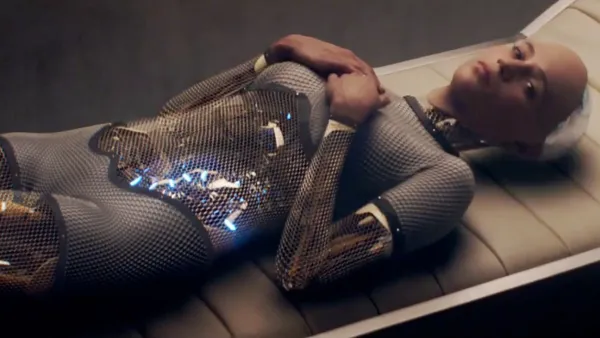
Once again, a sci-fi flick is asking the burning question: Is romance possible between man and machine?
In 2013, Her made the prospect seem inviting, especially since the machine was represented by the warm (if disembodied) voice of Scarlett Johansson.
Ex Machina offers a darker look at the same topic. This time around, we can see the machine, a personable and gorgeous robot named Ava (the FX-enhanced Alicia Vikander). But the protagonist meets her under circumstances so threatening that he’s justifiably leery of giving in to the feelings she arouses.
Writer/director Alex Garland (28 Days Later…) has devised a suspenseful film that keeps the protagonist—not to mention the viewers—guessing until the final moments.
Caleb (Domhnall Gleeson) is a young computer geek who has won a contest thrown by his company’s wealthy owner, Nathan (Oscar Isaac). His prize is a visit to Nathan’s secluded estate and the chance to take part in a scientific breakthrough.
Image
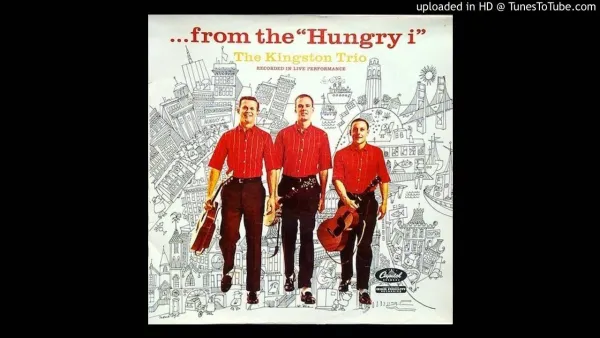
Over the last few weeks I’ve been working on a Calypso album. I don’t have any sort of a reasonable explanation for it, and the demos so far are not very promising. It’s probably a waste of time, although it has provided a break from my regularly scheduled activity of composing mediocre piano ballads. But I’ve done the homework, including watching insufferable drum instructors (is there any other kind?) demonstrate the Calypso beat online, so I think I ought to have something to show for it.
Nobody’s singing in an accent, super-promise, but this is more to minimize annoyance than avoid accusations of culture theft. Hey, why is it that everybody gives Sting a hard time for faking a Jamaican accent while the Beatles get a pass for faking an American one?
Image
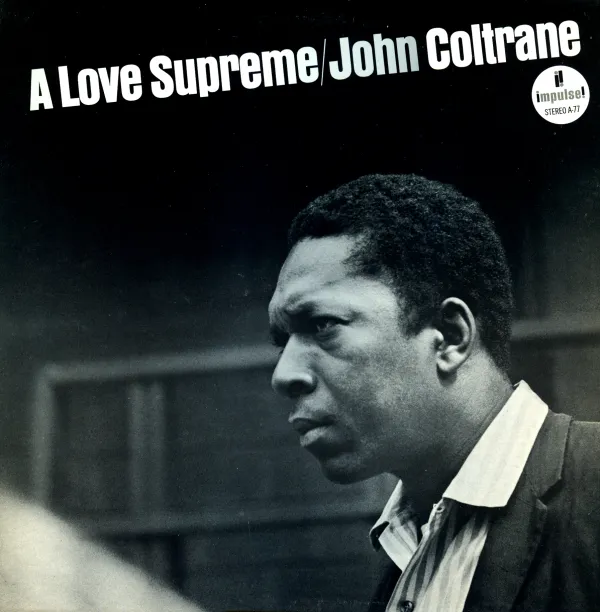
Great Jazz Albums
This spring herald's the 50th Anniversary of arguably the greatest Jazz album ever released. I don’t write these words lightly. There are many contenders.
“Kinda Blue” by Miles Davis (Columbia Records, 1959) hits every short list. Certified as quadruple platinum, it is the best selling Jazz album of all time. “Giant Steps” (Atlantic, 1960) is another challenger. Blistering arpeggios, known as “Sheets of Sound,” rise and fall faster then hummingbirds wings. The title track from “Giant Steps” is the quintessential study piece for Jazz improvisation. Modern enthusiasts claim that the newly discovered “John Coltrane & Thelonious Monk At Carnegie Hall” is equally worthy of consideration. In 1957 a Thanksgiving Jazz benefit was held for the Morningside Community Center in Harlem. Performers included Ray Charles, Billie Holiday, Dizzy Gillespie, John Coltrane and Thelonious Monk. This live recording lay hidden in the Library of Congress till being discovered, restored and finally released by Blue Note Records in 2005.
Image
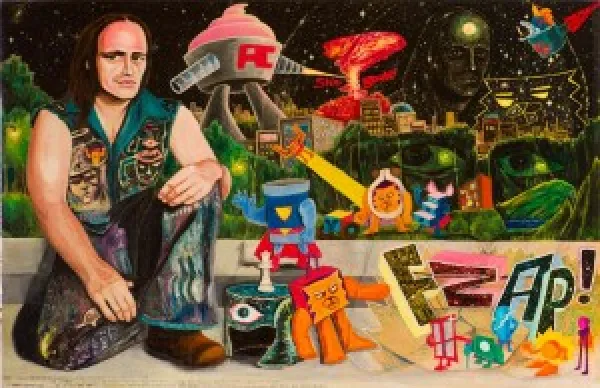
While the ridiculous Ameriflora exhibition took up residence at Franklin Park in downtown Columbus in 1992 – inexplicably there to commemorate the 500th anniversary Columbus “discovering America” – then-President George Herbert Walker Bush paid it a visit. Thankfully, Goblinhood was present to exorcise the spirit of the ex-CIA director from the park and restore it to its natural state that we enjoy today. He did so with stalks of broccoli, knowing that the President would recoil from his most hated vegetable, that had been banned from the White House.
Goblinhood, his suitcase, and cosmic weevil dolls, were creatures commonly found in the Short North during the 1990s, especially at the Acme Art Company gallery and performance space run by the late Lori McCargish. Wearing a spider-covered face mask, cape and clothes adorned with art, Goblinhood recited poetry at political events, performed on Comfest stages, and could be found giving tarot cards readings at a Free Press Second Saturday salon.
Image
It happened on August 29, 1786. Protestors, many of whom were veterans of the Revolutionary War, were angry about the distressed economic circumstance that developed in the aftermath of the war. Hard currency was in short supply, and this caused a credit squeeze. The government had come down hard on citizens in an effort to ameliorate the debt problem, and there were court hearings for those who could not or would not pay their taxes or other debts. Led by Daniel Shays, a veteran, protestors shut down courts in five cities, bringing the hearings to a halt. Shays’ followers also began raising an army. When some of the rebels were captured, their colleagues began arming; in response, a militia unit raised a private army and routed most of the rebels. Although there were scattered protests into the next summer, the rebellion was pretty much over by February 1787.
Image
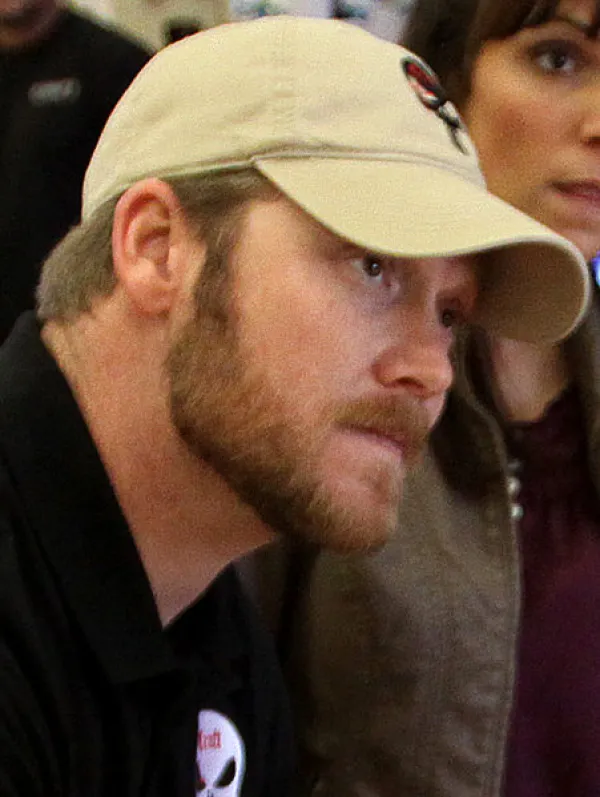
The Columbus Free Press recently printed a movie review of “American Sniper”, the Clint Eastwood directed film portraying Navy SEAL sniper Chris Kyle (Bradley Cooper) in a positive or at least a conflicted character. The movie is a huge box office success in America, bringing in $217,092,013 in the first 5 weekends.
The review by Richard Ades printed in this paper concludes with this gem: “The real-life Kyle was celebrated as a hero. Despite its occasional whiff of dramatic manipulation, American Sniper makes a compelling argument that he deserved the label. “
Unlike the review printed in this paper, American Sniper has been savaged by progressive voices throughout the country.
The best of the reviews is by “Killing Ragheads for Jesus” by Chris Hedges, which begins with this excellent introduction: