
The Free Press is bringing back a Reviews section after some absence. We hope to review plenty of events around town. Check back frequently and if what\'s going on is any good.
Arts & Culture
Image
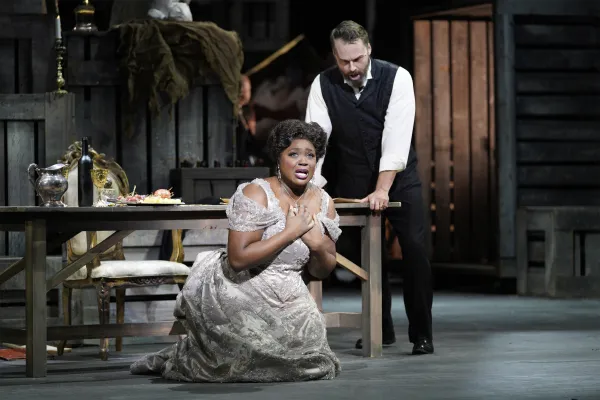
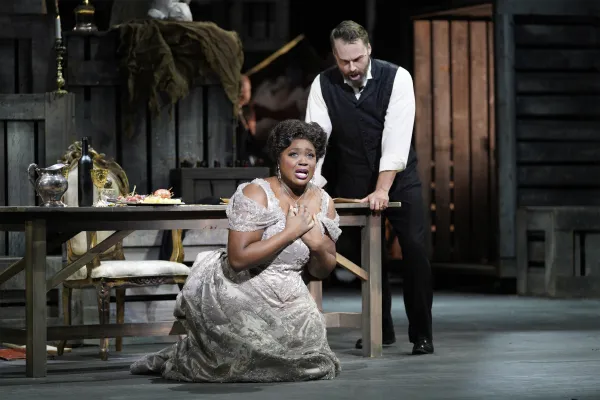
Having returned to L.A. after my voyage from Tahiti to Pitcairn Island aboard the cargo/cruiser Aranui, I’m happily back in the reviewer’s seat and was enraptured by LA Opera’s production of Giacomo Puccini’s Tosca, which premiered in Rome 122 years ago. Those in the TikTok generation and others who consider opera to be a stuffy, bourgeois art form should consider the plot of Tosca, which could be proverbially ripped from today’s headlines. Tosca centers around political prisoners, secret police, torture, executions and direct action against tyrants. I kid thee not, Dear Reader!
Image
Having returned to L.A. after my voyage from Tahiti to Pitcairn Island aboard the cargo/cruiser Aranui, I’m happily back in the reviewer’s seat and was enraptured by LA Opera’s production of Giacomo Puccini’s Tosca, which premiered in Rome 122 years ago. Those in the TikTok generation and others who consider opera to be a stuffy, bourgeois art form should consider the plot of Tosca, which could be proverbially ripped from today’s headlines. Tosca centers around political prisoners, secret police, torture, executions and direct action against tyrants. I kid thee not, Dear Reader!
Image
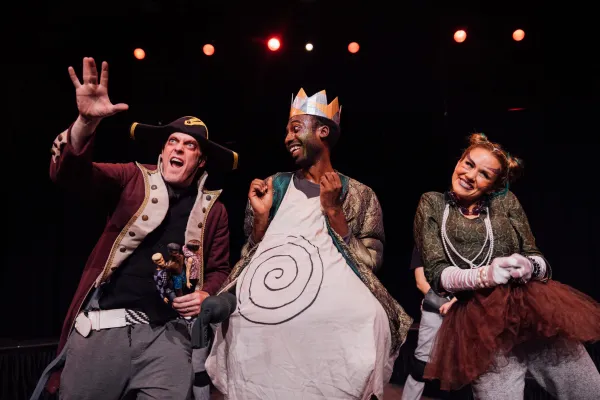
Upon returning from Tahiti and Pitcairn Island I was glad I hadn’t missed The Actors’ Gang’s 40th Anniversary production of Ubu the King, which has been extended. Especially as this veteran reviewer has never seen anything quite like this inspired insanity performed on a live stage before. The playbill includes credits for, and I quote, “fartists” (cast members Adam Dugas and Guebri Van Over hold that honor), and before the proverbial curtain lifts a bilingual woman announces house rules, such as where emergency exits (presumably for faint of heart ticket buyers) are located and warns audience members against committing acts of “terrorism,” like talking during the show.
The latter admonitions may reference the outraged disruptions that punk-tuated the world premiere of Ubu Roi (for readers who don’t parlez vous, “roi” is French for “king”). The ensuing 90-minutes of merry madcap mayhem on the boards of The Actors’ Gang’s Culver City theater clearly reveal what triggered Parisian spectators to riot during the apparently not-so-“Gay Nineties,” and the subsequent banning, of symbolist Alfred Jarry’s surreal satire.
Image
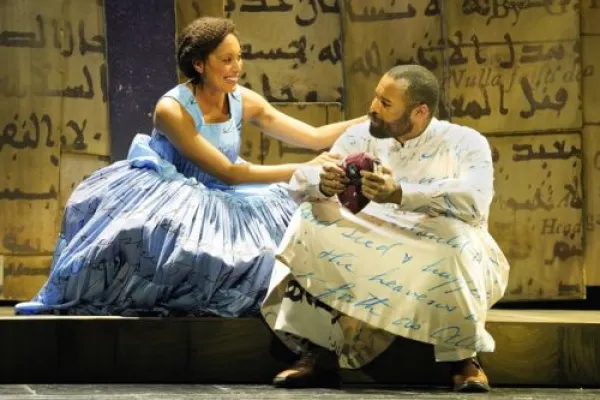
Owing to my voyage aboard the cargo/cruiser Aranui from Tahiti to Pitcairn Island, I missed most presentations of Rhiannon Giddens and Michael Abels’ Omar, but am very glad I was able to catch its last performance. Because – like LA Opera’s season opener, an updated version of Gaetano Donizetti’s 835 opera Lucia di Lammermoor – Omar is a highly innovative work that expands the operatic medium, in terms of theme, idiom and mode of expression.
This almost three-hour work, which world premiered earlier this year at the Spoleto Festival, located – appropriately enough – in Charleston, South Carolina, is based on the true story of Omar ibn Said, who was born 1770 in the imamate (theocratic state) of Futa Toro in what is now the West African nation of Senegal. Like Solomon Northup’s Twelve Years a Slave, Said also wrote a narrative account of his life, and his 1831 autobiography, which I believe he originally wrote in Arabic, forms the basis for the story that librettist and co-composer Rhiannon Giddens adapt and relate in Omar.
Image
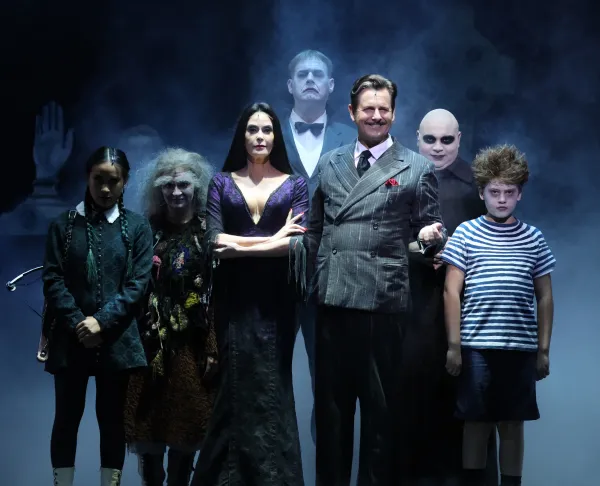
Just in time for Halloween, that “Mysterious and spooky …all together ooky” all-Un-American family, the Addams, are back. The Addams Family originally appeared in Charles Addams’ one-panel cartoons in The New Yorker magazine in 1938. In that franchise tradition of never letting a profitable brand name go to waste, the bizarre members of this clan with a supernatural vibe have appeared in numerous iterations, including a 1964-1966 ABC-TV sitcom; big screen, live action feature films; animated TV series and movies; and in 2010, a Broadway musical.
Image
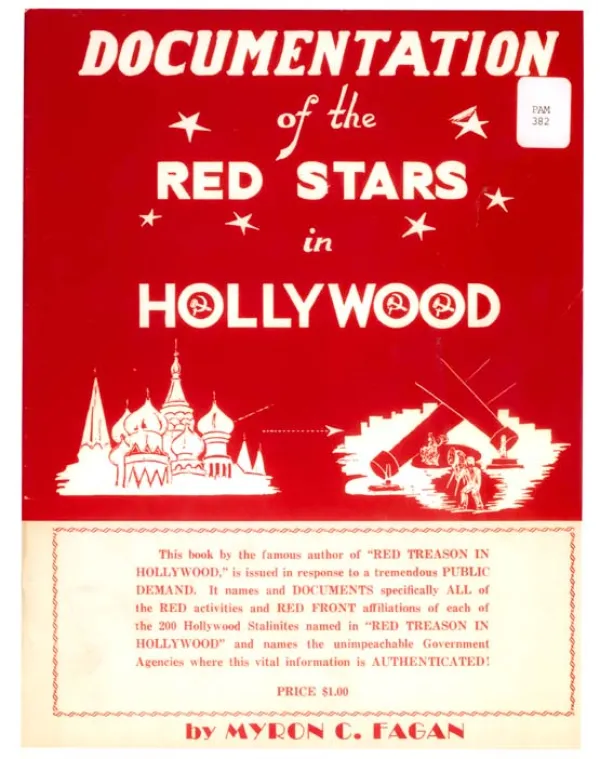
This month marks the 75th anniversary of the start of the Hollywood Blacklist. On October 27, 1947, screenwriter John Howard Lawson, the first member of what came to be known as the “Hollywood Ten,” testified before the House Un-American Activities Committee. (See: https://www.youtube.com/watch?v=F7W3XbDZqO4.) The contentious, testy testimony before a gavel-banging Congressman in Washington launched the Hollywood Blacklist, wherein members of the motion picture industry who refused to “cooperate” with HUAC by informing on themselves and others about their leftist politics were forbidden from working in the movies until roughly 1960, when the Hollywood Ten’s Dalton Trumbo received screen credits under his real name (instead of a pseudonym) for writing Spartacus and Exodus.
Image
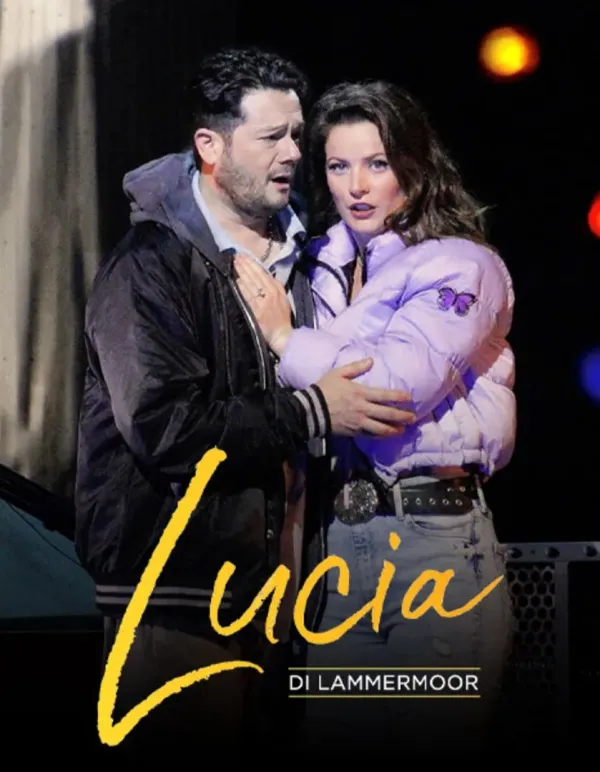
Composer Gaetano Donizetti may have been born in the 18th century and his 1835 opera Lucia di Lammermoor may be based on Sir Walter Scott’s The Bride of Lammermoor, which was published 1819. But the updated version of Lammermoor that LA Opera is rather gloriously kicking off its 2022/23 season with is a startlingly spectacular state of the art production that is arguably the most cutting edge operatic live show that this longtime reviewer has ever had the good luck to behold. As directed by Switzerland’s Simon Stone, this rendition of an early 19th century work is a role model in how to successfully update classics for 21st century audiences, just as Leonard Bernstein and company brilliantly reset the tragic saga of Verona’s teen age sweethearts in Romeo and Juliet to Manhattan’s mean streets in West Side Story for 20th century viewers.
Image
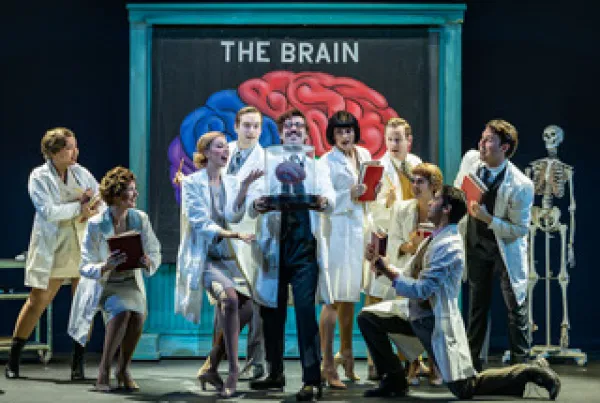
This critic usually reviews plays with deep social, psychological and philosophical significance, such as A Noise Within’s Animal Farm, Orwell’s satire about the revolution betrayed in Russia; Deaf West Theatre’s mounting of the Greek tragedy Oedipus at the Getty Villa; and Antaeus’ Everybody, an adaptation of the Christian morality play Everyman, about the meaning of life. I appreciated all of these quality productions but by far the most enjoyable work I’ve had the good fortune to experience this year is Mel Brooks’ Young Frankenstein, a musical comedy without any deep political, Freudian or existential messages.
Image
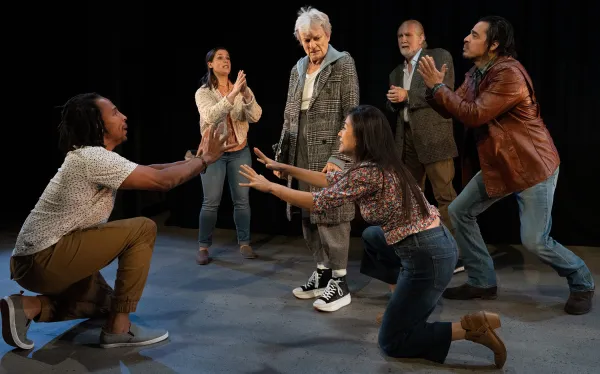
“What’s the point?” Everybody (Nicole Erb) plaintively asks about human existence as she confronts Death (a playful Anne Gee Byrd as a not so Grim Reaper) in Antaeus Theatre Company’s Everybody, a rollicking adaptation of the anonymously-written 15th century Christian morality play, Everyman. With its modern twists, including projections (designed by Yi-Chien Lee), sound (provided by Salvador Zamora) and lighting effects (illumined by Bryan Ealey) plus dialogue that translates Middle English into the 21st century vernacular, including loads of obscenities, penned by Branden Jacobs-Jenkins, Antaeus’ mounting brings this Middle Ages classic alive. The setting is a sort of dreamscape (Nicholas Ponting is the scenic and props designer)
Image
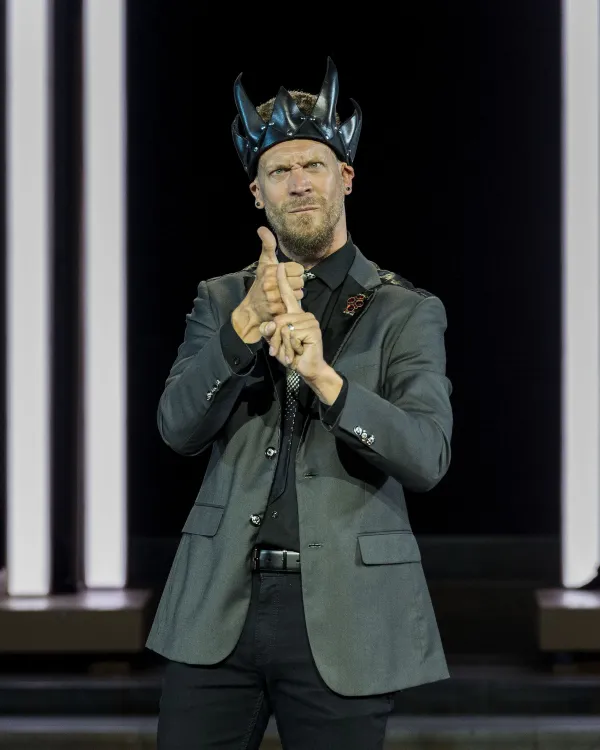
Before the premiere of Sophocles’ Oedipus, most of the outdoor tables at the Getty Villa’s café were filled, and while dining I spied from afar a longtime friend of mine, fellow reviewer Myron Meisel, tray in hand, looking for a place to eat, and I waved him over to our table. Joining us, Myron and I were pleased to see we had both survived the you-know-what. As Myron had co-made the 1993 documentary It’s All True, about Orson Welles’ unfinished South America film made during the 1940s, I told Myron that Voodoo Macbeth – a feature about the legendary Welles-directed all-Black 1936 production of the Scottish play reset in Haiti – had been shot, which was news to the astute Myron. I had received a press release about Voodoo Macbeth, which is to be theatrically released October 21, just a couple of days earlier.