
The Free Press is bringing back a Reviews section after some absence. We hope to review plenty of events around town. Check back frequently and if what\'s going on is any good.
Arts & Culture
Image
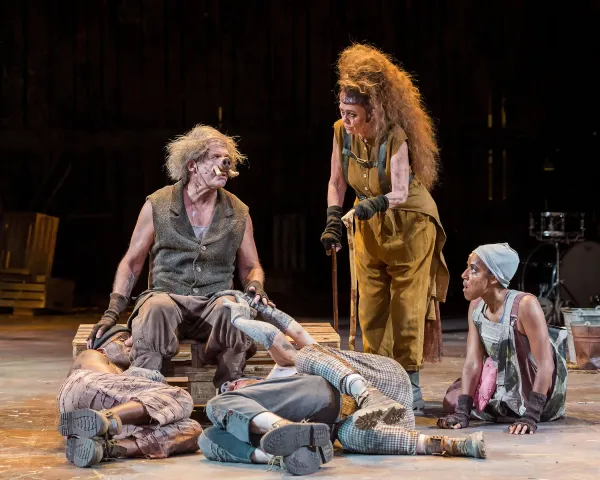
Orwell’s Peerless Proletarian Parable: Socialism with an Animal Face
Not even Brecht or Odets could make this one up: Mere days before A Noise Within debuts a theatrical version of George Orwell’s classic satirizing the betrayal of the Russian Revolution, as if right on cue, the last leader of the Soviet Union dies. Mikhail Gorbachev, of course, embodied the central theme of Animal Farm: Could socialism be democratic in nature or must it be bureaucratic and autocratic? I always regarded Lucy Pollak as a great publicist, but even she couldn’t pull off a publicity stunt like staging Gorbachev’s death right before the premiere of this proletarian parable about the USSR. Not to mention the timeliness of the ongoing conflict between Moscow and Kyiv…
ANW’s superb production presents Sir Peter Hall’s Animal Farm, with live music by Richard Peaslee and lyrics by Adrian Mitchell, is a perfect choice to open over Labor Day weekend. The musical premiered at the UK’s National Theatre in that most Orwellian of years – 1984, but of course – and adapts the 1945 novella by George Orwell.
Image

“I feel like I’m in heaven!” gushed a glowing Ava DuVernay. I overheard the director of 2014’s Civil Rights epic Selma at the August 17 press preview of the Academy Museum of Motion Pictures’ Regeneration: Black Cinema, 1898–1971 praising “the first large-scale exhibition… to examine the compellingly rich history of Black participation in American cinema, both inside and outside the Hollywood studio system,” as co-curators Rhea L. Combs and Doris Berger write in their 288-companion book with the same name as the groundbreaking show.
The helmer of 2016’s mass incarceration documentary 13th, and the 2019 Central Park Five film When They See Us, DuVernay issued her rave review of Regeneration in the Marilyn and Jeffrey Katzenberg Gallery, immersed in an 11,000-square-foot space that an Academy Museum press release states includes “rarely seen excerpts of films, documentaries, newsreels, and home movies, as well as historical photographs, costumes, props, and posters” chronicling and celebrating more than 70 years of often-ignored yet significant African-American contributions to cinema. The spectacular, sprawling show covers most of the Museum’s fourth floor.
Image
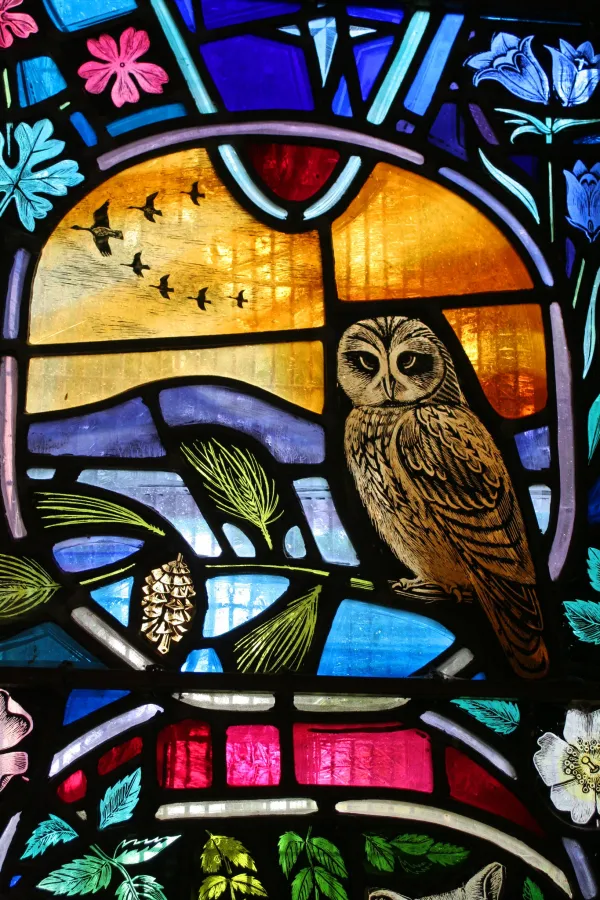
My daughter, Alison, who is 36 years old, flew into town the other day (angel that she is) and I can’t let go of the wonder and miracle of it all . . . being alive.
I had intended to write a column this week about the nature of the U.S. security state and the country’s trillion-dollar, only minimally challenged annual “defense” — actually, offense — budget, but then I came upon a journal entry I wrote in 1988, when my daughter, who is a stained-glass artist and poet living in Paris, was 2 years old.
Was this the birth of her career?
I wrote:
“Oh gosh, here it is, the morning of my 42nd birthday. I just dropped Alison off at Katy, Patrick and Erin’s. For some reason, she was real reluctant to go this morning. She was feeling her own brand of tension and disorientation. When Alison gets disoriented, she has to find some small, tangible, happy thing to focus on — for instance, the stained-glass teddy bear in Katy’s porch window. To psych herself up for her day at the babysitter this morning, Alison had to say, ‘I’m going to see the teddy bear!’ And imitating me as we walked down the sidewalk toward Katy’s house, ‘Where’s that teddy bear?’
Image
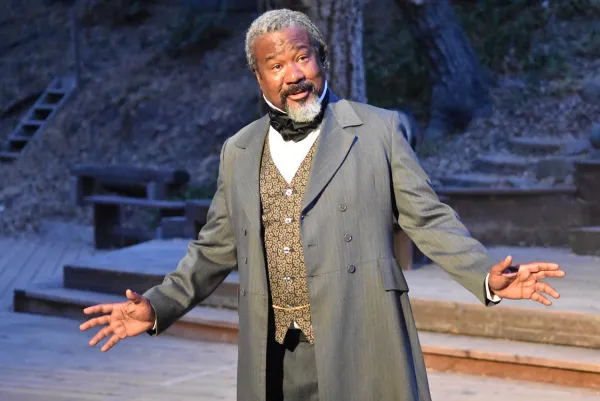
There are three great acts of naval rebellion in nautical history and the one that’s been the least celebrated in popular culture – until now – is (finally!) the subject of Trouble the Water. Ellen Geer’s stage adaptation of Rebecca Dwight Bruff’s 2019 novel of the same name dramatizes the remarkable real-life saga of Robert Smalls, who was born enslaved in 1839 and rose to become one of the Civil War’s great heroes and among America’s first Black Congressmen, initially elected during the Reconstruction Era.
Smalls’ stunning story is so phenomenal that it takes no less than two thespians to depict this Black Spartacus: A simmering Terrence Wayne, Jr. (whose credits include Will Geer’s Theatricum Botanicum’s production of Ibsen’s Enemy of the People) as the youthful slave-turned-revolutionary aptly nicknamed “Trouble,” and Gerald Rivers as the postwar Republican statesman who, having met Honest Abe during the Civil War, may have coined the phrase that refers to the GOP as “the party of Lincoln.” Rivers, a WGTB stalwart and, quite appropriately, a renowned Martin Luther King reenactor, also directs Trouble the Water.
Image
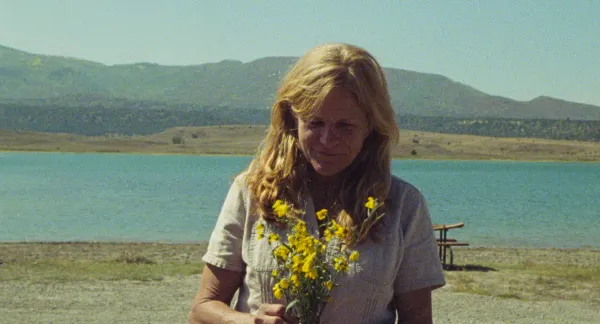
At a time when superhero and other action flicks explode and careen across our screens, with its decidedly indie sensibility, Max Walker-Silverman’s little gem A Love Song goes against the blockbuster grain. It is as gentle as Marvel Universe flicks are violent. With its simple, naturalistic style tinged by sly humor, A Love Song is a motion picture paean to the human condition, filled with yearning, grief, loss and the quest for meaningful (if not necessarily long-lasting) connection and love.
Image
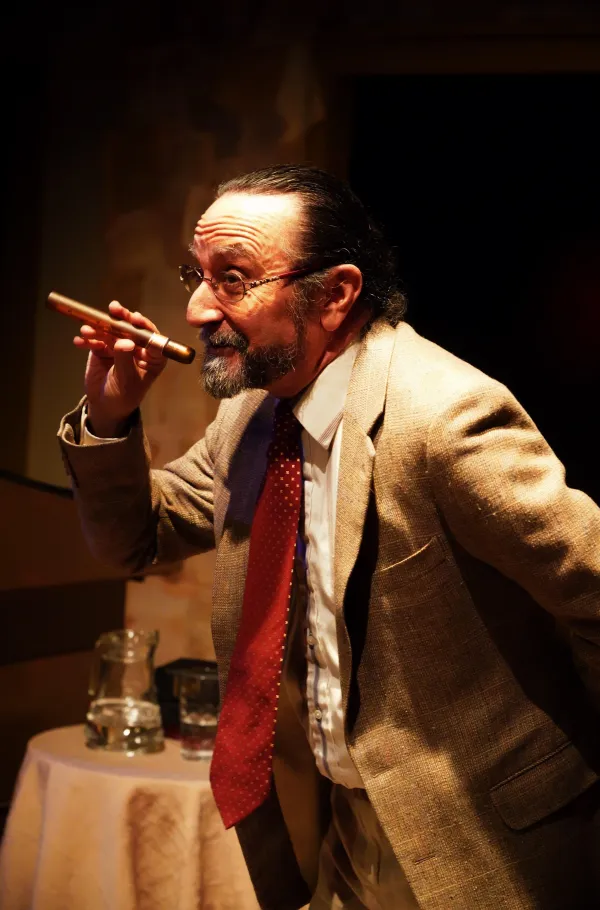
Playwright Willard Manus’ The Funny Man is a one-man show starring Sam Aaron as the Oscar-winning humorist S. J. Perelman, who The New York Times called “an artist whose nonpareil gift of ridicule, dazzling verbal effects, polished style, and keen observation made him a unique and precious figure in our literature.” The conceit of this solo show is that Perelman has been invited to the University of California at Santa Barbara in order to deliver a lecture on creative writing in 1976, when the screenwriter/playwright/author/essayist was 72. The Brickhouse Theatre’s stage is adorned by Zad Potter with a lectern, from which Aaron as the ersatz Perelman holds forth on the literary life, as well as Hollywood, Broadway, comedy, monogamy, travel, The New Yorker magazine and about what one suspects is the guest lecturer’s favorite subject: Himself.
Image
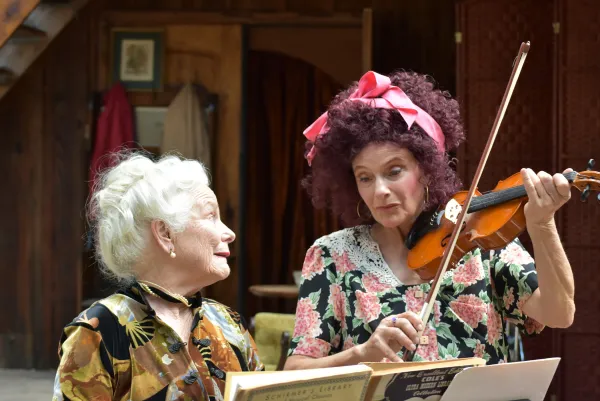
In this day and age of superheroes deluging the big screen with their derring-do, it’s a delight to discover a production performed on the live stage about three very real women grappling with the various vicissitudes of everyday life. This revised revival of playwright Ernest Thompson’s The West Side Waltz is about a trio of females of different ages who reside in an apartment building on Manhattan’s West 72nd Street. The Waltz part of the title refers to the fact that widowed 70-ish Margaret Mary Elderdice (Ellen Geer) is a former classical concert pianist, while her 50-ish neighbor Cara Varnum (Melora Marshall) accompanies her on the violin for household duets. And I suppose that Waltz could also refer to the dance of life that this play poignantly choreographs on the outdoor stage of Will Geer’s Theatricum Botanicum.
Image
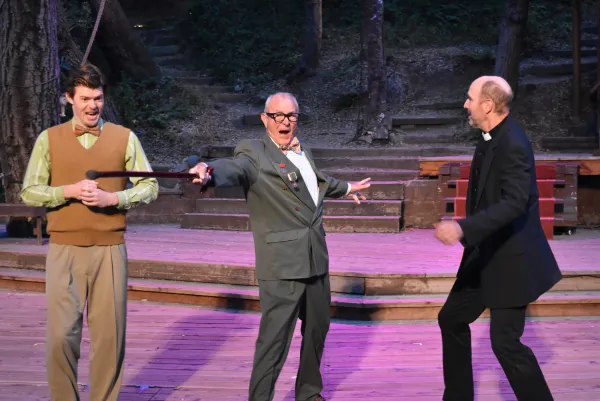
Sir John Falstaff is arguably William Shakespeare’s greatest comic character. The ribald, oversized skirt chaser appears in three of the Bard of Stratford-upon-Avon’s plays, including Henry IV, Part 1 and Part 2. According to Director’s Notes in the program, Queen Elizabeth enjoyed this roguish character so much that Her Majesty commanded the playwright to write another comedy featuring Falstaff. That third Falstaffian play, The Merry Wives of Windsor, is now the summer season opener of Will Geer’s Theatricum Botanicum at Topanga Canyon.
However, this version is the Bard with (literally) a twist: WGTB Artistic Director Ellen Geer has transported the Elizabethan-era, Windsor, England-set play to small town USA in Connecticut, during the1950s. Not only that, but a score of period music has been interjected into the madcap merriment of this modern dress revival, with songs from musicals such as My Fair Lady, South Pacific and Bye Bye Birdie, plus rock ‘’n’ roll hits such as “Rock Around the Clock.”
Image
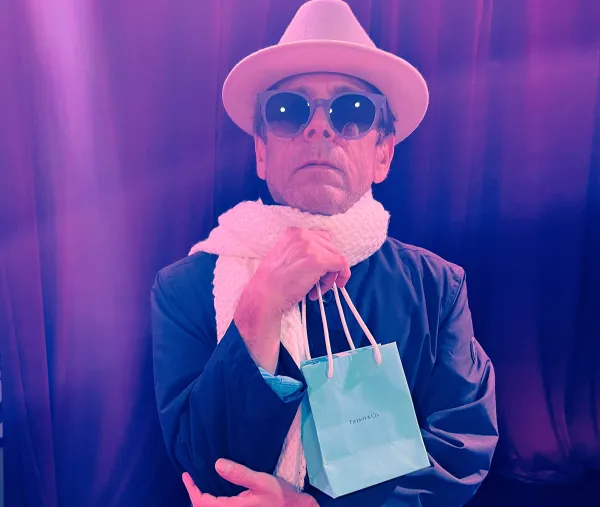
Jamie Galen’s uncanny incarnation of Truman Capote in the first act of playwright Jay Presson Allen’s 1989 Broadway adaptation of Capote’s writings and ruminations, Tru, is a must-see tour de force. The one-man show is set in the glitterati’s penthouse overlooking the glittering lights of Manhattan and the UN Building wherein the In Cold Blood and Breakfast at Tiffany’s author muses out loud and answers phone calls on Christmas Eve, 1975. At this moment critics and beau monde “pals” feel aggrieved that “Tru,” as he’s nicknamed, has betrayed their trust by publishing a chapter of his unfinished tell-all tale Unanswered Prayers in Esquire Magazine that dares tell the “Tru-th” about the lifestyles of these rich and famous “friends.”
Image
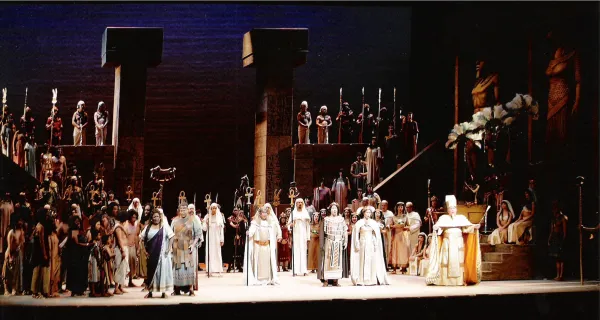
Right from the get go I must gush that in terms of sheer scale – optically and sonically – as staged by LA Opera, Aida’s scene set outside of the city walls wherein the masses are assembled to all hail the conquering heroes is among the most magnificent sequences I’ve ever experienced at a live theater in my entire life. Amidst fluttering banners and brandished weaponry, there are dancing girls, soldiers, priests, citizens, royalty and prisoners of war as the ancient Egyptians celebrate their returning, victorious army, who have just vanquished the Ethiopian invaders (as in ACT II, SCENE 2 of the original libretto by Antonio Ghislanzoni – but in LA Opera’s version directed by Francesca Zambello, this colossal triumphal scene takes place at the end of the first act, before the curtain drops to signal intermission).