
THE G-20 IN PITTSBURGH
by Tom Over 9-23-09
<br><br>
On Tuesday, Sept 22, activists from Philadelphia, New York City, Pittsburgh and other cities held a mock funeral procession to demand better policies for addressing the AIDS pandemic, a day ahead of the arrival of delegates for the G-20.
<br><br>
The approximately 50 participants in the New Orleans-style funeral march drew a mix of interest, irritation, and amusement from onlookers in the business district of downtown Pittsburgh.
<br><br>
At the head of the funeral march where pallbearers carried a cardboard coffin, a man shouted into a microphone while someone else carried a portable amplifier, “when people with AIDS are under attack, what do we do ?” and marchers shouted in unison, “fight back!”
<br><br>
Amidst the early afternoon bustle of an weekday, the demonstrators repeated this call-and-answer and similar chants as the funeral march made its way around the perimeter of the David L. Lawrence Convention Center, the site of the G-20 Summit later this week.
<br><br>
Erica Goldberg works with ACT UP Philadelphia. She said global health is not on the agenda of the G-20 Summit.
“One of the things that some of the G-20 nations have promised us is funding for the global fund to fight, TB, malaria, and HIV/AIDS. This is all really important, especially if we want to meet the United Nations’ Millennium goal of eradicating these diseases by 2015. As of right now, this won’t be met. We have to hold our leaders accountable. They are the ones making decisions for the poorer countries,” Goldberg said.
<br><br>
She commented on the timing of the demonstration. “We wanted this to be the first thing they (the G-20 delegates) see. They’re coming here tomorrow. We’re holding them accountable. This needs to be on the agenda.”
<br><br>
She said AIDS activists chose Sept 22, two days before the official start of the G-20 Summit, and one day before the arrival of the delegates, so as to not have to compete with other protests. Also, she said the AIDS activists figured there would be less of a chance of conflict with police if they staged their protest earlier in the week.
<br><br>
“We hope that this will hit the papers tomorrow, that it’s the first thing they see when they walk in, that they have this on their conscience and know we’re not going away,” Goldberg said. She urges people to contact legislators about supporting the Global Fund to Fight AIDS, Tuberculosis, and Malaria.
“President Obama, as much as I love him, went back on his promise to fulfill the funding,” Goldberg said.
<br><br>
She commented on how drug companies factor into all of this. “ Medication does not need to be this expensive. They can definitely lower their prices. We have big drug interests lobbying to prevent AIDS medication from getting” to developing nations.
<br><br>
Goldberg said debt cancellation for developing nations is a factor that comes into play.
“When you don’t cancel debts of nations and they have to pay back loans to the IMF and the World Bank, they won’t have the funds necessary for getting AIDS medication, or they might get the medication but can’t pay the health professional because of their debt.
<br><br>
She said vested interested motivated by huge profits stand in the way of doing a better job of addressing tuberculosis, malaria, and HIV/AIDS. “We have the power, the ability, and the medication.”
World News
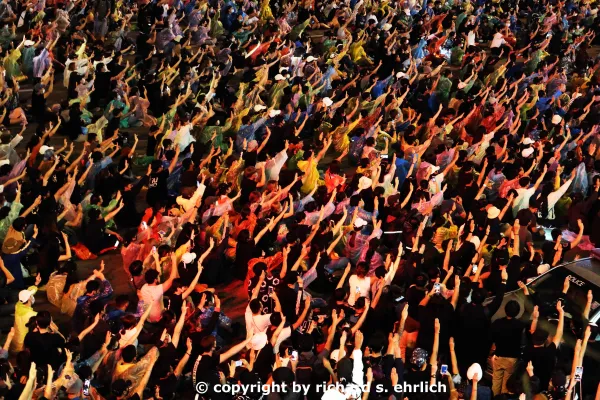
BANGKOK, Thailand -- Embattled Prime Minister Prayuth Chan-ocha on
October 22 revoked his mostly ineffectual "serious state of emergency"
in Bangkok, one day after saying he "will do so promptly if there are
no violent incidents."
The Royal Thai Government Gazette published his order which took effect at noon.
Prayuth clamped Bangkok under a "serious state of emergency" on
October 15, extending an existing state of emergency declared in March
to fight the coronavirus.
The emergency edict banned gatherings in public of five or more
people, distributing or publishing data that the government perceived
to be instigating fear or distorting information, and forbid using
public transportation or buildings for dissent.
Tens of thousands of protesters however repeatedly defied the
emergency edict by continuing to gather at daily demonstrations which
began on October 13.
Security forces, enjoying immunity under the emergency edict, could
detain people for 30 days in military camps without access to a
lawyer.

In theory, Europe and the United States stand on completely opposite sides when it comes to the Israeli occupation of Palestine. While the US government has fully embraced the tragic status quo created by 53 years of Israeli military occupation, the EU continues to advocate a negotiated settlement that is predicated on respect for international law.
In practice, however, despite the seeming rift between Washington and Brussels, the outcome is, essentially, the same. The US and Europe are Israel’s largest trade partners, weapon suppliers and political advocates.
One of the reasons that the illusion of an even-handed Europe has been maintained for so long lies partly in the Palestinian leadership itself. Politically and financially abandoned by Washington, the Palestinian Authority of Mahmoud Abbas has turned to the European Union as its only possible saviour.
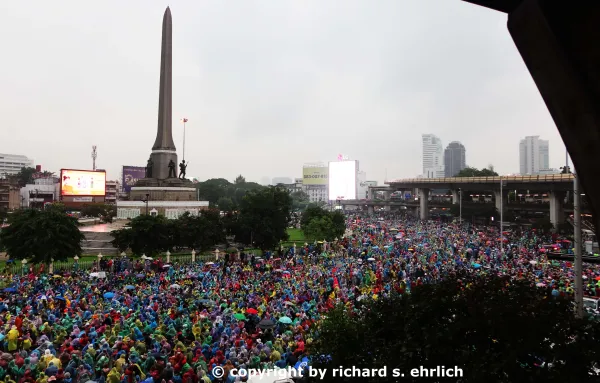
BANGKOK, Thailand -- After the military-backed government used
truck-mounted cannons to blast irritant-laden water at revolutionary
youngsters in the street last week, the protests spread.
“Don’t challenge the Grim Reaper," Prime Minister Prayuth Chan-ocha warned.
"We are just asking people not to do wrong and destroy the government
and people’s property.
"What the government needs to do is to protect the monarchy," Mr.
Prayuth said on October 19.
The regime repeatedly shut down Bangkok's mass transit system during
the protests, stranding thousands of passengers.
That also did nothing to stop the escalating pro-democracy dissent.
Looking increasingly desperate, vulnerable and bewildered, Prime
Minister Prayuth did the unthinkable -- he declared it illegal to post
online any selfies photographed at rally sites.
Protesters and others laughed at what seemed to them to be Mr.
Prayuth's ridiculous response.
Peaceful, nationwide, pro-democracy protests led by tens of thousands
of university students and school children gathered on the seventh
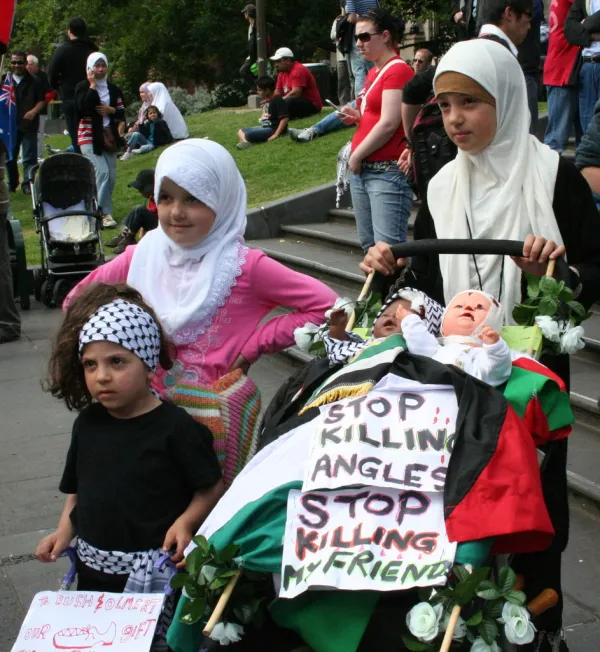
“No one cares about the prisoners.” Over the past few years, I have heard this phrase - or some variation of it - uttered many times by freed Palestinian prisoners and their families. Whenever I conduct an interview regarding this crucial and highly sensitive topic, I am told, repeatedly, that ‘no one cares.’
But is this really the case? Are Palestinian prisoners so abandoned to the extent that their freedom, life and death are of no consequence?
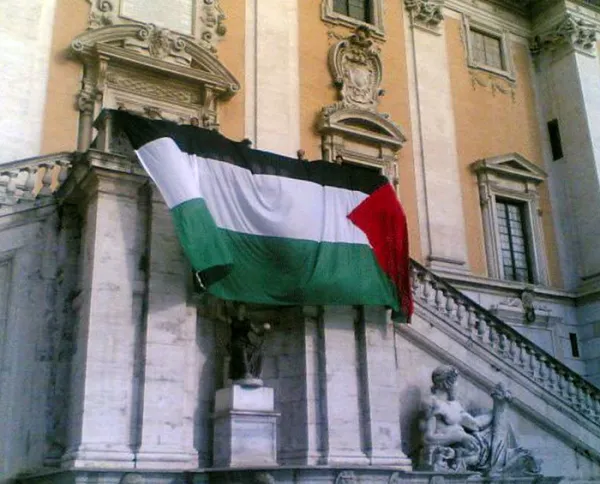
A Zionist-led war on a Palestinian cultural festival in Rome has exposed the fragility of the Italian political system when it comes to the conversation on Palestine and Israel. The sad truth is that, although Italy is not often associated with a ‘powerful’ pro-Israel lobby as is the case in Washington, the pro-Israel influence in Italy is just as dangerous.
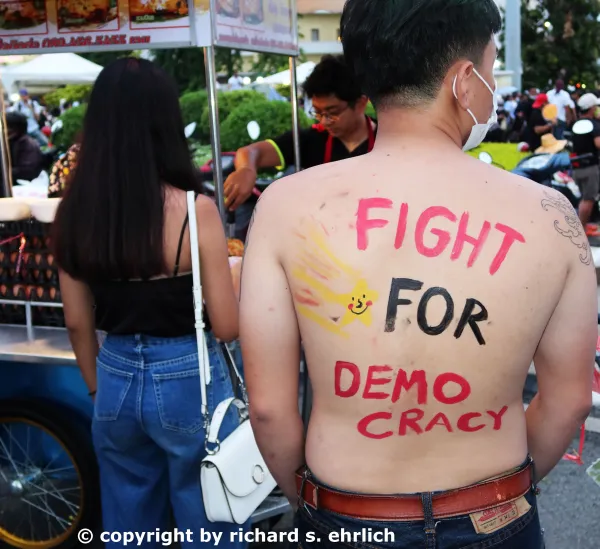
BANGKOK, Thailand -- Thousands of pro-democracy demonstrators are
ignoring the U.S.-backed government's declaration of harsh "emergency
situation" laws, which banned public gatherings, censored the media,
and increased its powers of imprisonment after crowds confronted the
royal family with a three-finger gesture of defiance.
Despite the crackdown, thousands of protesters gathered at a strategic
intersection -- paralyzing the heart of Bangkok near the U.S. embassy
-- flanked by five-star hotels and glitzy shopping malls.
They demanded the immediate release of their arrested protest leaders.
Watched by police on October 15, they also reiterated demands for coup
leader Prime Minister Prayuth Chan-ocha to resign, a new constitution
be written, and fresh elections be held.
In the evening, the crowd swelled, lit by neon signs from surrounding buildings.
"Like dogs cornered, we are fighting until our deaths," protest leader
Panupong "Mike Rayong" Jadnok told the cheering demonstrators,
according to Reuters.

BANGKOK, Thailand -- The U.S. Justice Department arrested and charged
a Tibetan-American New York City police officer as an "illegal agent"
involved in "intelligence gathering" for China during the past six
years, after he fought as a U.S. Marine against the Taliban in
Afghanistan.
Baimadajie Angwang, 33, reportedly told China's consulate in New York
that local Tibetans who did not believe in the Dalai Lama or Tibetan
Buddhism would collaborate with Beijing.
After serving in Afghanistan in 2013 and 2014, Mr. Angwang became an
Army Reserve staff sergeant at Fort Dix, New Jersey, and received
"secret" security clearance from the Pentagon.
The criminal complaint was unsealed on Sept. 21. in a New York federal court.
If convicted, Mr. Angwang could be imprisoned for 55 years.
His arrest and federal detention in New York comes amid worsening
U.S.-China relations, with both nations suspicious of each other for
alleged spying, propaganda attacks, unfair commercial competition and
other abuses.
Similar allegations involving various nationalities and ethnicities
It is abundantly clear that Palestinian Authority President, Mahmoud Abbas, has underestimated the seriousness of the challenges facing Palestine and the Palestinians.

Overwhelmed by uncontrollable circumstances, the Greek government is bracing for another financial crisis that promises to be as terrible as the last one in 2015.
Prime Minister, Kyriakos Mitsotakis, announced, on September 12, that Athens has made a “robust” arms deal that will “reinforce the armed forces” and create a “national shield”.

The inevitable has finally happened, and the coronavirus pandemic is now ravaging the besieged Gaza Strip. On August 24, a total lockdown was imposed by the Gaza authorities following the discovery of several COVID-19 cases outside designated quarantine areas. Since then, over 1,000 cases have been identified and ten people have died. Experts estimate the number to be significantly higher.
Businesses, mosques, schools, cafes and virtually everything else is now under lockdown. The local government, alongside the UN Palestinian refugee agency, UNRWA, and together with many volunteers, are desperately working to keep Gaza functioning and to limit the spread of the pandemic, despite limited and ever-shrinking resources.
Gaza’s crisis is multifaceted. The Israeli siege, combined with the massive destruction from the previous war, has left Gaza in the throes of a major humanitarian disaster. With electricity outages reaching up to twenty hours per day and with fuel supplies running low, Gaza was barely functioning, to begin with.