
THE G-20 IN PITTSBURGH
by Tom Over 9-23-09
<br><br>
On Tuesday, Sept 22, activists from Philadelphia, New York City, Pittsburgh and other cities held a mock funeral procession to demand better policies for addressing the AIDS pandemic, a day ahead of the arrival of delegates for the G-20.
<br><br>
The approximately 50 participants in the New Orleans-style funeral march drew a mix of interest, irritation, and amusement from onlookers in the business district of downtown Pittsburgh.
<br><br>
At the head of the funeral march where pallbearers carried a cardboard coffin, a man shouted into a microphone while someone else carried a portable amplifier, “when people with AIDS are under attack, what do we do ?” and marchers shouted in unison, “fight back!”
<br><br>
Amidst the early afternoon bustle of an weekday, the demonstrators repeated this call-and-answer and similar chants as the funeral march made its way around the perimeter of the David L. Lawrence Convention Center, the site of the G-20 Summit later this week.
<br><br>
Erica Goldberg works with ACT UP Philadelphia. She said global health is not on the agenda of the G-20 Summit.
“One of the things that some of the G-20 nations have promised us is funding for the global fund to fight, TB, malaria, and HIV/AIDS. This is all really important, especially if we want to meet the United Nations’ Millennium goal of eradicating these diseases by 2015. As of right now, this won’t be met. We have to hold our leaders accountable. They are the ones making decisions for the poorer countries,” Goldberg said.
<br><br>
She commented on the timing of the demonstration. “We wanted this to be the first thing they (the G-20 delegates) see. They’re coming here tomorrow. We’re holding them accountable. This needs to be on the agenda.”
<br><br>
She said AIDS activists chose Sept 22, two days before the official start of the G-20 Summit, and one day before the arrival of the delegates, so as to not have to compete with other protests. Also, she said the AIDS activists figured there would be less of a chance of conflict with police if they staged their protest earlier in the week.
<br><br>
“We hope that this will hit the papers tomorrow, that it’s the first thing they see when they walk in, that they have this on their conscience and know we’re not going away,” Goldberg said. She urges people to contact legislators about supporting the Global Fund to Fight AIDS, Tuberculosis, and Malaria.
“President Obama, as much as I love him, went back on his promise to fulfill the funding,” Goldberg said.
<br><br>
She commented on how drug companies factor into all of this. “ Medication does not need to be this expensive. They can definitely lower their prices. We have big drug interests lobbying to prevent AIDS medication from getting” to developing nations.
<br><br>
Goldberg said debt cancellation for developing nations is a factor that comes into play.
“When you don’t cancel debts of nations and they have to pay back loans to the IMF and the World Bank, they won’t have the funds necessary for getting AIDS medication, or they might get the medication but can’t pay the health professional because of their debt.
<br><br>
She said vested interested motivated by huge profits stand in the way of doing a better job of addressing tuberculosis, malaria, and HIV/AIDS. “We have the power, the ability, and the medication.”
World News
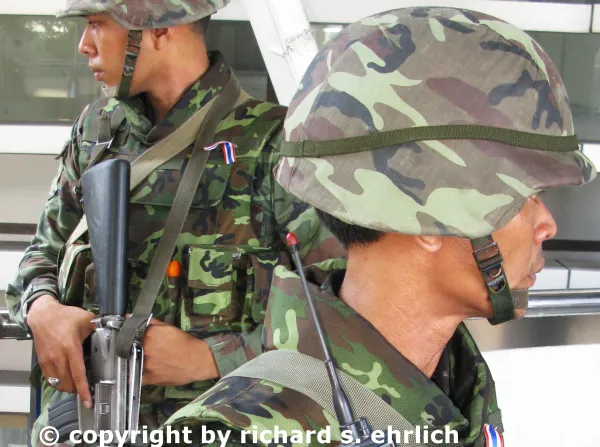
BANGKOK, Thailand -- President Donald Trump may strengthen
Washington's support for Bangkok's military government after sending
the head of the U.S. Pacific Command to open a 10-day Cobra Gold
military exercise on Valentine's Day, the highest-level officer to
arrive since Thailand's 2014 coup.
But Mr. Trump's silence on U.S.-Thailand relations has analysts
wondering if he will follow through, or risk allowing Bangkok to drift
closer to Beijing.
The Trump administration's focus in the Asia-Pacific region
includes Beijing's territorial claims in the South China Sea, Taiwan's
separate status from China, North Korea's nuclear ambitions, and the
spread of Islamic terrorism.
"A Trump administration, less concerned with issues of human
rights, could see a return to full American engagement, but at this
point, Trump's approach to Asia is unclear and contradictory at best,"
former Canadian ambassador to Thailand Phil Calvert said on February 7
in "A Diplomat's Assessment" published by the Canadian International
Council.
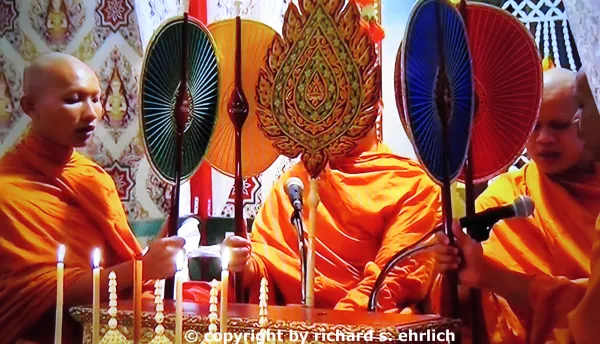
BANGKOK, Thailand -- Thailand's military government is consolidating
its control and skillfully handling the country's traumatic mourning
in the aftermath of King Bhumibol Adulyadej's death on October 13 at
age 88, while a flow of hundreds of thousands of grieving people offer
Buddhist prayers in front of the golden royal coffin.
Prime Minister Prayuth Chan-ocha, a staunch royalist who seized
power in a bloodless 2014 coup, is overseeing the elaborate funeral
arrangements and extensive public security amid the nation's
grief-stricken changes.
The widely revered, late constitutional monarch headed an
influential institution which supported the military.
In turn, the armed forces proudly protected Bhumibol during his
70-year reign.
Prayuth's post-coup policies are also defending Thailand's "old
money" elite against social climbing "nouveau riche" rivals.
Those quashed rivals are led by former Prime Minister Thaksin
Shinawatra, who Prayuth helped topple in a 2006 coup, and by Thaksin's
On October 9, I was in the Nevada desert with Catholic Workers from around the world for an action of prayer and nonviolent resistance at what is now called the Nevada National Security Site, the test site where between 1951 and 1992, nine hundred and twenty-eight documented atmospheric and underground nuclear tests occurred. Since the Comprehensive Nuclear-Test-Ban Treaty and the apparent end of the Cold War, The National Nuclear Security Administration, NNSA, has maintained the site, circumventing the intent of the treaty with a stated “mission to maintain the stockpile without explosive underground nuclear testing.”

A former diplomat who writes about the two issues pushing the world to the edge- foreign policy & religion.
This post is hosted on the Huffington Post’s Contributor platform. Contributors control their own work and post freely to our site. If you need to flag this entry as abusive, send us an email.
“That men do not learn very much from the lessons of history is the most important of all the lesson of history.” Aldous Huxley
BANGKOK, Thailand -- Armed Palestinian "Black September" guerrillas
seized the Israeli Embassy in Bangkok, threatened to execute the six
Israelis inside and blow up the building, but suddenly surrendered
saying, "We love your king," when told that King Bhumibol Adulyadej
was appointing his son that day in 1972 as sole heir to the throne.
Today, while Thailand mourns King Bhumibol's death on October 13,
his son Crown Prince Maha Vajiralongkorn is preparing to fulfill his
father's decision and become this country's next monarch.
But on December 28, 1972, the king's royal appointment ceremony of
then-Prince Vajiralongkorn to be crown prince and heir, was almost
marred by bloodshed across town.
Four Palestinian guerrillas wearing jackets in the sweltering heat
had arrived in a taxi at the Israeli Embassy on Soi Langsuan near the
British Embassy just before lunch on December 28.
They climbed "over the wall, using the embassy insignia [placard]
as a step-ladder," the embassy's messenger Anek Bariman said hours
later.
BANGKOK, Thailand -- King Bhumibol Adulyadej's death at age 88 on
October 13 has plunged Thailand into the deepest political and
emotional trauma in the lifetime of its people, breaking millions of
hearts, creating an unpredictable leadership situation for the
military government, and prompting widespread fear and pessimism about
this often violent nation's future.
"Dear all Thai people, His Majesty the King Bhumibol Adulyadej, the
Ninth of His Dynasty, has passed away," announced Prime Minister
Prayuth Chan-ocha on national TV several hours after the monarch's
death.
"Long live His Majesty the King of the New Reign," he said,
indicating King Bhumibol's only son, 64-year-old Crown Prince Maha
Vajiralongkorn, will be confirmed as Thailand's new monarch.
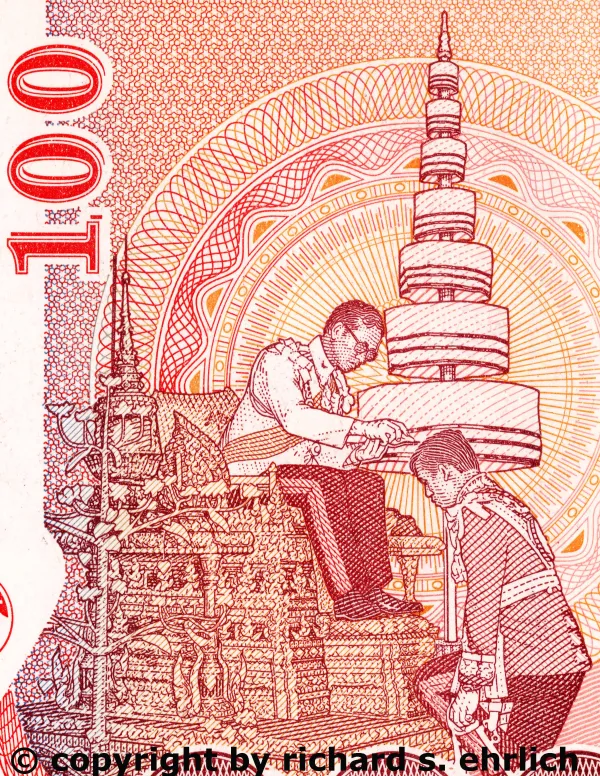
In 1972, when he was Crown Prince Vajiralongkorn, he became the
royal heir in a ceremony that was later engraved onto a commemorative
currency note, showing the younger man kneeling in front of his
enthroned father.
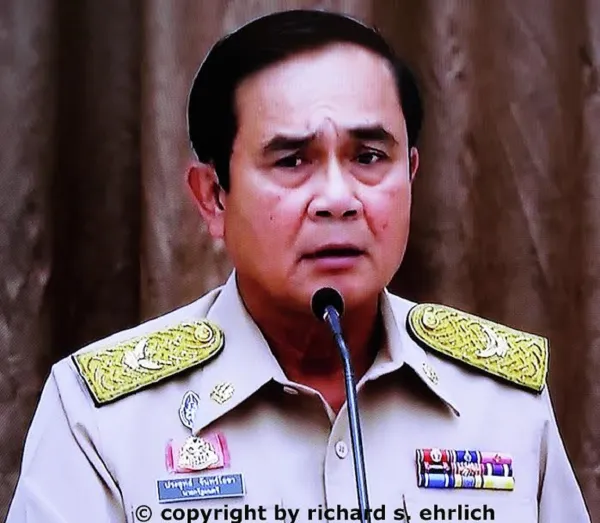
BANGKOK, Thailand -- Thailand's fearful and punished political
opposition is no immediate threat to the military's coup-installed
regime which is using arrests, re-education camps, censorship and the
creation of a new, restrictive constitution to enforce peace in the
streets and extend its control.
Smoldering under the surface here in the so-called "Land of Smiles"
is a mere handful of outspoken students, academics and politicians.
But an increasingly critical local media, Thai and foreign
analysts, diplomats and others warn that this Buddhist-majority
country remains dangerously polarized.
The appearance of stability and various claims that the junta is
popular are trumpeted as proof that Thailand is once again an
investment-rich environment for U.S. and other international
corporations.
The response has been mixed.
Some multinational companies are still doing business, making fresh
investments and voicing optimistic predictions despite Thailand's
flattened economy.