
THE G-20 IN PITTSBURGH
by Tom Over 9-23-09
<br><br>
On Tuesday, Sept 22, activists from Philadelphia, New York City, Pittsburgh and other cities held a mock funeral procession to demand better policies for addressing the AIDS pandemic, a day ahead of the arrival of delegates for the G-20.
<br><br>
The approximately 50 participants in the New Orleans-style funeral march drew a mix of interest, irritation, and amusement from onlookers in the business district of downtown Pittsburgh.
<br><br>
At the head of the funeral march where pallbearers carried a cardboard coffin, a man shouted into a microphone while someone else carried a portable amplifier, “when people with AIDS are under attack, what do we do ?” and marchers shouted in unison, “fight back!”
<br><br>
Amidst the early afternoon bustle of an weekday, the demonstrators repeated this call-and-answer and similar chants as the funeral march made its way around the perimeter of the David L. Lawrence Convention Center, the site of the G-20 Summit later this week.
<br><br>
Erica Goldberg works with ACT UP Philadelphia. She said global health is not on the agenda of the G-20 Summit.
“One of the things that some of the G-20 nations have promised us is funding for the global fund to fight, TB, malaria, and HIV/AIDS. This is all really important, especially if we want to meet the United Nations’ Millennium goal of eradicating these diseases by 2015. As of right now, this won’t be met. We have to hold our leaders accountable. They are the ones making decisions for the poorer countries,” Goldberg said.
<br><br>
She commented on the timing of the demonstration. “We wanted this to be the first thing they (the G-20 delegates) see. They’re coming here tomorrow. We’re holding them accountable. This needs to be on the agenda.”
<br><br>
She said AIDS activists chose Sept 22, two days before the official start of the G-20 Summit, and one day before the arrival of the delegates, so as to not have to compete with other protests. Also, she said the AIDS activists figured there would be less of a chance of conflict with police if they staged their protest earlier in the week.
<br><br>
“We hope that this will hit the papers tomorrow, that it’s the first thing they see when they walk in, that they have this on their conscience and know we’re not going away,” Goldberg said. She urges people to contact legislators about supporting the Global Fund to Fight AIDS, Tuberculosis, and Malaria.
“President Obama, as much as I love him, went back on his promise to fulfill the funding,” Goldberg said.
<br><br>
She commented on how drug companies factor into all of this. “ Medication does not need to be this expensive. They can definitely lower their prices. We have big drug interests lobbying to prevent AIDS medication from getting” to developing nations.
<br><br>
Goldberg said debt cancellation for developing nations is a factor that comes into play.
“When you don’t cancel debts of nations and they have to pay back loans to the IMF and the World Bank, they won’t have the funds necessary for getting AIDS medication, or they might get the medication but can’t pay the health professional because of their debt.
<br><br>
She said vested interested motivated by huge profits stand in the way of doing a better job of addressing tuberculosis, malaria, and HIV/AIDS. “We have the power, the ability, and the medication.”
World News

Last month, I attended the Ninth Annual Voting And Elections Summit in Washington, hosted by Fair Vote, The Lawyers' Committee For Civil Rights Under Law, US Vote Foundation, and Overseas Vote Foundation, each a progressive organization dedicated to the betterment of elections in the United States. The summit was indeed a gathering of very bright, motivated, devoted, and patriotic individuals and organizations, whose efforts I deeply appreciate.
It was undercut, however, by a tragic, widely shared blindspot regarding the core vulnerability of the American vote counting process, both in theory and in concrete political bottom-line fact. That process, in the computerized voting era, has become and remains unobservable, offering an open invitation to targeted manipulation sweeping in its cumulative effect.

"There are a lot of people in this room that are
on watch lists, with huge dossiers," Edward Snowden's colleague Jacob
Appelbaum warned a packed audience of international journalists and
diplomats, business executives, software experts and others here in
Bangkok at the Foreign Correspondents' Club of Thailand.
"Not just me. Probably people you wouldn't imagine," Appelbaum said.
"I think that that's a problem. To have a secret police state society,
is really scary."
Appelbaum helped create -- and appears in -- "CITIZENFOUR" which won
Best Documentary at the Oscars on February 22 for portraying former
U.S. National Security Agency (NSA) subcontractor Snowden and the
information he smuggled out, revealing America's electronic spying on
the public worldwide.
The film was directed by Laura Poitras who Appelbaum assisted during
their joint initial interviews with Snowden online, encrypting their
conversations and confirming his NSA qualifications.
Appelbaum, a Californian, is based in Berlin.
A month after former CIA officer Jeffrey Sterling was convicted on nine felony counts with circumstantial metadata, the zealous prosecution is now having potentially major consequences -- casting doubt on the credibility of claims by the U.S. government that Iran has developed a nuclear weapons program.
With negotiations between Iran and the United States at a pivotal stage, fallout from the trial’s revelations about the CIA’s Operation Merlin is likely to cause the International Atomic Energy Agency to re-examine U.S. assertions that Iran is pursuing nuclear weapons.
In its zeal to prosecute Sterling for allegedly leaking classified information about Operation Merlin -- which provided flawed nuclear weapon design information to Iran in 2000 -- the U.S. government has damaged its own standing with the IAEA. The trial made public a treasure trove of information about the Merlin operation.
According to the CIA Factbook – that’s right, the CIA – Cuba is a more literate society than the United States. Cuba is rated fifth in the world in literacy. The United States, a mere 22nd. UNESCO, the United Nations Educational, Scientific and Cultural Organization, confirms the CIA’s assessment of Cuban literacy.
Yet, what most U.S. citizens don’t know is how the Cuban went from being one of the least literate nations in the world in 1959 under the brutal dictator and mob-front Batista.
With Cuba’s literacy rate at a staggering low 23 percent in 1960, Castro appeared before the United Nations on September 20 and proclaimed the people of Cuba would eliminate illiteracy in a year. They succeeded.
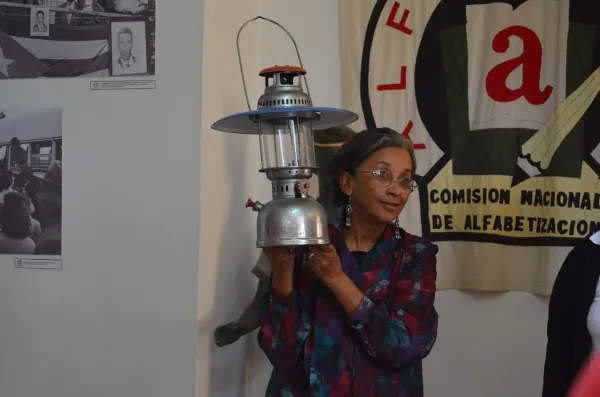
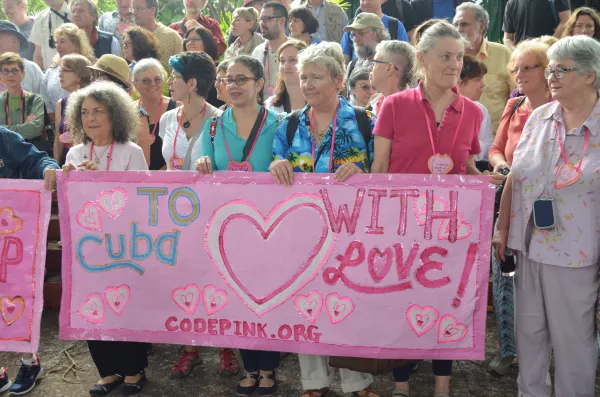
I had the privilege of visiting Cuba’s National Literacy Museum on February 10th , 2015 as part of a Code Pink “To Cuba with Love” delegation. It is housed in an old military base, the one Batista fled Cuba from with the CIA and mob over New Year’s in 1959-1960. It is the only literacy museum in the world.
“…Cuba's voice is a voice that must be heard in the United States of America. Yet it has not been heard. It must now be heard because the United States is too powerful, its responsibilities to the world and to itself are too great, for its people not to be able to listen to every voice of the hungry world.” ~ C. Wright Mills, Listen, Yankee: The Revolution in Cuba, 1960.

"It's behind us," Fernando Gonzales of the Cuban Five said with a smile when I told him just a few moments ago that I was sorry for the U.S. government having locked him in a cage for 15 years. It was nice of the New York Times to editorialize in favor of negotiations to release the remaining three, he said, especially since that paper had never reported on the story at all.

Gonzales said there is no ground for the United States keeping Cuba on its terrorist list. That there are Basques in Cuba is through an agreement with Spain, he said. The idea that Cuba is fighting wars in Central America is false, he added, noting that Colombian peace talks are underway here in Havana. "The President of the United States knows this," Gonzales said, "which is why he asked for the list to be reviewed."
What can I be sure of after only one week in Havana? Very little. There are exceptions to every pattern, and sometimes more exceptions than patterns. But a few claims, I think, are possible:

1. The sea and this island in it are stupendously beautiful even to someone longing for people and places up north.

Today in Havana, Mariela Castro Espin, director of the national center for sexual education and daughter of the president of Cuba, gave us a truly enlightened talk and question-and-answer session on LGBT rights, sex education, pornography (and why young people should avoid it if they want to have good sex) -- plus her view of what the Cuban government is doing and should be doing on these issues. She advocates equal rights for same-sex couples and a ban on discrimination, for example.

The U.S. began a 12-day annual, multinational
Cobra Gold military exercise on Monday (February 9), despite the
biggest pro-democracy protest in months displaying coup leader Gen.
Prayuth Chan-ocha as a gigantic faux Teletubby authoritarian.
In a sign of disapproval against the coup, Washington scaled-down
Cobra Gold, its biggest military exercise in the Asia-Pacific, and
this year sent about 3,600 U.S. troops instead of last year's 4,300.
"The large-scale, live-fire exercise associated w/ amphibious landing
was cancelled," American Embassy charge d'affaires W. Patrick Murphy
tweeted on Tuesday (February 10).
Other lethal exercises will be included.
A "non-combatant evacuation" from Thailand's tourist-packed Pattaya
beach near Bangkok is also scheduled, plus a "field training exercise"
involving troops in various formations.
Thailand is a key non-NATO ally of the U.S. in Southeast Asia.
Gen. Prayuth staged a bloodless coup on May 22, toppling a popularly
elected prime minister, Yingluck Shinawatra.
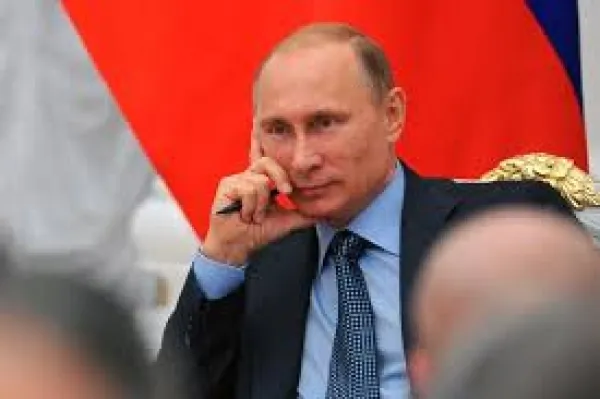
“Russian aggression” – the bad faith mantra of dishonest brokers
Just as NATO allies Germany and France were undertaking a peace initiative with Russia and Ukraine, U.S. Secretary of State John Kerry turned up in Kiev at the same time, seeking to poison the talks before they started by spouting yet again the ritual U.S. accusation of “Russian aggression.” The incantation is meaningless without context. Its purpose is mesmerize a false consciousness. “Russian aggression” may or may not exist in the events of the past year, just like “Russian self-defense.” Reporting on the ground has been too unreliable to support any firm analysis, never mind the provocative “Russian aggression” the U.S. brandishes as a virtual call for war.