
Global
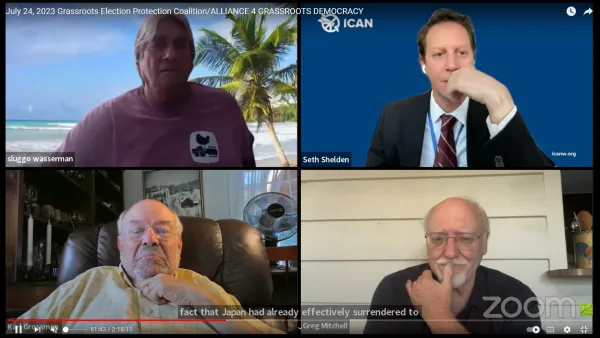
The surprising blockbuster success of Christopher Nolan’s OPPENHEIMER comes to the 145th zoom of the Green Grassroots Election Protection Coalition.
We hear from legendary music and political journalist GREG MITCHELL, whose op ed on the Bomb appears in the Los Angeles Times.
SETH SHELDON from the International Campaign to Abolish Nuclear Weapons joins us from the United Nations. Seth’s work is derived from the global treaty to abolish atomic weapons continues to demand global attention.
From Long Island, KARL GROSSMAN recalls his lifetime of activism against nuclear extinction, including his detailed critique of this important new film.
LYNNE FEINERMAN wonders why we would ever bother with this film.
TATANKA BRICCA shows the connection between atomic power reactors and Bomb production.
Reporting from DeSantisland, WENDI LEDERMAN criticizes the idea that nuclear power might be some kind of “human right."
MARY DOUGLAS challenges our assumptions about campaigning for peace.
DAVID SALTMAN recounts his amazing, unique childhood under the cloud of a removed security clearance.
The surprising blockbuster success of Christopher Nolan’s OPPENHEIMER comes to the 145th zoom of the Green Grassroots Election Protection Coalition.
We hear from legendary music and political journalist GREG MITCHELL, whose op ed on the Bomb appears in the Los Angeles Times.
SETH SHELDON from the International Campaign to Abolish Nuclear Weapons joins us from the United Nations. Seth’s work is derived from the global treaty to abolish atomic weapons continues to demand global attention.
From Long Island, KARL GROSSMAN recalls his lifetime of activism against nuclear extinction, including his detailed critique of this important new film.
LYNNE FEINERMAN wonders why we would ever bother with this film.
TATANKA BRICCA shows the connection between atomic power reactors and Bomb production.
Reporting from DeSantisland, WENDI LEDERMAN criticizes the idea that nuclear power might be some kind of “human right."
MARY DOUGLAS challenges our assumptions about campaigning for peace.
DAVID SALTMAN recounts his amazing, unique childhood under the cloud of a removed security clearance.

“A 4-year-old girl passed out in 100-degree heat after she was pushed back toward Mexico by Texas National Guard personnel. A pregnant woman became trapped in razor wire and had a miscarriage. A state trooper said he was under orders not to give migrants any water.”
Yes, these are scenes from something called “Operation Lone Star,” but the director isn’t John Ford; it’s Texas Gov. Greg Abbott — and this is real life, as reported by USA Today.

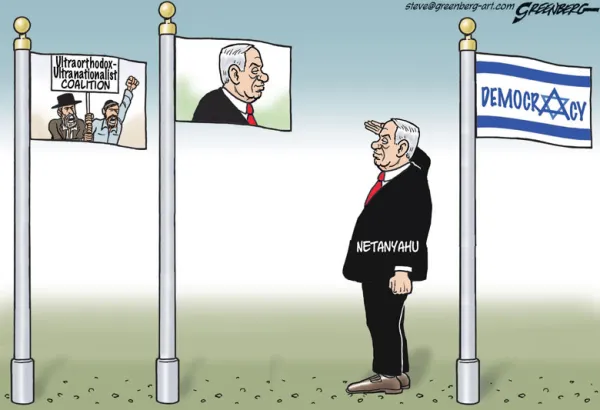
Israeli President Isaac Herzog added nothing of great value in his speech at the United States Congress on July 19.
His was the typical language. He spoke of a ‘sacred bond’, touted the shared experience between both nations as “unique in scope and quality”, and celebrated the great, common “values that reach across generations”.
But this theatrical language was meant to hide an uncomfortable truth: the relationship between Israel and the US is changing at a fundamental level.

Donald Trump is a man of many words. All of them no more than a few syllables. I know he speaks the English language, one word after another. But does he have to speak it so poorly?
The blood that runs through my brains has a rich DNA past with tributaries in many European and far flung places. I dip my verbal oars into the wondrousness of words as I try to decipher exactly what Trump is trying to say, for better or for verse. Just listen as he murders the spoken word and insidiously replaces it with sewer talk. Filling our brains with farce words, farce thoughts, farce gobbledegook. Is he just trying to butcher our brains? Yes conclusively, can we blame the entire decline and fall of the American Empire on Donald Judas Trump.

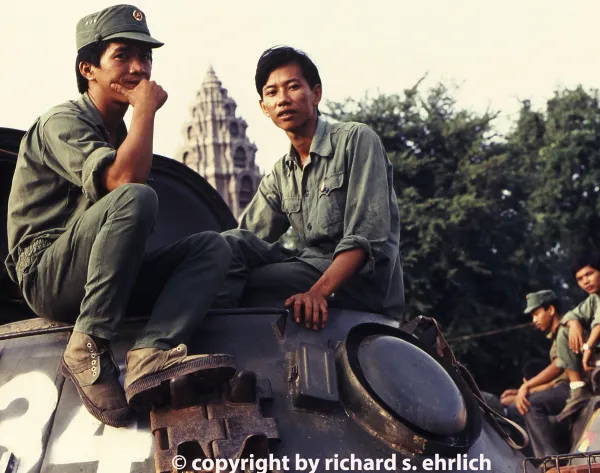
BANGKOK, Thailand -- Cambodian Prime Minister Hun Sen won reelection on July 23, as expected, extending his 38 years in power by monopolizing politics, jailing rivals, silencing free speech, and winning all 125 parliament seats.
"We've won a landslide," said Hun Sen's Cambodian People's Party (CPP) spokesperson Sok Eysan hours after the polls closed.
The only suspense after the election are cliff-hangers -- how quickly will Mr. Hun Sen install his West Point-trained son as next prime minister, and how deep will they expand Cambodia's already extensive diplomatic, economic, and military ties with China.
"Any improvement in (U.S.-Cambodian) relations depends in large part on whether Western governments are willing to accept a less democratic baseline for Cambodia," Prime Minister Hun Sen's son, four-star Gen. Hun Manet, said hours before the polls, according to Bloomberg.
Heir apparent Mr. Hun Manet, 45, was a first-time candidate in the July 23 election to the National Assembly, representing his father's ruling CPP in the capital Phnom Penh.