
Global

Tuesday’s debate and vote in the U.S. Senate on whether to end (technically whether or not to vote on whether to end) U.S. participation in the war on Yemen can certainly be presented as a step forward. While 55 U.S.
The Other Side of the News March 16 2018-Interview wth ACORN founder Wade Rathke
http://www.wcrsfm.org/content/other-side-news-march-16-2018-interview-w…

The Other Side of the News March 9 2018-Trump, Manafort, Connell and local news
http://www.wcrsfm.org/audio/by/title/the_other_side_of_the_news_march_9…

http://www.wcrsfm.org/audio/by/title/the_other_side_of_the_news_march_2…


In 2014 I wrote an article titled ‘The Global Elite is Insane’. I want to elaborate what I explained in the earlier article so that people have a clearer sense of what we are up against in our struggle to create a world of peace, justice and ecological sustainability.
Of course, as I explained previously, it is not just the global elite that is insane. All those individuals – politicians, businesspeople, academics, corporate media editors and journalists, judges and lawyers, bureaucrats…. – who serve the elite, including by not exposing and resisting it, are also insane. And it is important to understand this if we are to develop and implement effective strategies to resist elite violence, exploitation and destruction but also avert the now-imminent human extinction driven by their insane desire for endless personal privilege, corporate profit and political control whatever the cost to Earth’s biosphere and lifeforms (human and non-human alike).

In Friedrich Engels’ 1880 book Socialism: Utopian and Scientific the co-founder of communism wrote about the difference between an idealistic conception of socialism and one rooted in historical, material reality. Raoul Peck’s new movie biopic The Young Karl Marx deals with this disparity and shows how during the 1840s Marx and Engels rooted the emerging notion of socialism in the real world and class struggle. In John Morogiello’s play Engaging Shaw the dramatis personae all belong to the former decidedly fanciful, airy-fairy trend of socialistic thought - and they sure act like it.
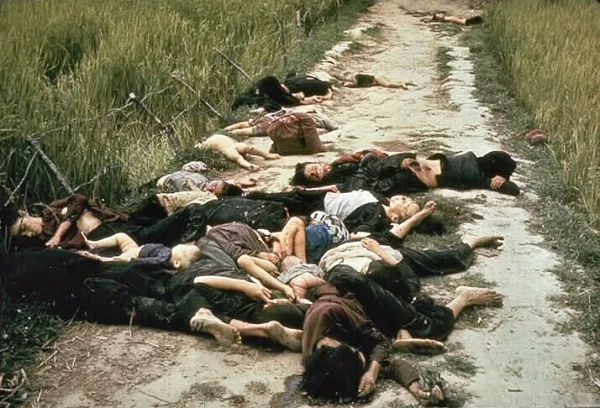
50 years ago today, on March 16,1968, a company of green, battle-untested US Army combat soldiers from the Americal Division, swept into the un-defended Vietnamese hamlet of My Lai, rounded up the 500+ unarmed women, children, babies and old men, and efficiently executed almost all of them in cold blood, Nazi-style. No weapons or Viet Cong soldiers were found in the village. The entire killing operation took only 4 hours.
Although there was a prolonged attempt to cover-up the operation (which involved a young up-and-coming US Army Major named Colin Powell), those who participated in the massacre did not deny the details of the slaughter when the case came to trial two years later. Despite the cover-up, the story did eventually filter back to the Western news media, thanks to a some courageous military eye-witnesses whose consciences were still intact. An Army court-marital trial eventually convened against a handful of the soldiers, including Lt. William Calley and Company C commanding officer, Ernest Medina.

Perhaps the best political news of the Trump era has been the emergence of sanctuary cities — city governments valuing the presence of immigrants and standing for the protection of their right to live without fear — and their defiance of this country’s current manifestation of legal racism.
“How dare you vilify members of our community by trying to frighten the American public into thinking that all undocumented residents are dangerous criminals? . . . How dare you distort the reality about declining violent crime rates in a diverse, sanctuary city like Oakland to advance a racist agenda?”

BANGKOK, Thailand -- A jailed Belorussian woman who claims to have audio of Russians and Americans colluding with President Trump's election, boasted that she is a trained "huntress" who secretly recorded her "seduction" of wealthy "victims" while lying, faking love and using kinky sex.
While in a Bangkok jail, Anastasia Vashukevich told reporters she and her Russian "master" Alexander Kirillov secretly recorded 16 hours of audio when she was Russian oligarch Oleg Deripaska's "mistress" in 2016-2017.
She claims her secret audio included Deripaska's alleged meetings in person and collusion with Americans and Russians meddling in the US election.
Graphic descriptions of the elaborate sexual and surveillance strategies used by Vashukevich and Kirillov appear in her lightly fictionalized, Russian-language instruction book titled, "Who Wants to Seduce a Billionaire."