
Global

Dziga Vertov’s The Man with the Movie Camera
V.I. Pudovkin’s short Chess Fever
Sergei Eisenstein’s first film Glumov's Diary
Los Angeles, Sept. 15, 2017 – The Los Angeles Workers Center and Hollywood Progressive co-present a triple feature of films by three of Soviet cinema’s greats. These movies show that the Bolsheviks had a sense of humor.

As the Nazis ride again, British playwright Oliver Cotton’s brilliant play Daytona is about how fascism impacts and haunts survivors throughout their lives (and those are the “lucky” ones!) and what may be the first postwar “Antifa” in America. The two-acter opens mundanely enough, with an old married couple practicing for a dance competition in their rather routine, drab Brooklyn apartment, expertly designed with her usual deftness and eye for detail by Hillary Bauman.
But what is about to befall the seventy-something Elli (Sharron Shayne) and Joe (George Wyner) is anything but typical, as out of the blue, the long lost Billy (the peerless Richard Fancy) shows up to upset the proverbial applecart. Billy’s arrival from out of nowhere reminds first Joe and then, in Act II, Elli about who and what they really are and their deep dark past, as long buried secrets are excavated and revealed.

Come join us in celebration in uplifting the Reeb Avenue Center on Sunday, September 17th in the 2050 S. High courtyard from 3-8 p.m.
There wil be:
-2 stages with entertainment by: magician Drew Murray, DJ Bill, comedian Michelle Trimmer and musical artist Wyatt Henderson
-BBQ and Pizza
-Photo Booth
-50/50 Raffle drawn at aproximately 7PM
-Live Silent Auction - drawn at aproximately 6:45PM
100% of proceeds from this event benefit the nearby Reeb Avenue Center, who is making major impacts in the Southside of Columbus. They focus in areas of: GED certifications, pay-as-you-can food market and restaurant, human sex trafficking, drug addiction rehab, children's education, childcare, and much more.
Purchase tickets now and join us for a rejuvenation to the neighborhood, providing hope, jobs and excitement to the Southside of Columbus and our community.
TAGS

How blessed we Angelenos are: LA Opera’s Carmen is opera at its grandest, right here on Grand Avenue. I was immediately swept away by the opening strains of the “Prelude,” with Georges Bizet’s ebullient sounds as frothy as wave rolling ashore at Malibu or Makapuu in Oahu. When James Conlon strode up to conduct the 61-piece LA Opera Orchestra to launch his 10th year wielding the baton at the Dorothy Chandler Pavilion and LA Opera’s glorious new season, the sold out crowd erupted in applause, chanting: “Connie! Connie! Connie!” (Okay, so that’s a total lie about the shouts - but not the clapping, although I imagine many of us did indeed feel like calling out the maestro’s moniker in acclaim.)

The Greek tragedian Euripides’ rumination on war, Iphigenia in Aulis, is the Getty Villa’s annual outdoor classical theater production reviving a Greek classic at the Malibu amphitheater. Iphigenia was first performed posthumously in 405 BC at an Athens amphitheater with 20,000 seats. Iphigenia won ancient Greece’s equivalent of the Tony or Ovation Award at the city state’s Dionysia festival.
Unfortunately, the Iphigenia production at the 500-ish seat outdoor Barbara and Lawrence Fleischman Theater at the Getty Villa remains startlingly relevant. Iphigenia is set against the background of the Trojan War, which according to legend was triggered by Paris running off with the beautiful Helen, wife of the Spartan king Menelaus (Michael Huftile). His brother Agamemnon (Mark Montgomery) is the leader of the Greek forces that have assembled at Aulis to set sail with a formidable fleet to recapture Helen of Troy. However, the Greek god Artemis has conspired to prevent this from happening - unless Agamemnon commits an unspeakable act as a sacrifice to the gods.
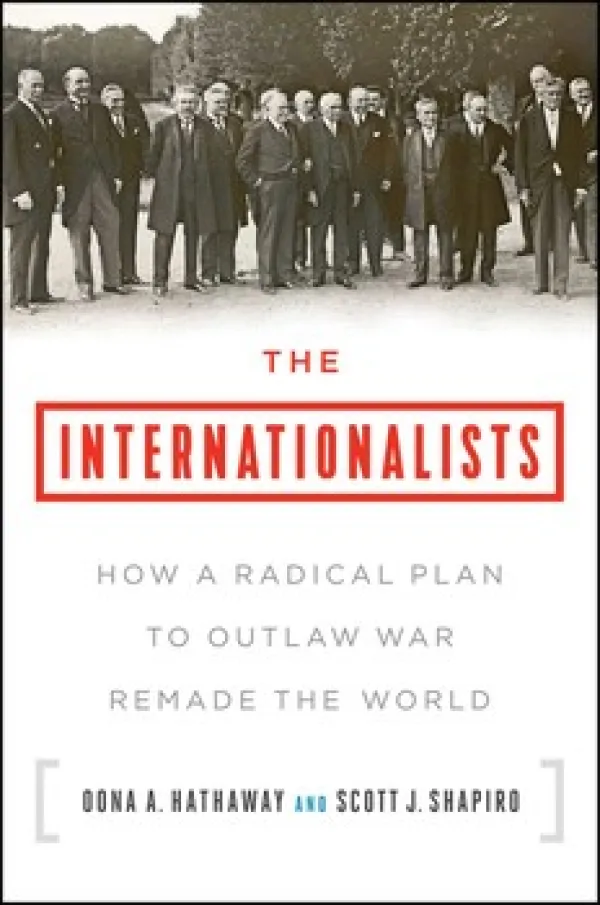
When I wrote a book about the Kellogg-Briand Pact my goals were to draw lessons from the movement that created it, and to call attention to its existence as a still-current law
The U.S. proposal for a U.N. resolution allowing “all necessary measures” to forcibly halt and inspect North Korean ships and to cut off oil to North Korea may send our species out the door with a culminating act that echoes and builds on numerous historical precedents.
We know, if we don’t deny the science, that climate change threatens us all, that a single nuclear bomb could push climate change well past the point of no return (if we aren’t there already), that several nuclear bombs could starve us out of existence, and that a significant nuclear war could end our follies quite swiftly.
That alone ought to be enough reason to choose diplomacy over the foreign-policy equivalent of shooting guns at a hurricane.
But why is innocent harmless philanthropic inspecting of ships for the good of the Rule of Law a problem? If those people have nothing to hide, then what — insert clever grin here — do they have to worry about, huh?
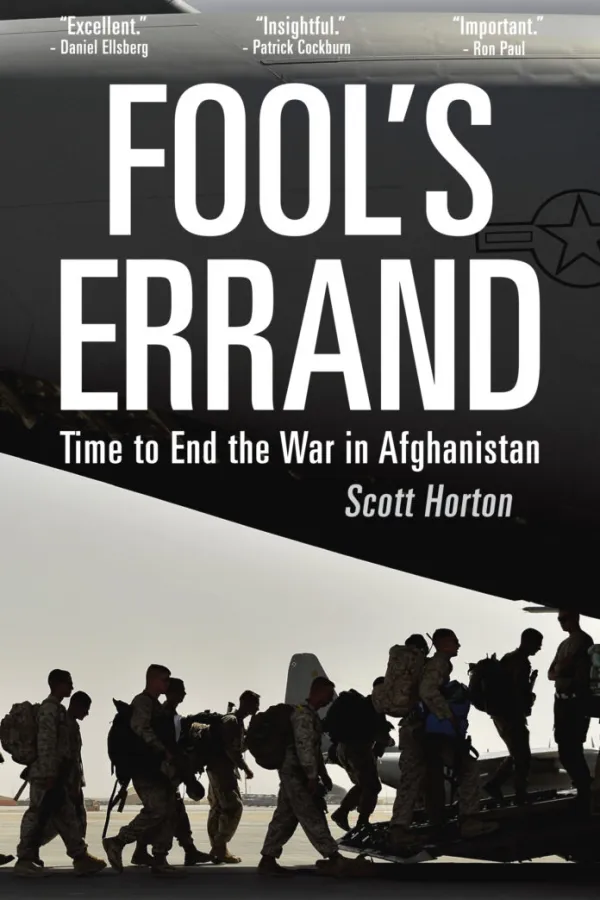
Scott Horton, Fool’s Errand: Time to End the War in Afghanistan, The Libertarian Institute, 318 pages.
I was one of the first American officials to arrive in Kabul at the end of 2001. The war that seemed to be ending back then is currently in its 16th year with no end in sight, and for those of us who were there at the beginning it now sometimes seems like it was a lifetime ago. President Barack Obama not so long ago referred to Afghanistan as the “necessary war.” But now it might be more appropriate to refer to it as a “forgotten war,” as President Donald Trump has sent a few thousand more soldiers to Kabul—while also stating emphatically that he will not be discussing strategy or entertaining any questions regarding what might be coming next.

To my knowledge, and I very, very much hope I am wrong, this upcoming conference will be the very first environmental conference in the United States to take on the single gravest threat to the world’s na

-The reasons we have high incidence of hurricanes, floods, and other
catastrophe is man made climate change
-The reason we are not doing much about climate change is that there are
greedy individuals who profit from the trends
-We have wars to distract us from the inequalities and injustices and to
make money for a few already very rich people
-There are no just wars. There are understandable and justified resistance
of native people to colonialism
- North Korea watched what the US did in places like Libya (after Libya
ended its nuclear program), in Syria and in Iraq. North Korea learned from
its own history (US committed near genocide in the 1950s) and from these
other attacks and acted in its best interests.
-Israel is not an asset to the US or to any other country but a liability.
It is a country that supported genocide and brutal dictatorships from South
America in the 1970s to Saudi Arabia and Burma/Myanmar today.
-A world Zionist network created Israel and supports it at the cost of
millions of native Arab rights