
Local
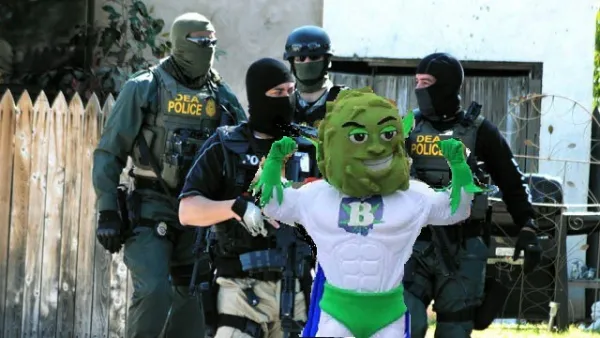
As the day of days nears for Ohio medicinal and recreational users of marijuana, questions and rumors about how exactly Issue 3 could affect their lifestyle are circling like clouds after a bong session.
Of course Issue 3 has to pass first, yet the fact Ohio marijuana users finally have a chance to vote for legalization is historical (at least for them).
And victory is possible as a Quinnipiac poll released October 8th shows 90 percent of Ohio voters support legalization for medicinal use and 53 percent support recreational use. But if it does pass, its fate is still in doubt as Issue 2, a constitutional amendment put forth by the Ohio legislature, could invalidate economic monopolies and was initiated in direct response to Issue 3.
A Kent State University poll released October 15th shows Issue 2 supported by 54 percent with 26 percent undecided, however.
Nevertheless, tried-and-true Ohio marijuana activists who for three decades have fought for legalization are concerned what the future will truly be if the Issue 3 passes and Issue 2 does not.

Mac Miller performed at the Promowest Pavillon Sunday. Miller just dropped a new album called “G.O.O.D. A.M” and is touring in support of it. He recently switched from Rostrum to his own REMember imprint through Warner Brothers.
They gave him 10,000,000. I actually sat here trying to figure out the mathematical equation on how to recoup 10,000,000. The first conclusion, I landed on was this is this is why I don’t have 10,000,000 dollars.
On the Big Sean record “Control,” Kendrick Lamar listed off who he considers his peers and competition. Mac Miller was listed next to J. Cole, Drake, K.R.I.T, Meek Mill. Pusha T, Tyler and more as contenders in barber shop arguments of “Where I’m From” or “Til My Lungs Collapse” listings of the current era of emcees.
Like Tyler, K.R.I.T, and J.Cole, Mac Miller also produces which I think shows a desire for sequencing as opposed to just rapping over some drums. I’m sure this not only aids in creativity, it also makes 10,000,000 dollars easier to recouped because Mac doesn’t have to pay for producers.
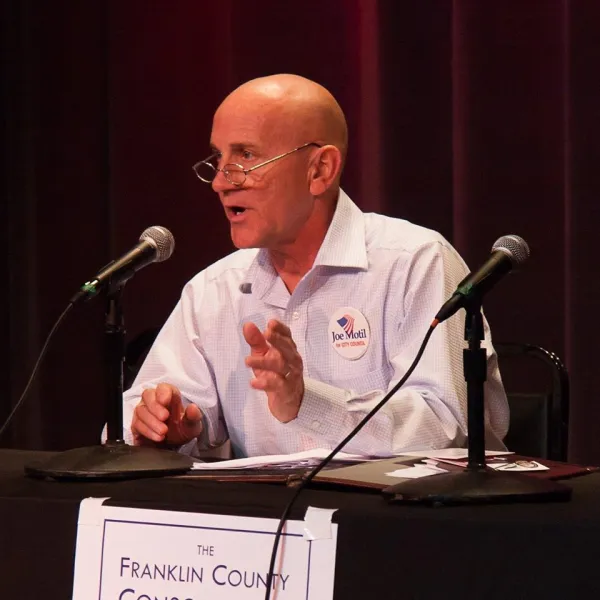
Joe Motil, Independent write-in candidate for the unexpired term race for Columbus City Council, commented on a recent Columbus Dispatch article entitled, “Columbus council candidate decides to campaign after all.” Ms. Ashley Wnek, who is technically also a candidate for the Columbus City Council unexpired term race claimed that, “I am working to let people know they have an alternative to my opponent, who is currently the subject of an ethics investigation.”
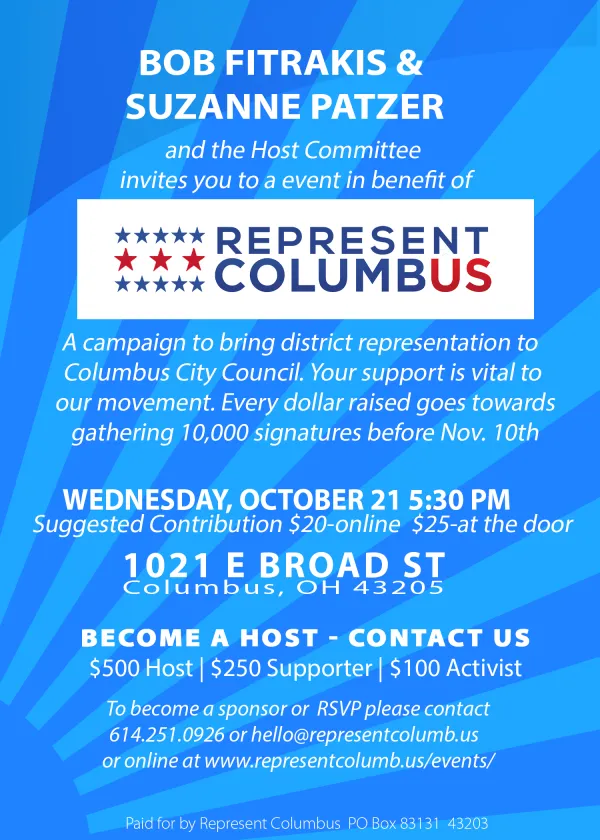

Buy tickets: http://bit.ly/1g5qVWX
Monday, October 19, 2015
5:30-9pm
Florentine Restaurant
907 W Broad St, Columbus, OH 43222
Free parking
Come in west side back door to party room area (ground floor)
Handicap accessible
$15 per person, $25 couple, $10 or negotiable, low income
Buffet dinner and awards ceremony
Vegetarian options
Honoring with the Free Press "Libby" Award for Lifetime Achievement in Community Activism:
Chuck Lynd
Julie Weatherington-Rice
Pranav Jani
Kenny Schweickart
DSCO Debs-Thomas-Harrington Award winner:
Fadhel Kaboub
Bill Moss Award for Outstanding African American Activist winner:
Torin Jacobs
Contact: 614-253-2571 or colsfreepress@gmail.com
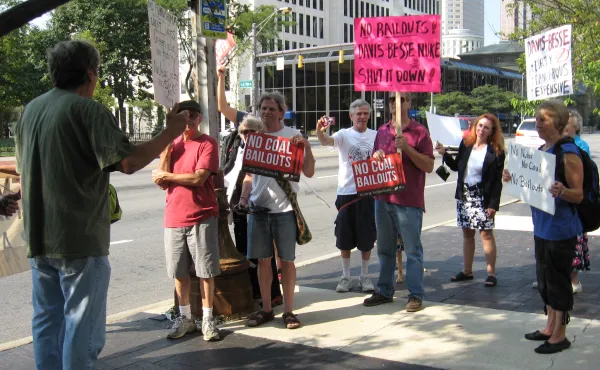
On August 31, the Public Utilities Commission of Ohio (PUCO) began conducting evidentiary hearings on FirstEnergy’s request for a bailout for their Davis-Besse nuclear power reactor and three Ohio coal plants.
Over 20 protesters were outside, on Broad Street in downtown Columbus, to greet them. This is the third rally that protesters have held at the PUCO, telling them to SAY NO! to nuclear and coal bailouts.
The Ohio Consumers Counsel has estimated that ratepayers will pay an extra $3 billion in electric charges if PUCO grants this request. That’s one big bailout! FirstEnergy claims that this request will save ratepayers $2 billion. Are we supposed to believe that they are requesting a change that would cause them to lose $2 billion in customer payments?
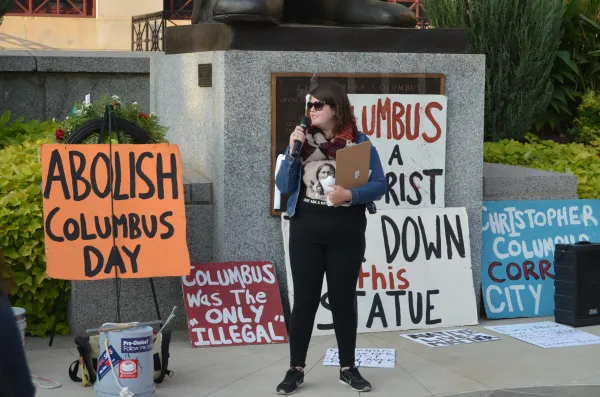
In keeping with a long tradition of protesting the celebration of Columbus Day, dozens of people gathered today, October 12, 2015 by the statue of Christopher Columbus at Columbus City Hall. Signs read "Columbus was a mass murderer," "Tear down this statue," "Stop Celebrating Genocide," "Abolish Columbus Day," and more. Speakers talked about how Columbus' visit to the U.S. brought oppression and death to the indigenous people and fomented racsism and homophobia. The crowd included a diverse group of people including Native American activists. A march to the OSU campus followed the rally. At the lead was a banner proclaiming today as "Indigenous People's Day." Not long ago, after many years of protest by Native Americans and supporters, the Santa Maria ship was removed from the river by City Hall, and City Council once declared the week in October that included Columbus Day "Indigenous People's Week." There was no response from City Council today except for police presence during the rally at City Hall.
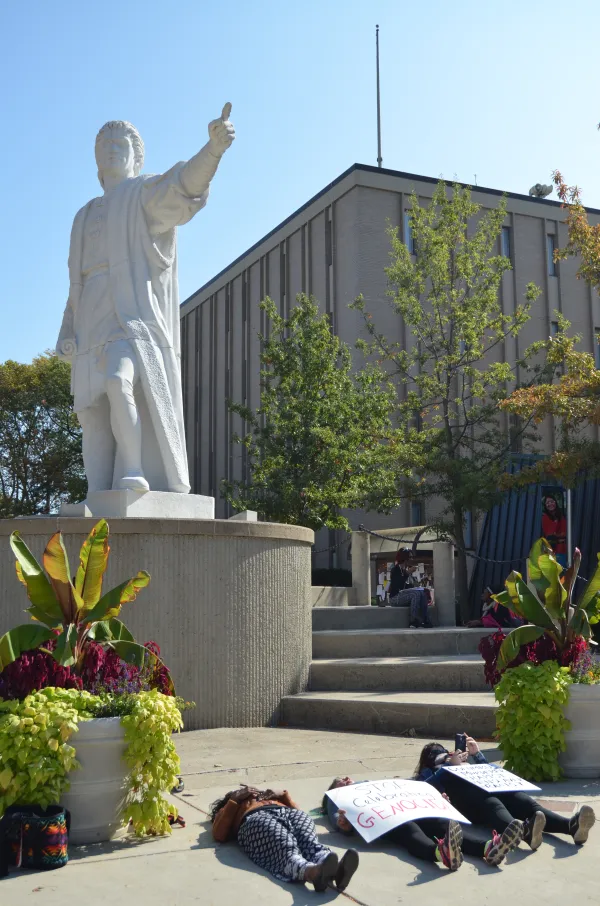
Beneath the Christopher Columbus statue in the square on Columbus State Community College campus, there was a die-in to call attention to the fact that celebrating Columbus Day is glorifying Christopher Columbus as a hero -- when in fact he was a conqueror responsible for the deaths of many indigenous people. Christopher Columbus was a slave trader and in reality is a symbol of colonialism, repression and genocide in our country. The die-in was staged so that Columbus State students would think about the real Columbus legacy and what it means to have such a statue as a icon on their campus. This was the first of three events happening today, October 12, 2015, to demonstrate against Columbus Day in Columbus, Ohio, so-named after the murderous conquistador. At 5:30pm, activists will gather for a protest by the Columbus statue outside the south side of Columbus City Hall, then march for a vigil on OSU campus at 7pm.
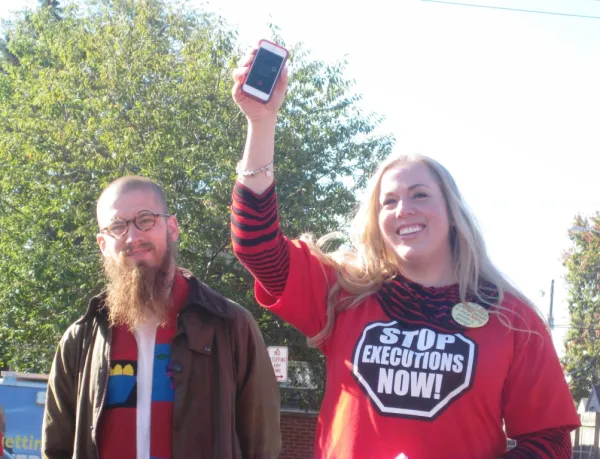
“I really appreciate what you all are doing,” said death row inmate Keith LaMar on Saturday morning from the Ohio State Penitentiary, the supermax prison in Youngstown. “Keep pushing for it!”
LaMar was speaking on the phone to more than 80 death penalty opponents gathered outside Southwood Elementary School as they prepared to walk the final two miles of the Walk to Stop Executions.
A dozen of the protesters completed the entire week-long, 83-mile trek, sponsored by Ohioans to Stop Executions. They started at the death house at the Southern Ohio Correctional Facility near Lucasville, and stopped overnight at Catholic, Protestant, and evangelical churches along the way.
“What do we want? Abolition! When do we want it? Now!” chanted the walkers as they proceeded up South High Street to the Ohio Statehouse. They gathered on the west side of the Statehouse and took turns tolling a bell to call for an end to the death penalty in Ohio. From there they walked to the Trinity Episcopal Church on the east side of the Statehouse for a rally.
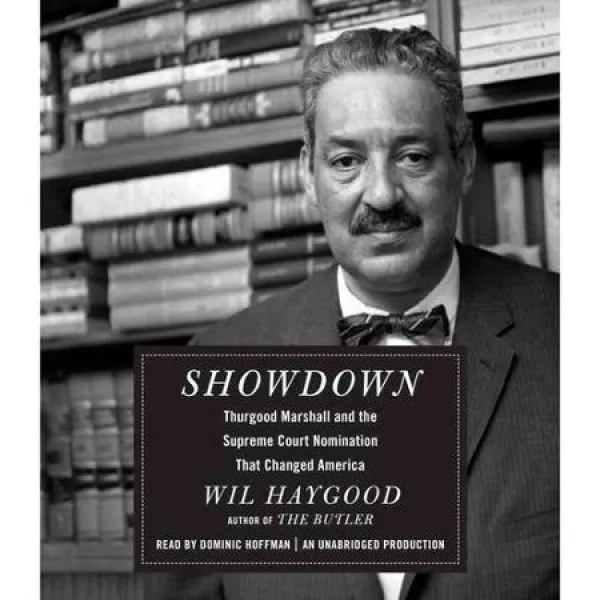
Thurgood Marshall is one of the most overlooked and underappreciated freedom fighters of the twentieth century. For more than two decades he was the preeminent lawyer for the National Association for the Advancement of Colored People (NAACP); it was Marshall who founded and directed the organization’s Legal and Educational Defense Fund.
The subject matter in which he dealt was broad: segregated schools, the rights of the accused, voting discrimination, questions on federal jurisdiction. (Not all of his legal acumen was directed at such weighty matters. A series of stern letters from Marshall to the Whitman candy company convinced them to cease selling a candy they called Chocolate Covered Pickaninny Peppermints that came in a box festooned with racist caricatures of black children.)