
The Free Press is bringing back a Reviews section after some absence. We hope to review plenty of events around town. Check back frequently and if what\'s going on is any good.
Arts & Culture
Image
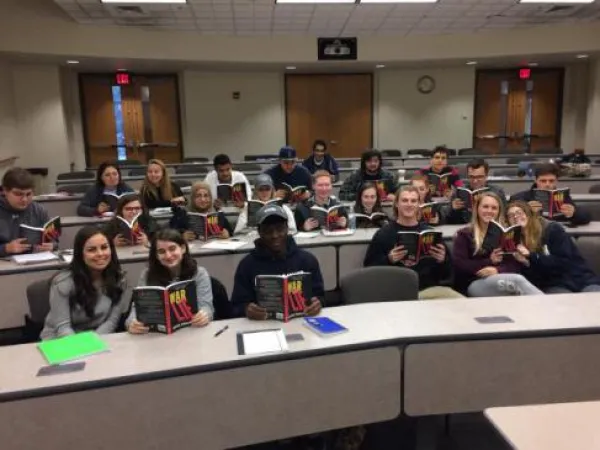
I was afraid that The Post would give us a Hollywood film version of the publication of the Pentagon Papers and manage never to say what was in the Pentagon Papers. I was afraid it would be turned into a pro-war movie. I was afraid we’d be told that the Washington Post was a courageous institution while Daniel Ellsberg was a dirty traitor. I am pleased to have had no reason for such concerns.
The Post is not exactly an anti-war movie, Ellsberg is not a main character, the peace movement is just rabble scenery, and the major focus is split between journalism’s struggle against government and Katherine Graham’s struggle against sexism. But we are in fact told in this film that the Pentagon Papers documented decades of official war lies and the continuation of mass-slaughter year-after-year purely out of cowardly unwillingness to be the one to end it. The Post leaves Ellsberg looking like the hero he is and Robert McNamara looking like the Nazi he was. And I’m left to complain that I have nothing to complain about.
Image
Oliver Stone’s 2012 thriller Savages opens with gorgeous coastline images accompanied by O or Ophelia’s (Blake Lively) voiceover saying: “It started here in paradise, Laguna Beach, where they say God parked himself on the seventh day…” In addition to its stunning scenery, languid Laguna has much to lure Angelenos away from the big city’s daily grind to this SoCal oceanic enclave located about 50 miles south on the 5 Freeway from Downtown L.A.
Of course, this Orange County seaside village is widely known for its art galleries - and it’s no wonder, given the splendor of its natural surroundings that would make any dauber’s palette burst with color. But there are also eateries there to make gourmet’s palates drool, so I decided to combine one of my regular excursions as a theater reviewer south to the Laguna Playhouse with a feast.
Drifting Down to Driftwood Kitchen: Caramel-By-the-Sea
Image
[NOTE: This review may contain plot spoilers.]
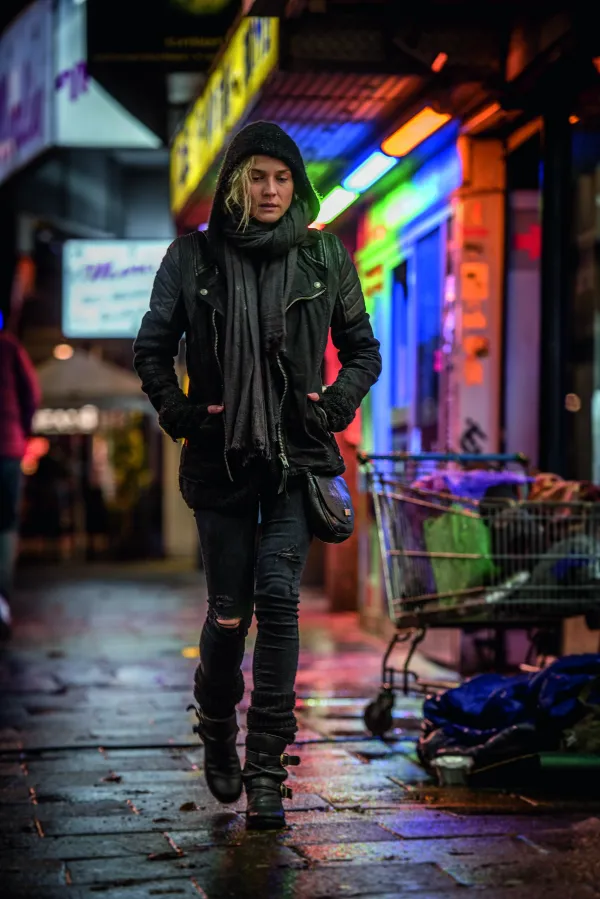
I never fail to be astonished at how the arts, as Shakespeare put it, hold a mirror up to nature, that is, to our society and current events. As the rightwing anti-immigrant, anti-Muslim tide rises, with its ripped-from-the-proverbial-headlines vibe, In the Fade (Aus dem Nichts) is a case in point. This German neo-nazi drama written and directed by Turkish-German auteur Fatih Akin’s (Head On, Soul Kitchen, The Edge of Heaven) is extremely timely.
Image
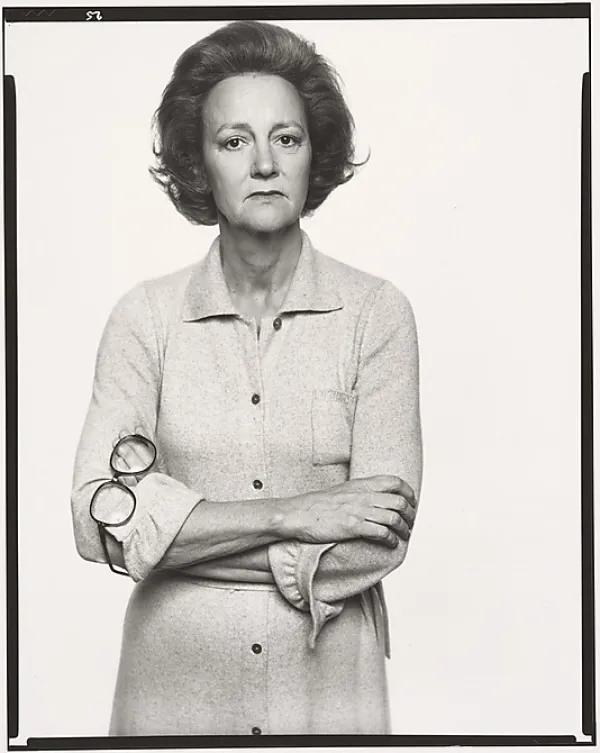
Movie critics are already hailing “The Post,” directed by Steven Spielberg and starring Meryl Streep as Washington Post publisher Katharine Graham. Millions of people will see the film in early winter. But the real-life political story of Graham and her newspaper is not a narrative that’s headed to the multiplexes.
“The Post” comes 20 years after Graham’s autobiography Personal History appeared and won enormous praise. Read as a memoir, the book is a poignant account of Graham’s long quest to overcome sexism, learn the newspaper business and gain self-esteem. Read as media history, however, it is deceptive.
"I don’t believe that whom I was or wasn’t friends with interfered with our reporting at any of our publications," Graham wrote. However, Robert Parry -- who was a Washington correspondent for Newsweek during the last three years of the 1980s -- has shed some light on the shadows of Graham’s reassuring prose. Contrary to the claims in her book, Parry said he witnessed "self-censorship because of the coziness between Post-Newsweek executives and senior national security figures."
Image
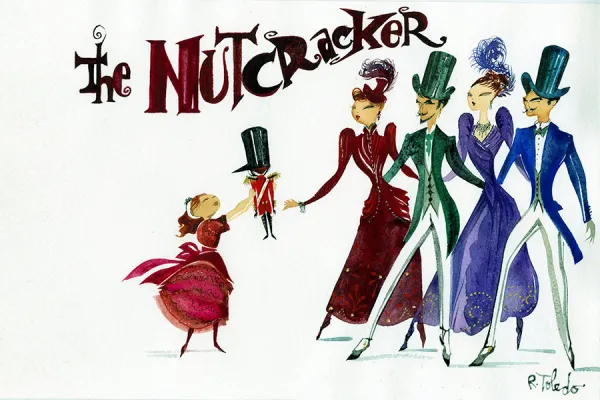
Peter Ilyich Tchaikovsky’s narrative ballet The Nutcracker, based on E.T.A. Hoffmann’s children’s story about magical mice, sugarplum fairies, toy soldiers and dolls that come to life, is a perennial holiday favorite. The Miami City Ballet version, with choreography by the renowned George Balanchine and the Russian composer’s melodic score performed by a live orchestra, remains ideal for the Christmas season for children of all ages.
As youngsters gathered around the Stahlbaums’ lavishly decorated Christmas tree for yuletide greetings in Scene 1, Act I, the stage of the Dorothy Chandler Pavilion was filled with projections designed by Wendall K. Harrington. The graphics continued throughout Scene 2’s childlike dreamland of a fantastical battle between the gigantic Mouse King, a Nutcracker that comes alive and their minions. During the third scene’s lovely winter wonderland sequence it seemed like it was snowing onstage.
Image
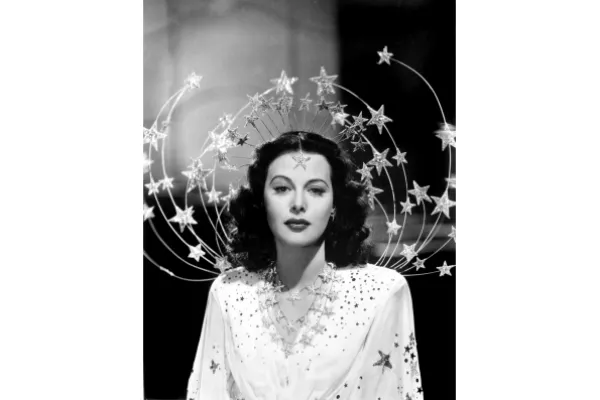
Writer/director Alexandra Dean’s nonfiction Bombshell: The Hedy Lamarr Story is a 90 minute slice of cinema history - and much more - about an enigmatic screen star who was also a behind-the-scenes inventor. Like 2015’s documentary Listen to Me Marlon, Dean uses tapes featuring the thespian’s own voice to tell the inside story of the iconic, exotic actress who dazzled and delighted audiences in movies such as 1938’s Algiers (where Hedy romances Charles Boyer as jewel thief Pepe le Moko in this classic directed by John Cromwell, scripted by John Howard Lawson - both of them future blacklistees); the 1940 Soviet spoof Comrade X (appearing opposite her Boomtown co-star Clark Gable for the second time that year); the titillating Tandelayo n 1942’s White Cargo; the Biblical temptress in 1949’s Samson and Delilah co-starring Victor Mature, directed by Cecil B. DeMille; etc.
Image
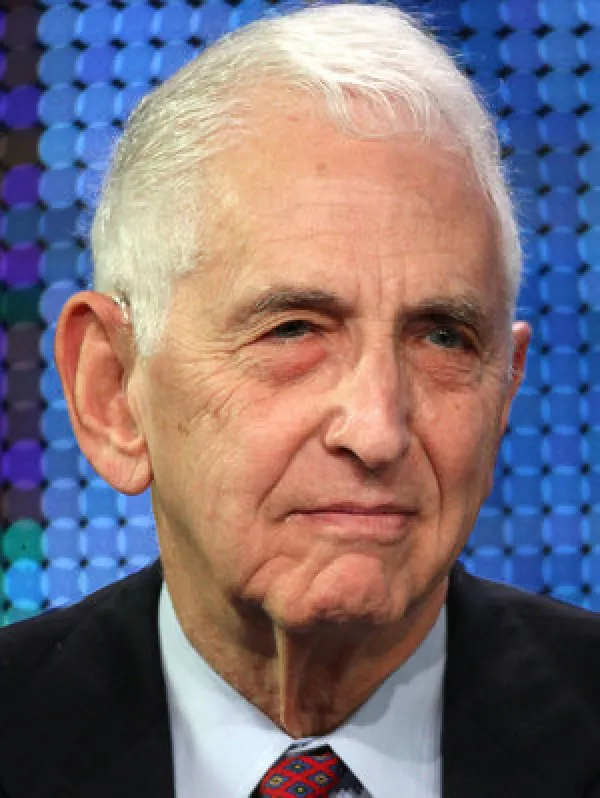
Daniel Ellsberg’s new book is The Doomsday Machine: Confessions of a Nuclear War Planner. I’ve known the author for years, I’m prouder than ever to say. We have done speaking events and media interviews together. We’ve been arrested together protesting wars. We’ve publicly debated electoral politics. We’ve privately debated the justness of World War II. (Dan approves of U.S. entry into World War II, and it seems into the war on Korea as well, though he has nothing but condemnation for the bombing of civilians that made up so much of what the U.S. did in those wars.) I’ve valued his opinion and he has rather inexplicably asked for mine on all sorts of questions. But this book has just taught me a great deal I had not known about Daniel Ellsberg and about the world.
Image
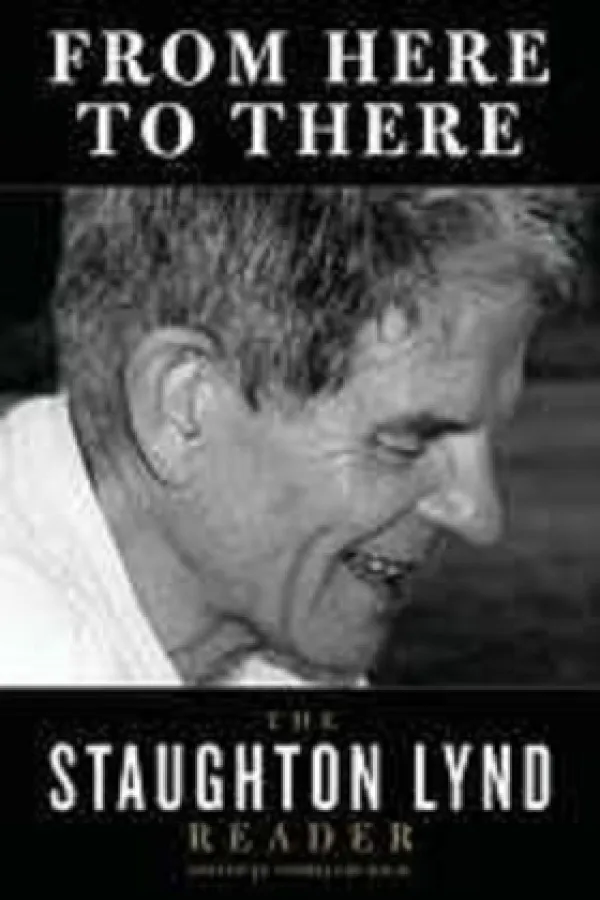
Suddenly Staughton Lynd is all the rage. Again. In the last several years, Lynd has published a number of new books as well as new editions of classics such as Rank and File, plus a memoir co-authored with his wife Alice. In addition, two books about his life as an activist have been published, one on the years through 1970 by educator Carl Mirra (The Admirable Radical: Staughton Lynd and Cold War Dissent, 1945-1970) and another about his work since 1970 by historians Mark Weber and Stephen Paschen, Side by Side: Alice and Staughton Lynd, the Ohio Years.
Image
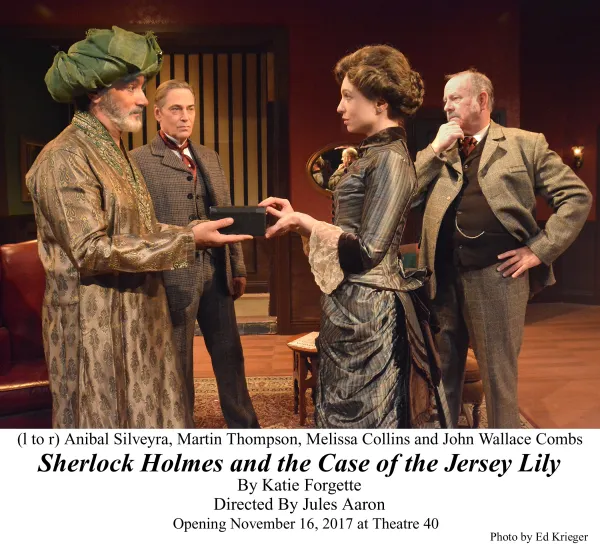
The game is afoot yet again, as Theatre 40 brings beloved Sherlock Holmes (stage and screen actor Martin Thompson, who has carved a niche out for himself depicting the detective) back, this time onto the stage, with a revival of Katie Forgette’s 2009 play Sherlock Holmes and the Case of the Jersey Lily. The “Lily” in question is English actress Lillie Langtry (Melissa Collins), who is being blackmailed.
What saves this play from being just another creaky Sherlockian retread featuring Sir Arthur Conan Doyle’s popular private investigator is that the playwright has cleverly taken the artistic liberty of commingling preexisting literary characters created by another author with actual historical personages and dramatis personae the writer has presumably cooked up herself. Alongside Holmes, Dr. Watson (John Wallace Combs) and that dastardly "Napoleon of Crime" Prof. Moriarty (screen and on-and-Off-Broadway thesp Dave Buzzota), Forgette has injected the real life Oscar Wilde (theatre and film actor Scott Facher) and the eponymous Lillie Langtry (an actual famed British actress) into this comedy-drama set in Victorian London.
Image
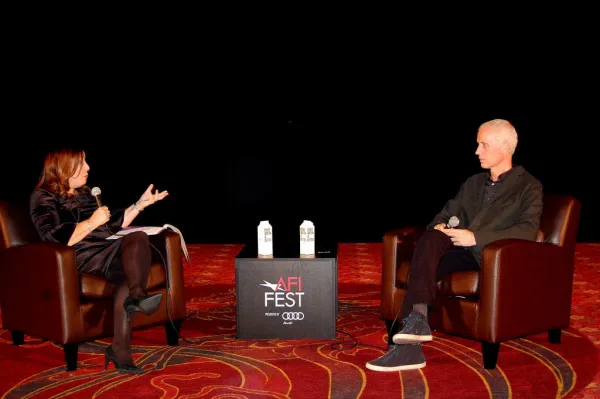
The star-studded AFI FEST 2017, one of L.A.’s top annual film festivals, highlighted racism this year,with features and documentaries about African Americans, Native Americans, Australian Aborigines, etc. The film fete’s director, Jacqueline Lyanga, a young Black woman born in Dar es Salaam, Tanzania, helped bestow an international vibe on the Nov. 9-16 annual extravaganza, held this year in Hollywood. Amidst Tinseltown’s sturm und drang about race, gender discrimination and sexual harassment, the Festival included powerful films about racism, highlighted female talents and screened other politically-themed pictures. Here are some highlights: