
Global
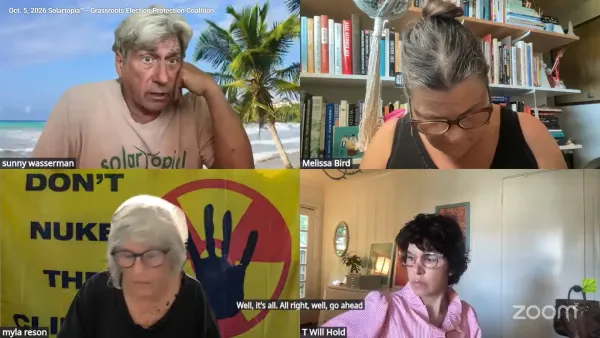
From Minnesota we hear HEDY TRIPP’S report on lawsuits from the family of the murdered Renee Good & masked ICE’s continued predation in MN.
From MIKE HERSH we’re reminded that ICE staff is not vetted or trained with purposeful agenda of citizen terror.
The Green Party’s HOWIE HAWKINS give us the message that Ukraine is being helped by caravans from across Europe, and has no intent of caving into Putin’s brutally violent dictatorship.
Engineer STEVE CARUSO takes us into the nitty-gritty of impeachment, equating it with a “no confidence” vote from Europe.
From Oregon we’re warned by DR. MELISSA BIRD of a horrific corporate Democrat who may open the door to an extreme MAGA poised to turn the state back for decades.
From THIS WILL HOLD we hear from “T” about the possibility of votes disappearing across the country and what must be done to see our democracy survive.
From HENRY WINCHESTER we get a deep technical dive into the desperate need to protect the vote count this November.
Amidst an all-out corporate attack, CHARLIE CRAY of Greenpeace dissects the horrific rigging of the trial that fined it $665 million.
I judge Jewish people’s character based on whether or not they oppose the genocidal apartheid state of Israel. This is also how I judge the character of people who are not Jewish.
Ever since the UK Green party’s “Zionism is racism” motion we’ve been seeing this narrative circulating that Jews are somehow exempt from the basic human duty to oppose genocide and apartheid, just because support for Israel happens to be common among the Jewish community.
The British political/media class has been frenetically attacking the Greens’ objectively correct position as antisemitic, putting out statement after statement proclaiming that it is wrong to ask Jews to oppose a nakedly racist and destructive political ideology.
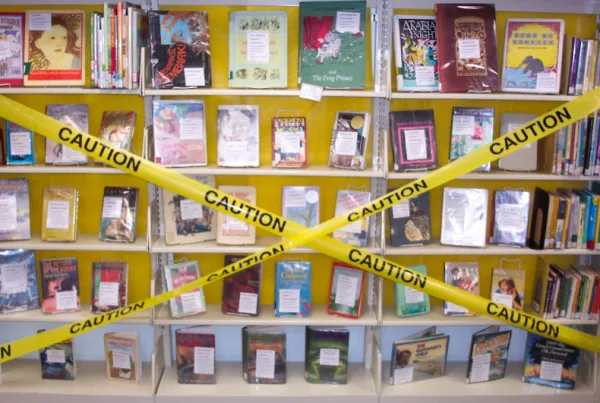
Book bans are a conservative cause du jour in many parts of the country. PEN America reports that there were over 12,000 books that were banned in public schools in 2025. Texas and Florida are at the top of the leader board in this new censorship movement. School administrators on the chopping block are swinging a dull axe at the restrictions using algorithms to sort out the offending volumes.
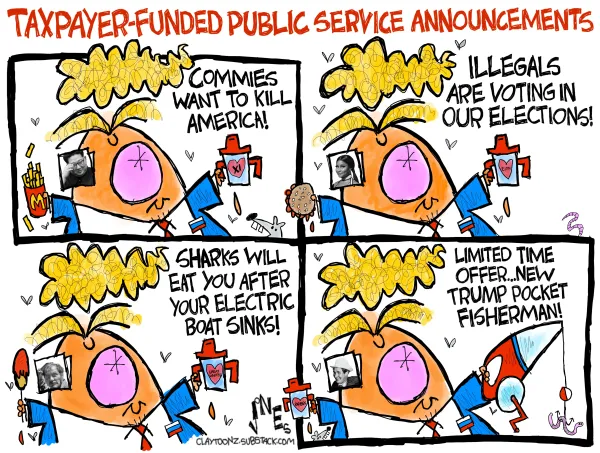
Although the United States-Israeli military campaign against Iran may appear to have entered a period of reduced intensity, there is no peace on the horizon. Instead, the warfare has moved into another arena. What began with an extraordinary campaign of airstrikes and the targeted killing of senior Iranian political and military leaders—a strategy of regime decapitation—has increasingly evolved into a broader and more comprehensive campaign of economic warfare: sanctions and financial restrictions targeting virtually every major sector of the Iranian economy, including banking, automobile manufacturing, and aviation; a naval blockade; and efforts to choke the Iranian economy and sever its remaining connections to international trade.

Bill would expand federal role in transmission
A permitting reform bill introduced in the U.S. Senate last week would, in most cases, prevent the revocation or suspension of previously issued federal permits for energy projects, and strengthen the Federal Energy Regulatory Commission's authority to site transmission lines.
The bill, named the Bipartisan American Affordability and Jobs Act deals with energy system permitting, power grid and transmission expansion and data center cost allocations.
Under permitting, the bill would reduce the authority states have under the Clean Water Act to block gas pipeline applications, shorten deadlines and impose a 150-day limit for judicial challenges to projects, and restrict federal interference and protect permits once they have been issued.
The bill also expands the Federal Energy Regulatory Commission's (FERC) permitting authority for transmission infrastructure, mandates inter regional grid planning and cost sharing and requires modern grid-enhancing technology and virtual power plant market access.

On Sunday the UK Greens adopted a motion asserting that Zionism is a form of racism, defining the ideology as “an ethnonationalist political project.”
Green Party leader Zack Polanski, who is Jewish, was immediately banned by the Israeli government from entering the nation after the motion was passed.
As you might expect, Israel apologists are presently churning out hasbara trying to spin the new Green Party policy as an evil attack on Jews and arguing that Zionism is actually a perfectly lovely and normal thing that we should all support.
“Zionism is just the belief that Jews deserve a homeland and self-determination,” they’ll claim, often adding a suggestion that the real racists are those who would oppose such a reasonable position.

October 4 has a special meaning to me. On this day, 49 years ago, I came to America.
What I enjoy most about living here is the freedom of speech. I have been writing about Palestine and Islam for more than 40 years. Because I disagree with some aspects of our government's foreign policy, I have sometimes been accused of being anti-American or ungrateful.
But disagreeing with my government is my right as an American.
I did not inherit my citizenship. I worked hard to earn it.
The truth is, if I were to say some of the things I say here overseas, I might not see the sun again. For that freedom, I am grateful.
That said, I also love Reuben sandwiches, Italian pasta salad, pineapple upside-down cake—and I love the United States Postal Service.
The next time you put a letter in the mailbox, take a moment to look at the stamp.
It may be only a little square of paper, but sometimes a postage stamp can tell us something about who we are as Americans.