Local

Just how serious has the problem of heroin addiction become for Columbus and its suburbs?
Before a recent 60 Minutes story that exposed the local epidemic nationally, there were reports that Central Ohio rehabilitation centers were maxed out and putting abusers on waiting lists. But when The Columbus Dispatch editorial board called for a clean needle exchange program this past summer, it was truly eye opening. A double-take moment for many considering the paper has often promoted itself as a local mainstay of moral and conservative excellence.
Pressure from the Dispatch is apparently working. Mayor Michael Coleman announced in November the city with $280,000 in initial funding will begin a needle exchange program scheduled to start in January. Called “Safe Point,” the exchange will be administered by the AIDS Resource Center Ohio in the Short North.

The morning after Election Day 2015, I woke up suddenly. My mind was racing, “This isn’t right. This isn’t right. Something’s not right.” As an analyst, I’m used to working with mass quantities of data; I’m used to looking at patterns of numbers. Sometimes these differences just leap out at me. Such was the case on that morning.
The prior evening, Issue 3, which would have legalized marijuana in Ohio while according growing rights to just ten properties, went down in flames. Just 34 percent of voters supported the measure; a crushing 65 percent opposed it. So said Ohio’s election officials when the vote was called at 9:41 pm.
The defeat had opponents jumping for joy. Issue 3’s “deeply flawed, monopolistic approach failed garner broad support” said one. It “would have made a handful of rich celebrities and businesspeople even richer” mused another. Meanwhile, those who understand the sordid history of Ohio elections were witnessing the repeat of a troubling pattern.

Thursday, December 3, 6:30 - 8 pm
Northwood High Bldg, Room 100
2231 N. High St (park in rear lot "R" spaces)
Come explore in depth the transition from global "fast fashion" to global fair trade and local fashion! What will that look like? We'll have clips from the film "The True Cost" and experts to lead a discussion on how we can make the transition to a sustainable clothing future!
Cost: Free, donations to Simply Living Sustainable University welcome.
Contact: Chuck.Lynd@gmail.com or call 614-354-6172 with questions.

As you read this, a terror attack has put atomic reactors in Ukraine at the brink of another Chernobyl-scale apocalypse.
Transmission lines have been blown up. Power to at least two major nuclear power stations has been “dangerously” cut. Without emergency backup, those nukes could lose coolant to their radioactive cores and spent fuel pools. They could then melt or explode, as at Fukushima.
Yet amidst endless “all-fear-all-the-time” reporting on ISIS, the corporate media has remained shockingly silent on this potential catastrophe.
Nor has it faced the most critical step needed to protect our planet in a time of terror: shutting all atomic reactors.
The world’s 430-plus licensed commercial nuclear plants give terrorists like ISIS the power at any time to inflict a radioactive Apocalypse that could kill millions, destroy huge parts of the Earth and devastate the global economy.

It’s been a while since I was a groupie of any band. I am too old for concert going and fan obsession...or so I thought. I have found my new calling. I have been revived. Last night I attended the concert of Young Rising Sons, a soulful soul-filled band from Red Bank, NJ.
The show started with The Mosers, their music is upbeat, fun and loud and their personalities shown through in their new sound. Their energy was a great way to start the show.
Following this uplifting act came Night Riots. Lead singer Travis Hawley’s voice was hauntingly eerie and it was fitting we were in Brooklyn, as they were as hipster (in a good way) as they come. At one point Travis stood on the drums. Yes, on the Drums – don’t ask me how. Their music left you entranced and ready, and talent was tangible.
It’s been a while since I was a groupie of any band. I am too old for concert going and fan obsession...or so I thought. I have found my new calling. I have been revived. Last night I attended the concert of Young Rising Sons, a soulful soul-filled band from Red Bank, NJ.
The show started with The Mosers, their music is upbeat, fun and loud and their personalities shown through in their new sound. Their energy was a great way to start the show.
Following this uplifting act came Night Riots. Lead singer Travis Hawley’s voice was hauntingly eerie and it was fitting we were in Brooklyn, as they were as hipster (in a good way) as they come. At one point Travis stood on the drums. Yes, on the Drums – don’t ask me how. Their music left you entranced and ready, and talent was tangible.

As you read this, a terror attack has put atomic reactors in Ukraine at the brink of another Chernobyl-scale apocalypse.
Transmission lines have been blown up. Power to at least two major nuclear power stations has been “dangerously” cut. Without emergency backup, those nukes could lose coolant to their radioactive cores and spent fuel pools. They could then melt or explode, as at Fukushima.
Yet amidst endless “all-fear-all-the-time” reporting on ISIS, the corporate media has remained shockingly silent on this potential catastrophe.
Nor has it faced the most critical step needed to protect our planet in a time of terror: shutting all atomic reactors.
The world’s 430-plus licensed commercial nuclear plants give terrorists like ISIS the power at any time to inflict a radioactive Apocalypse that could kill millions, destroy huge parts of the Earth and devastate the global economy.
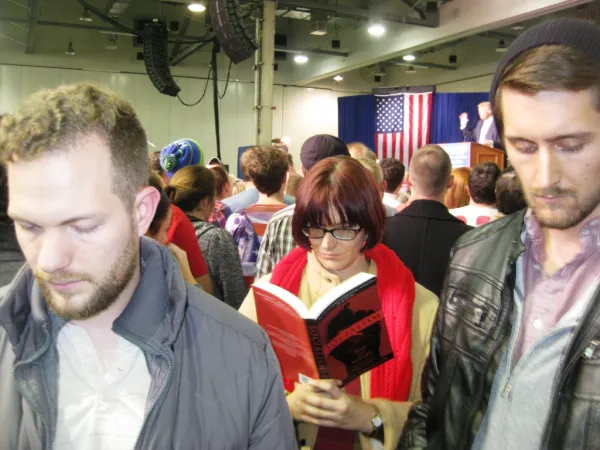
Mindful of the violent reactions from Donald Trump supporters at recent campaign rallies, a small group of protesters took a more subtle approach when the presidential candidate spoke at the Greater Columbus Convention Center on November 23. When Trump got to the podium and began to speak, the protesters turned their backs on him.
As Trump pitched his anti-immigrant, anti-woman, anti-Muslim agenda to a cheering crowd, the protesters took out books by classic and modern socialist authors and quietly read through the first 40 minutes of the rally. They stood about 200 feet from the podium, surrounded by thousands of ardent Donald Trump supporters.
The action was organized by Hayley Cotter, who supports Bernie Sanders’ run for President. “My inspiration was from Johari Osayi Idusuyi, a woman who read a book through another Trump rally,” she said. “It was a very powerful statement in opposition to Trump’s fascism.”
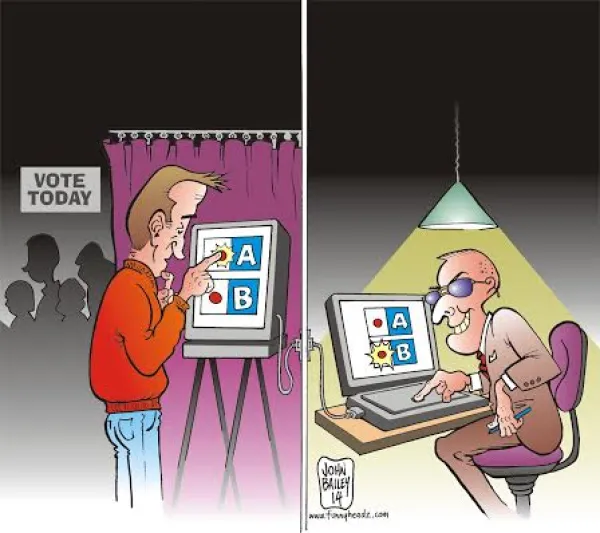
The “stolen election” controversy over this month’s officially defeated Ohio pot legalization referendum has gone to a new level.
“The results are not only impossible but unfathomable,” stated Ron Baiman, Assistant Professor of Graduate Business Administration at Benedictine University, where he teaches economics and statistics.
The Columbus Free Press asked Baiman to calculate the odds of the official vote count of Ohio’s Issue 3, to legalize marijuana, being correct – compared to the tracking polls charting voter preference leading up to this year’s November election. The Free Press supplied Baiman with poll results taken prior to the election by noted pollster Jon Zogby.
The polls leading into the November 3 vote showed the referendum passing. But the official results claim it lost by 2:1.