
Environment
The projected price for Georgia's Vogtle Double Reactor Project has jumped at least $900 million in just three months....and that's just for starters.
Will you pay for it? The future of new atomic power in the US hangs in the balance.
A national grassroots campaign is now working to stop tax/ratepayer handouts and kill the project.
Construction there is defined by faulty concrete and non-spec rebar steel that threaten public safety and could delay completion dates beyond those projected even before construction began.
South Carolina's V.C. Summer, the only other new US reactor project now under construction, is meeting fierce rate payer resistance in two states. From Iowa to Brazil, Japan to France, the global reactor industry is collapsing in tandem. But what other nations will it bankrupt and irradiate before it's finished?
Will you pay for it? The future of new atomic power in the US hangs in the balance.
A national grassroots campaign is now working to stop tax/ratepayer handouts and kill the project.
Construction there is defined by faulty concrete and non-spec rebar steel that threaten public safety and could delay completion dates beyond those projected even before construction began.
South Carolina's V.C. Summer, the only other new US reactor project now under construction, is meeting fierce rate payer resistance in two states. From Iowa to Brazil, Japan to France, the global reactor industry is collapsing in tandem. But what other nations will it bankrupt and irradiate before it's finished?
There are zero commercial reactors operating in Japan today. On March 10, 2011, there were 54 licensed to operate, well over 10% percent of the global fleet.
But for the first time in 42 years, a country at the core of global reactor electricity is producing none of its own.
Worldwide, there are fewer than 400 operating reactors for the first time since Chernobyl, a quarter-century ago.
And France has replaced a vehemently pro-nuclear premier with the Socialist Francois Hollande, who will almost certainly build no new reactors. For decades France has been the "poster child" of atomic power. But Hollande is likely to follow the major shift in French national opinion away from nuclear power and toward the kind of green-powered transition now redefining German energy supply.
In the United States, a national grassroots movement to stop federal loan guarantees could end new nuclear construction altogether.
But for the first time in 42 years, a country at the core of global reactor electricity is producing none of its own.
Worldwide, there are fewer than 400 operating reactors for the first time since Chernobyl, a quarter-century ago.
And France has replaced a vehemently pro-nuclear premier with the Socialist Francois Hollande, who will almost certainly build no new reactors. For decades France has been the "poster child" of atomic power. But Hollande is likely to follow the major shift in French national opinion away from nuclear power and toward the kind of green-powered transition now redefining German energy supply.
In the United States, a national grassroots movement to stop federal loan guarantees could end new nuclear construction altogether.
Japan's one remaining operating reactor (of 54) may go dark tomorrow. Japan would be nuke-free for the first time in a half-century.
Prime Minister Yoshihiko Noda is desperately trying to get Osaka's Mayor to allow the Ohi nuke to stay open. But Japanese law gives local officials far more power over the reactor industry than in the US or China. And the 42-year-old Toru Hashimoto, the son of a Yakuza gangster, is holding firm. Now probably Japan's most popular politician, Hoshimoto has harshly criticized its nuclear industry for lying to the public and for causing the Fukushima catastrophe and then covering up its true impacts.
Japan has long been at the core of the global reactor business. It manufactures pressure vessels, steam generators and much more of the serious hardware that comprises the world's atomic infrastructure. Should it go totally post-nuclear, the symbolic as well as tangible impact would be huge. Even Germany, which has announced its intent to go green, has a number of nukes still going.
Prime Minister Yoshihiko Noda is desperately trying to get Osaka's Mayor to allow the Ohi nuke to stay open. But Japanese law gives local officials far more power over the reactor industry than in the US or China. And the 42-year-old Toru Hashimoto, the son of a Yakuza gangster, is holding firm. Now probably Japan's most popular politician, Hoshimoto has harshly criticized its nuclear industry for lying to the public and for causing the Fukushima catastrophe and then covering up its true impacts.
Japan has long been at the core of the global reactor business. It manufactures pressure vessels, steam generators and much more of the serious hardware that comprises the world's atomic infrastructure. Should it go totally post-nuclear, the symbolic as well as tangible impact would be huge. Even Germany, which has announced its intent to go green, has a number of nukes still going.
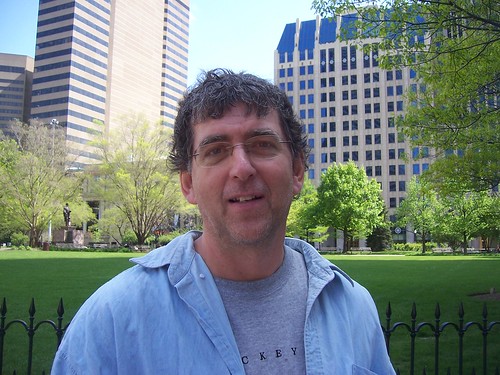 Eric Boardman came to Columbus from Mansfield on April 18 to call for better fracking regulations. Acknowledging our country's need for energy, he said he is not necessarily against fracking. But he said the public can’t make an informed decision about the safety of fracking because of the industry’s lack of disclosure. He supports the idea of using non-toxic tracer dyes to track chemicals gas companies might be putting into the water.
The GE Stockholders’ Alliance (GESA) believes the Fukushima Daiichi nuclear power plant meltdowns, explosions and continuing dispersal of radioactive waste could have been prevented if design deficiencies of the GE Mark I reactors, recognized in the early 1970s, would have been acted upon, instead of ignored.
A stockholder proposal submitted by the GE Stockholders’ Alliance (GESA) is on the agenda for the General Electric annual meeting, to be held 10 am EDT April 25, 2012 at the Detroit Marriott at the Renaissance Center, in Detroit, MI. The GESA is particularly alarmed that 23 of the same aging GE Mark I reactors are currently operating in the U.S. All but one has received a 20-year license extension from the Nuclear Regulatory Commission. The only exception, the Fermi 2 atomic reactor located 35 miles south of Detroit in Frenchtown Township near Monroe, is expected to apply for an extension in 2014. Almost all the Mark Is have also been granted “power uprates,” meaning they are being run harder and hotter than originally designed, despite their age-related degradation.
A stockholder proposal submitted by the GE Stockholders’ Alliance (GESA) is on the agenda for the General Electric annual meeting, to be held 10 am EDT April 25, 2012 at the Detroit Marriott at the Renaissance Center, in Detroit, MI. The GESA is particularly alarmed that 23 of the same aging GE Mark I reactors are currently operating in the U.S. All but one has received a 20-year license extension from the Nuclear Regulatory Commission. The only exception, the Fermi 2 atomic reactor located 35 miles south of Detroit in Frenchtown Township near Monroe, is expected to apply for an extension in 2014. Almost all the Mark Is have also been granted “power uprates,” meaning they are being run harder and hotter than originally designed, despite their age-related degradation.
The future of nuclear power now hangs on a single decision by President Obama---and us.
His Office of Management and Budget could cave to the unsustainable demands of reactor builders who cannot handle the standard terms of a loan agreement.
Or he could defend basic financial procedures and stand up for the future of the American economy.
You can help make this decision, which will come soon.
It's about a proposed $8.33 billion nuke power loan guarantee package for two reactors being built at Georgia's Vogtle. Obama anointed it last year for the Southern Company, parent to Georgia Power. Two other reactors sporadically operate there. Southern just ravaged the new construction side of the site, stripping virtually all vegetation.
His Office of Management and Budget could cave to the unsustainable demands of reactor builders who cannot handle the standard terms of a loan agreement.
Or he could defend basic financial procedures and stand up for the future of the American economy.
You can help make this decision, which will come soon.
It's about a proposed $8.33 billion nuke power loan guarantee package for two reactors being built at Georgia's Vogtle. Obama anointed it last year for the Southern Company, parent to Georgia Power. Two other reactors sporadically operate there. Southern just ravaged the new construction side of the site, stripping virtually all vegetation.
Oil and gas corporations, their trade associations, mass media outlets like the Wall Street Journal and Time magazine, and numerous pundits continue to report there is a new day unfolding in the energy future of the U.S. Indeed, they sometimes say it is a revolution in the making. It's now feasible to mine hitherto unreachable or unprofitable sources of "unconventional" oil and gas. As a result, massive, environmentally-devastating mining of tar sands in Canada expands, with a proposed and controversial pipeline to carry the partly processed oil from Alberto to Texas. Drilling for oil in the Gulf of Mexico, the arctic, multiple off-shore locations drill ever-more deeply into the ocean floor and beneath it. As far as mining for shale gas and oil goes, the situation is described with words such as gushers, or bonanzas, or energy independence.
The only two US reactor projects now technically under construction are on the brink of death for financial reasons.
If they go under, there will almost certainly be no new reactors built here.
The much mythologized "nuclear renaissance" will be officially buried, and the US can take a definitive leap toward a green-powered future that will actually work and that won't threaten the continent with radioactive contamination.
As this drama unfolds, the collapse of global nuclear power continues, as two reactors proposed for Bulgaria have been cancelled, and just one of Japan's 54 licensed reactors is operating. That one may well close next month, leaving Japan without a single operating commercial nuke.
Georgia's double-reactor Vogtle project has been sold on the basis of federal loan guarantees. Last year President Obama promised the Southern Company, parent to Georgia Power, $8.33 billion in financing from an $18.5 billion fund that had been established at the Department of Energy by George W. Bush.
If they go under, there will almost certainly be no new reactors built here.
The much mythologized "nuclear renaissance" will be officially buried, and the US can take a definitive leap toward a green-powered future that will actually work and that won't threaten the continent with radioactive contamination.
As this drama unfolds, the collapse of global nuclear power continues, as two reactors proposed for Bulgaria have been cancelled, and just one of Japan's 54 licensed reactors is operating. That one may well close next month, leaving Japan without a single operating commercial nuke.
Georgia's double-reactor Vogtle project has been sold on the basis of federal loan guarantees. Last year President Obama promised the Southern Company, parent to Georgia Power, $8.33 billion in financing from an $18.5 billion fund that had been established at the Department of Energy by George W. Bush.
On the eve of the 33rd annual commemoration of the Three Mile Island meltdown, the five NRC Commissioners voted unanimously yesterday to reject an environmental coalition's contention that wind power and solar power could readily replace the 908 Megawatts-electric from Davis-Besse, instead of FirstEnergy's proposed 20 year license extension at the problem-plagued atomic reactor with a cracked concrete containment. The environmental coalition put out a media release, and plans to appeal to the federal courts at the first opportunity.
NRC's Atomic Safety (sic) and Licensing Board (ASLB) presiding over the Davis-Besse license extension proceeding has ordered pre-hearing oral arguments about the latest, cracked concrete containment contention. The oral arguments will take place on Friday, May 18th, beginning at 9 a.m. in the Common Pleas Courtroom at the Ottawa County Courthouse, 315 Madison Street, Port Clinton, Ohio -- about ten miles from Davis-Besse.
Update on March 28, 2012 by admin
NRC's Atomic Safety (sic) and Licensing Board (ASLB) presiding over the Davis-Besse license extension proceeding has ordered pre-hearing oral arguments about the latest, cracked concrete containment contention. The oral arguments will take place on Friday, May 18th, beginning at 9 a.m. in the Common Pleas Courtroom at the Ottawa County Courthouse, 315 Madison Street, Port Clinton, Ohio -- about ten miles from Davis-Besse.
Update on March 28, 2012 by admin
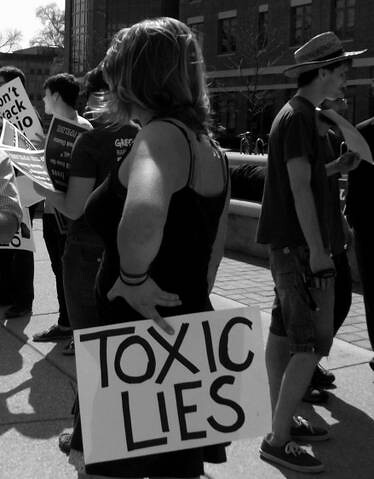 (Photo by Bill Baker)
A couple of hours before President Obama spoke at the Ohio State University on March 22, about 25 demonstrators against the Keystone XL pipeline project gathered on the sidewalk along High Street in front of the Ohio Union.
(Photo by Bill Baker)
A couple of hours before President Obama spoke at the Ohio State University on March 22, about 25 demonstrators against the Keystone XL pipeline project gathered on the sidewalk along High Street in front of the Ohio Union.
A day earlier, Obama announced in Cushing, Oklahoma his decision to fast-track the leg of the pipeline that will run from Oklahoma to Texas. Critics, many of them on the political right, say the president should approve the entire XL project, while environmentalists say he’s backpedaling, and going against his '08 campaign promise to address Climate Change.