
Environment
In the wake of Fukushima, grassroots citizen action is shutting the worldwide nuclear power industry.
A Solartopian tipping point is upon us in the US, Europe and Japan which will re-define how the human race gets its energy.
States rights and local democracy are at the core of the battle.
The definitive breaking point looms in Vermont.
By mid-March a state board is likely to deny the Yankee reactor licenses to operate or to create radioactive waste.
If that happens, a Vermont shutdown could mark a critical moment in establishing state power over an atomic reactor. A critical domino would fall---as it has in Japan and Europe---and we will begin taking down old reactors all across the US. Four new reactors barely under construction will go down with them, making inevitable the end America's age of atomic power.
In Vermont, the New Orleans-based Entergy bought the Yankee reactor in 2002. Entergy agreed to shut it if the state's Public Service Board denied it a Certificate of Public Good to continue to operate and generate radioactive waste.
A Solartopian tipping point is upon us in the US, Europe and Japan which will re-define how the human race gets its energy.
States rights and local democracy are at the core of the battle.
The definitive breaking point looms in Vermont.
By mid-March a state board is likely to deny the Yankee reactor licenses to operate or to create radioactive waste.
If that happens, a Vermont shutdown could mark a critical moment in establishing state power over an atomic reactor. A critical domino would fall---as it has in Japan and Europe---and we will begin taking down old reactors all across the US. Four new reactors barely under construction will go down with them, making inevitable the end America's age of atomic power.
In Vermont, the New Orleans-based Entergy bought the Yankee reactor in 2002. Entergy agreed to shut it if the state's Public Service Board denied it a Certificate of Public Good to continue to operate and generate radioactive waste.
I've seen a lot of sick stuff in my career, but this was sick on a new level. Here was the handwritten log kept by a senior engineer at the nuclear power plant:
Wiesel was very upset. He seemed very nervous. Very agitated. . . . In fact, the plant was riddled with problems that, no way on earth, could stand an earthquake. The team of engineers sent in to inspect found that most of these components could "completely and utterly fail" during an earthquake.
"Utterly fail during an earthquake." And here in Japan was the quake and here is the utter failure.
The warning was in what the investigations team called The Notebook, which I'm not supposed to have. Good thing I've kept a copy anyway, because the file cabinets went down with my office building ....
WORLD TRADE CENTER TOWER 1, FIFTY-SECOND FLOOR NEW YORK, 1986
[This is an excerpt in FreePress.org from Vultures' Picnic: In Pursuit of Petroleum Pigs, Power Pirates and High-Finance Carnivores, to be released this Monday. Click here to get the videos and the book.]
Wiesel was very upset. He seemed very nervous. Very agitated. . . . In fact, the plant was riddled with problems that, no way on earth, could stand an earthquake. The team of engineers sent in to inspect found that most of these components could "completely and utterly fail" during an earthquake.
"Utterly fail during an earthquake." And here in Japan was the quake and here is the utter failure.
The warning was in what the investigations team called The Notebook, which I'm not supposed to have. Good thing I've kept a copy anyway, because the file cabinets went down with my office building ....
WORLD TRADE CENTER TOWER 1, FIFTY-SECOND FLOOR NEW YORK, 1986
[This is an excerpt in FreePress.org from Vultures' Picnic: In Pursuit of Petroleum Pigs, Power Pirates and High-Finance Carnivores, to be released this Monday. Click here to get the videos and the book.]
The summer of 2011 was one of the hardest ever on American nuclear power plants. After the Fukushima Daiichi disaster, U.S. nuclear plants were required to inventory and test emergency equipment , and undergo emergency drills to make sure safety systems were in place and working properly. One of the biggest threats to the safety of any nuclear power plant would be a prolonged loss of electrical power because the plants need to be able to continue pumping water over the radioactive fuel to keep it cool. Failure of one or more dams upstream from a nuclear power plant may result in flood levels at a site that render essential safety systems inoperable.
In the immediate aftermath of the Fukushima nuclear disaster, Japanese officials assured everyone that the problems at Fukushima Daiichi were limited and controllable, everything was alright; everything was under control. It took a only took few days for that house of cards to be destroyed, only to be re-built, destroyed, and resurrected many times over, in a perpetually endless cycle.
In the immediate aftermath of the Fukushima nuclear disaster, Japanese officials assured everyone that the problems at Fukushima Daiichi were limited and controllable, everything was alright; everything was under control. It took a only took few days for that house of cards to be destroyed, only to be re-built, destroyed, and resurrected many times over, in a perpetually endless cycle.
Toledo, Ohio-- The recent U.S. Nuclear Regulatory Commission (NRC) inspection report, coupled with a revelation provided by U.S. Representative Dennis Kucinich (Democrat-Ohio), have provided environmental intervenors against the Davis-Besse atomic reactor with substantial documentation to confront relicensing of the nuclear plant.
The FirstEnergy Nuclear Operating Company’s (FENOC) proposal to extend operations at the problem-plagued Davis-Besse atomic reactor by 20 years has been challenged by a coalition which includes Beyond Nuclear, Citizens Environment Alliance of Southwestern Ontario, Don’t Waste Michigan, and the Green Party of Ohio. The coalition submitted its supplementary contention this morning to the NRC’s Atomic Safety and Licensing Board, which is planning an oral hearing near Davis-Besse in the weeks ahead.
The FirstEnergy Nuclear Operating Company’s (FENOC) proposal to extend operations at the problem-plagued Davis-Besse atomic reactor by 20 years has been challenged by a coalition which includes Beyond Nuclear, Citizens Environment Alliance of Southwestern Ontario, Don’t Waste Michigan, and the Green Party of Ohio. The coalition submitted its supplementary contention this morning to the NRC’s Atomic Safety and Licensing Board, which is planning an oral hearing near Davis-Besse in the weeks ahead.
As the Nuclear Regulatory Commission approves a construction/operating license for two new reactors in Georgia, alarming reports from Japan indicate the Fukushima catastrophe is far from over.
Thousands of tons of intensely radioactive spent fuel are still in serious jeopardy. Radioactive trash and water are spewing into the environment. And nuclear engineer Arnie Gundersen reports that during the string of disasters following March 11, 2011's earthquake and tsunami, Fukushima 1's containment cap may actually have lifted off its base, releasing dangerously radioactive gasses and opening a gap for an ensuing hydrogen explosion.
There are some two dozen of these Mark I-style containments currently in place in the US.
Thousands of tons of intensely radioactive spent fuel are still in serious jeopardy. Radioactive trash and water are spewing into the environment. And nuclear engineer Arnie Gundersen reports that during the string of disasters following March 11, 2011's earthquake and tsunami, Fukushima 1's containment cap may actually have lifted off its base, releasing dangerously radioactive gasses and opening a gap for an ensuing hydrogen explosion.
There are some two dozen of these Mark I-style containments currently in place in the US.
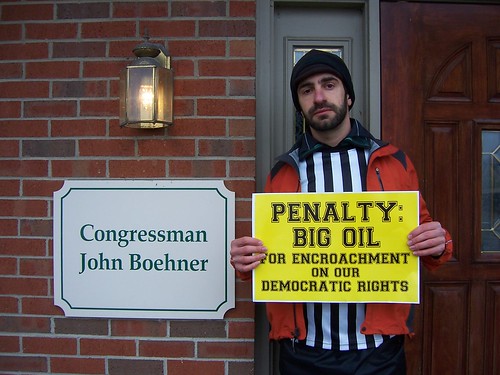 Danny Berchenko of 350.org Ohio said Speaker of the House, John Boehner is touting false numbers as part of his conflict-of-interest, due to his investments in big oil companies, and due to the $1 million the Republican Congressman has taken from the fossil fuel industry during his time in office.
“He’s claiming 20,000 jobs will be created. Those numbers are from a biased study by the company that will build the pipeline if the permit is approved.” (See also EcoWatch Journal )
Danny Berchenko of 350.org Ohio said Speaker of the House, John Boehner is touting false numbers as part of his conflict-of-interest, due to his investments in big oil companies, and due to the $1 million the Republican Congressman has taken from the fossil fuel industry during his time in office.
“He’s claiming 20,000 jobs will be created. Those numbers are from a biased study by the company that will build the pipeline if the permit is approved.” (See also EcoWatch Journal )
Berchenko said independent analyses show that building Keystone XL would create, at most, 5,000 temporary jobs and only 50 permanent jobs.
“Today the U.S. Department of Energy’s Blue Ribbon Commission on America’s Nuclear Future unveiled the result of its two-year-long investigation into what to do with the accumulated radioactive waste at this country’s atomic reactors. By this year’s end, that waste will constitute a mountain 70 years high, with the first cupful generated on December 2, 1942 at Enrico Fermi’s Manhattan Project lab at the University of Chicago, when scientists first created a self-sustaining nuclear chain reaction.
There remains no viable solution for either the management or certainly the ‘disposal’ of radioactive waste. Yet, the one essential recommendation that is not contained in the DOE report is to stop making any more of it. While a child would never be allowed to continue piling up toys in his or her room indefinitely, failing to tidy up the mess, the nuclear industry continues to be permitted to manufacture some of the world’s most toxic detritus without a cleanup plan.
There remains no viable solution for either the management or certainly the ‘disposal’ of radioactive waste. Yet, the one essential recommendation that is not contained in the DOE report is to stop making any more of it. While a child would never be allowed to continue piling up toys in his or her room indefinitely, failing to tidy up the mess, the nuclear industry continues to be permitted to manufacture some of the world’s most toxic detritus without a cleanup plan.
A federal judge has told the people of Vermont that a solemn contract between them and the reactor owner Entergy need not be honored.
The fight will almost certainly now go to the US Supreme Court. At stake is not only the future of atomic power, but the legitimacy of all deals signed between corporations and the public. Chief Justice John Roberts' conservative court will soon decide whether a private corporation can sign what should be an enforceable contract with a public entity and then flat-out ignore it.
In 2003 Entergy made a deal with the state of Vermont. The Louisiana-based nuke speculator said that if it could buy and operate the decrepit Vermont Yankee reactor under certain terms and conditions, the company would then agree to shut it down if the state denied it a permit to continue. The drop dead date: March 21, 2012.
In the interim, VY has been found leaking radioactive tritium and much more into the ground and the nearby Connecticut River. Under oath, in public testimony, the company had denied that the pipes that leaked even existed.
One of Yankee's cooling towers has also collapsed...just plain crumbled.
The fight will almost certainly now go to the US Supreme Court. At stake is not only the future of atomic power, but the legitimacy of all deals signed between corporations and the public. Chief Justice John Roberts' conservative court will soon decide whether a private corporation can sign what should be an enforceable contract with a public entity and then flat-out ignore it.
In 2003 Entergy made a deal with the state of Vermont. The Louisiana-based nuke speculator said that if it could buy and operate the decrepit Vermont Yankee reactor under certain terms and conditions, the company would then agree to shut it down if the state denied it a permit to continue. The drop dead date: March 21, 2012.
In the interim, VY has been found leaking radioactive tritium and much more into the ground and the nearby Connecticut River. Under oath, in public testimony, the company had denied that the pipes that leaked even existed.
One of Yankee's cooling towers has also collapsed...just plain crumbled.
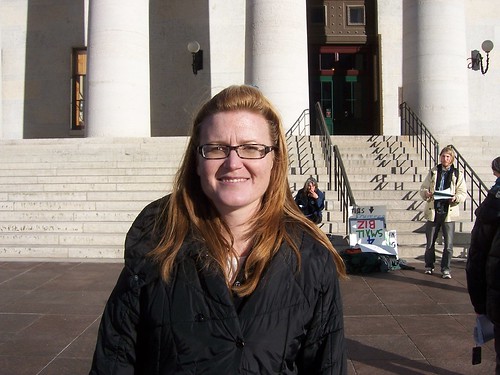 Cheryl Johncox said she and fellow activists with Buckeye Forest Council are not being perfectionists about the environment at the expense of society’s need for energy. She said they want better regulations.
“I can’t believe they can put a pit with radioactive fluid a hundred feet from my house and not even have to fence it in.”
Cheryl Johncox said she and fellow activists with Buckeye Forest Council are not being perfectionists about the environment at the expense of society’s need for energy. She said they want better regulations.
“I can’t believe they can put a pit with radioactive fluid a hundred feet from my house and not even have to fence it in.”
Johncox said that as of 2010, companies no longer have been required to submit a radioactivity log, and that fracking fluid from Marcellus shale and Utica shale contain radioactive particles at a thousand times the recommended limit
The U.S. Department of State and President Obama, if only temporarily, handed out a big victory for human health and the environment this afternoon by rejecting the proposed permit for the Keystone XL pipeline.
In the tense moments leading to the Congressional Christmas recess, Republicans attached a rider to the payroll tax cut extension calling for a sped-up, 60-day review process of the pipeline to leverage President Obama into approving the project. By attaching the pipeline review to a politically charged piece of legislation designed to extend a two-percentage-point payroll tax cut in addition to providing a reduction in Medicare payments to doctors and desperately needed extensions for unemployment benefits, Republicans ostensibly had the perfect mechanism to force a decision on Keystone XL in the favor of Big Oil.
This afternoon, the Department of State recommended to President Obama that he reject the presidential permit based upon insufficient time for a proper review and insufficient evidence that the construction of the pipeline is in the national interest. President Obama agreed.
This afternoon, the Department of State recommended to President Obama that he reject the presidential permit based upon insufficient time for a proper review and insufficient evidence that the construction of the pipeline is in the national interest. President Obama agreed.