
News

As I demonstrate in previous essays, the “city” of Columbus, Ohio and The Ohio State University are two peas in a decaying pod. (See references below.)The intertwined failings of the two disorganized, anti-constituent, private-profiteering, anti-public institutions are symbolically and practically encapsulated in the purposeless, falsely-named University District Organization. The UDO, as it calls itself (but does not pronounce out loud at least in my hearing), is the illegitimate creation of the two. It is no more than an offense to members of both communities.

Thrive Companies is cleaning up brownfields and building mixed-used developments in Columbus like no other developer in the city’s history. They’ve completed more brownfield projects than any developer in Ohio, transforming Italian Village, Grandview, Franklinton, and Weinland Park. A massive Thrive development visible from 670 West, for instance, is emerging in Italian Village at the former stie of the Jeffrey Mining Company.
“Thrive Companies remediates forgotten land in Columbus, creating intentional communities from previously inactivated spaces,” states their website.
Thrive’s history in Columbus goes back decades and is currently led by third generation Mark and Eric Wagenbrenner. According to the news site Construction Today, “In the early 2000s, Mark and Eric Wagenbrenner sought to pursue their own path, and launched Wagenbrenner Development (renamed Thrive Companies). Together, the brothers decided to strategically tackle large, complex brownfield projects, and they quickly amassed a sizeable land position in the Columbus market.”

What we witness on the video footage released is more evidence of murder, a lack of urgency in providing trained medical care to a clearly pregnant and wounded woman, and a concerted effort to shield Officer Connor Grubb from accountability and criminal charges.
In the footage, you hear Officer Grubb repeatedly state “she tried to run me over” to other officers on the scene, as justification for killing Ta’Kiya, before a sheriff’s deputy informs him that he’ll get a lawyer for him and to stop talking. What is clear from the video is that she did not try and run him over, she turned the wheel as far away from him as possible before the vehicle began to slowly move forward and to the right, and Grubb had every opportunity to follow departmental policy and take evasive action instead of discharging his firearm into Ta’Kiya’s chest.

Ta’Kiya Young’s death was a terrible mix of poor decisions, bad timing, and a lack of de-escalation training. But the bottom line is, Kroger is a $100 billion corporate monster – just ask their store employees – and shoplifting should never mean pulling a gun on a young mother and her unborn baby, let alone killing both.
The K9 attack in Circleville in one massive way mirrors Ta’Kiya’s death. The Free Press has heard from several law enforcement sources that the Ohio state troopers who pulled over Jadarrius Rose approached his semi with guns drawn. This was a mistake, these same law enforcement sources told us.
In this post-George Floyd world-on-edge, some younger African Americans panic in the presence of law enforcement. But as Cynthia Brown of the Ohio Coalition to End Qualified Immunity (OCEQI) has repeatedly told us, Ohio law enforcement lacks the skills to help change a life, and because of this, they instead take a life.

Ta’Kiya Young – an unarmed 21-year-old pregnant woman – was shot and killed by local law enforcement for allegedly shoplifting. What many may not be aware of is that Kroger corporate – averaging $30 billion in annual profit since 2020 – has forgone shoplifting charges for several years now, and if caught by store security, those caught are asked to leave and never come back.
Curbing increasing gun violence, police-involved shootings, and shoplifting, has no good solution no matter how hard the community tries. But one thing we have learned from relatives of those killed by local law enforcement is that police shootings give our young people this attitude – “If the police can do it, then I can do it.”
But there may be an answer to police-involved shootings, but the GOP-besieged state government won’t allow this potential solution be approved for a statewide vote and thus decided by citizens themselves.

On Wednesday, August 16, reportedly at 8:56 am, a multiple alarm fire erupted in a large student rental house at 1996 Iuka Ave in the heart of fraternity row in the historic residentially zoned University District. Ten student renters were evacuated safely by the fire department as towering flames spread more than 10 feet above the third floor of the old house. They are without their overpriced housing just days before classes begin.
Not at all surprisingly, given the fact as I recently reported, the City of Columbus Zoning (Anti)-Enforcement Department, The Ohio State University, and the absentee property owners have colluded secretly and illegally not to enforce zoning laws and conduct regular inspections, two smoke detectors did not operate. The fire men on site informed me that the cause was electrical failure.

Hours after Ohio’s Issue 1 went down in the August special election, Secretary of State Frank LaRose “sounded the alarm” on Fox News about the latest proposed constitutional amendment to end Qualified Immunity for law enforcement.
Sore loser LaRose told Fox, “They’re trying to turn Ohio into California [and] now they’re coming after our police.” In reality, no one is “coming after” police and by the way, what is so scary about California?
What LaRose knows and refused to mention is that the effort to end Qualified Immunity in Ohio has been ongoing for well over half a decade.
The Ohio Coalition to End Qualified Immunity (OCEQI) was inspired by the shooting death of 30-year-old Kareem Ali Nadir Jones in 2017. Jones was killed after he was approached by Columbus police for no good reason (family members pictured above). The police body cam video of Kareem’s death can be viewed here.

Democracy in Ohio ain’t dead yet -- voters ensured that yesterday by overwhelmingly rejecting Issue 1. The people’s right to democratically amend the Ohio Constitution prevailed despite relentless attacks from far-right schemers and big business owners.
As of the morning after the election (August 9), the unofficial results from the Secretary of State (who, it should be noted, campaigned hard for Issue 1 to pass) show 1,315,346 votes in favor of Issue 1 and 1,744,094 against – showing that overwhelming 57 percent of voters said “hell no” to the Statehouse power grab.
These results are quite a debacle for Ohio Republicans. In January, they made August Special Elections illegal. They argued that, especially due to low turnout, elections in August were a “waste of money.”

In response to a criminal complaint filed by Columbus mayoral candidate Joe Motil against a city official, Columbus City Attorney Zach Klein referred the matter to Whitehall assistant prosecutor Brad Nicodemus, supposedly for an independent review. Nicodemus had previously been a special prosecutor who declined to pursue charges of alleged misconduct by Columbus police during the 2020 protests over George Floyd’s murder.
Because Nicodemus’ dismissal of Motil’s complaint had serious problems, concerns have resurfaced about his dismissal of the police cases.
Motil’s complaint stemmed from his removal from an April 28 press conference at the Columbus Police Academy. Mayor Andrew Ginther and other city officials were there to discuss the city’s disturbing rise in gun violence. Motil had attended similar events without incident before becoming a candidate for mayor.
But Glenn McEntyre, an assistant director for the city’s Department of Public Safety, told Motil to leave because he wasn’t a member of the press. Motil said McEntyre grabbed his arm in the process.
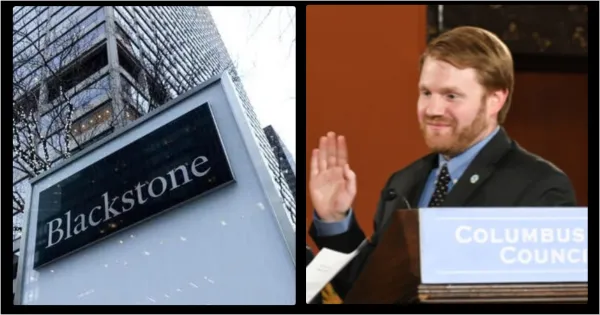
Are you struggling to pay rent in Columbus? Are those creeping student loan payments causing you anxiety? Is healthcare forcing you to pick up extra hours at work?
Well, good news! Your tax dollars are about to be going to work for you by going to an international developer with $1 trillion in assets to build less than 600 apartment rooms that have no guarantee to be affordable to anyone who doesn’t work downtown.
Blackstone, an international investment group owning more than 150 companies, was approved yesterday by Columbus City Council for re-zoning changes as a first step towards tax abatements. According to the Guardian, “Over the past two decades, (Blackstone) has quietly taken control of apartment blocks, care homes, student housing, railway arches, film studios, offices, hotels, logistics warehouses and datacentres.” They are the largest commercial landlord in world history.