
Global

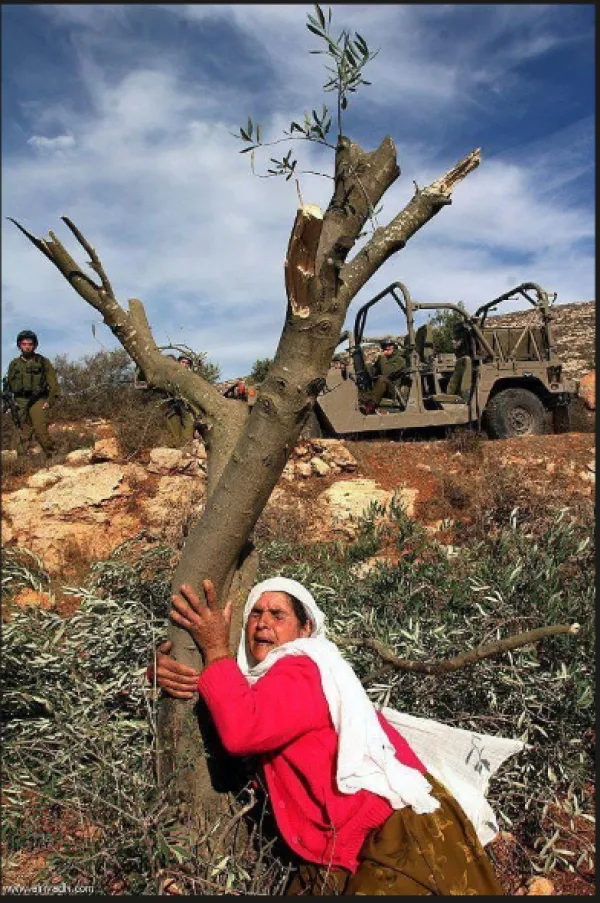
For decades, the IDF & Jewish Israeli settlers have uprooted thousands of Palestinian olive trees & restricted farmers from accessing their fields—measures that Palestinians have long viewed as an effort to drive them from their land.
The justification? In some cases, the IDF has claimed that these trees posed a “security threat” to Israeli settlements. But how can an olive tree be a security threat? And when destroying a family’s trees also destroys its livelihood, what are we really talking about? I call it Israeli economic terrorism.
The olive tree is far more than a tree in Palestine. It is a symbol of resilience, rootedness, and the enduring connection of the Palestinian people to their land. For centuries, olive trees have provided food and livelihoods while carrying deep cultural, spiritual, and historical meaning.
Destroying an olive tree does more than remove a source of income. It can erase decades—even generations—of cultivation and sever a living connection between families and the land they have worked for generations.

The death of Palestinian artist Sliman Anis Mansour stirred powerful memories.
He passed away at Al-Makassed Hospital in occupied East Jerusalem on August 24, at the age of 79, bringing to a close a legacy that cannot truly be described, but only experienced.
His life almost exactly spanned the age of the Palestinian Nakba. He was born mere months before the mass expulsion of the Palestinian people from their homeland. Yet his death in an occupied city tells us that the story of Mansour, his art and the Palestinian struggle for freedom is far from over.
Oddly, for years, I knew Mansour through a single painting: Jamal al-Mahamel (The Camel Carrier of Hardships).


The United States and Israel continue an unprovoked, illegal, immoral and barbaric war on Iran. Your representative and senators need to hear from you now!
Congress has several tools available to exercise its authority. Lawmakers can:

BANGKOK, Thailand -- The troubled USS Abraham Lincoln's 5,000 sailors and Marines ended 264 days at sea at Pattaya, a notoriously raunchy beach town where authorities hope they will avoid thousands of exuberant sex workers in pulsating bars and instead shop, sightsee, and unwind from Iran War combat.
U.S. and Thai security officials arranged tight security for the September 2-6 stopover by the aircraft carrier, accompanied by two other U.S. Navy vessels, at Laem Chabang Port next to Pattaya, a popular hedonistic town built on tourism 62 miles (100 kms) east of Bangkok.
Thailand is perceived as especially nervous because Bangkok has enjoyed excellent relations with Iran -- most notably when Tehran hosted Thai Muslim officials and Hamas militants, resulting in a November 2023 deal which freed 23 Thai hostages held by Hamas in Gaza.
Bangkok and Washington said the U.S. Navy Carrier Strike Group's nuclear-powered Lincoln is on an "R & R" rest and recreation visit, a Pentagon-Pattaya tradition dating back to the Vietnam War more than 50 years ago.
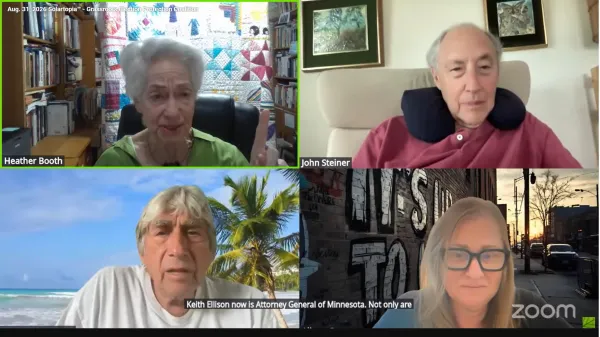
Legendary Midwest Academy organizer HEATHER BOOTH is introduced by JOHN STEINER and takes us deep into the grassroots with decades of wisdom on how to protect democracy and win a green-powered Earth.
She is changing and greening the world from the grassroots down, and here she tells us how.
From Florida ALISON GREENE tells us about going door-to-door to check on the realities of voter registration and protecting the vote count in the 2026 mid-terms, into which hundreds of millions of dark dollars are now pouring.
From ANTHONY FLACCAVENTO we hear of the mega discontent among America’s rural MAGA constituency, which is focused on economics rather than preserving democracy or Trump’s corruption. “Kitchen Table Populism” is what it’s about, he says.
Continuing our “Homebrew2 series” we welcome LEE FELSENSTEIN to dig deep into the issues of AI (which he calls Assisted Intelligence” and the data centers that are ripping American to pieces. He warns of crypto overcapacity and the inevitable burst that the bubble will soon experience.

We were deeply disappointed to learn that Cameron Mitchell Restaurants (CMR) sponsors “Friends of the Israel Defense Forces (FIDF) - Ohio.” In the wake of three years of continued genocide against Palestinians - from daily bombings in Gaza to the continued murder and dispossession of Palestinians in the West Bank - we find this position unconscionable and demand that CMR cease supporting the FIDF.

A 17-year-old girl who allegedly livestreamed the San Diego mosque shooting last May—an attack that left three men dead—now faces murder charges, according to the Los Angeles Times.
The three men killed in the attack have been credited with helping prevent even greater bloodshed at a time when approximately 140 children were at the mosque’s school. The victims—security guard Amin Abdullah, 51; caretaker Mansour Kaziha, 78; and Nadir Awad, 57, the husband of a teacher at the Islamic Center of San Diego—were hailed as heroes at a memorial service.
On May 18, Cain Clark, 17, and Caleb Vazquez, 18, stormed the Islamic Center of San Diego before being driven back outside by Abdullah, who exchanged gunfire with the attackers while initiating a lockdown. His actions helped protect the 140 children who were only steps away from the shooting.
The attackers killed Abdullah and two other men before fleeing and later taking their own lives in a nearby vehicle.
Central Ohio experienced an intense storm that caused power outages for days. Some suffered home damage and significant expenses. For others, it was inconvenient but manageable.
As power was restored, I discovered my refrigerator wouldn’t restart. I can’t get a technician until Aug. 25 – no refrigeration for two weeks. That’s more than inconvenient.
While figuring out where to get my next meal, I realized: What if this wasn’t temporary?
What if this were your daily reality? How do families manage not having enough food? It requires extra work, planning and creates stress.
Millions of families with children, people with disabilities and the elderly rely on the Supplemental Nutrition Assistance Program to buy groceries. It is both successful and necessary. Yet Congress has cut SNAP benefits severely – 4 million people have lost coverage in the past year. Worse, some states are now forced to share costs the federal government traditionally carried, leaving states no choice but to cut more people.